

Should You Buy Micron Stock Under $1,000?

Source The Motley Fool

Key Points

  • Micron recently reported blowout earnings, and management's guidance was encouraging.

  • Broader weakness in AI semiconductor stocks has weighed on sentiment around Micron.

  • Micron's valuation setup is extremely attractive based on its forward profitability metrics.

  • 10 stocks we like better than Micron Technology ›

Despite delivering exceptional results in its fiscal third-quarter earnings report, shares of Micron Technology (NASDAQ: MU) have slid roughly 11% since the company's earnings release on June 24. The contrast between strong business fundamentals and the market's reaction is a little puzzling.

While near-term sentiment on Micron appears to be turning cautious, the company's underlying momentum and valuation profile suggest the sell-off is more a reflection of broader sector dynamics as opposed to a fundamental deterioration at Micron itself. This disconnect creates a unique opportunity to buy Micron stock at more attractive levels.

Where to invest $1,000 right now? Our analyst team just revealed what they believe are the 10 best stocks to buy right now, when you join Stock Advisor. See the stocks »

Micron logo on muted blue background with palm trees in front of corporate headquarters.

Image source: The Motley Fool.

Why is Micron stock plummeting?

A number of factors are weighing on Micron following the company's recent earnings report. Namely, increased capital spending from key competitors Samsung and SK Hynix have raised concerns about potential future supply and pricing pressure in the DRAM, NAND, and high-bandwidth memory (HBM) markets. Sometimes investors interpret competitors' aggressive investments as a signal that industry capacity could outpace demand growth in the medium term even when the near-term outlook remains robust.

Moreover, over the last couple of weeks, there has been a broader rotation out of AI semiconductor stocks. This has brought additional downward pressure to a number of leading chip stocks, including Micron.
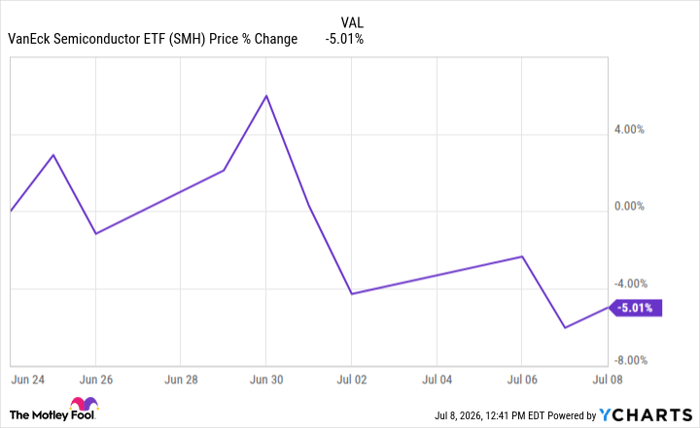
SMH Chart

SMH data by YCharts.

After a strong multi-year run driven by accelerating data center build-outs, some investors are taking profits or reducing exposure to the obvious winners amid macro uncertainty and questions about the pace of AI infrastructure spending from the hyperscalers.

Micron is demonstrating incredibly strong momentum

Micron has posted robust revenue and earnings per share (EPS) growth over the last several quarters. During the most recent earnings call, management's guidance remained constructive -- highlighting new long-term supply agreements that provide greater revenue visibility and reduce cyclical risk.
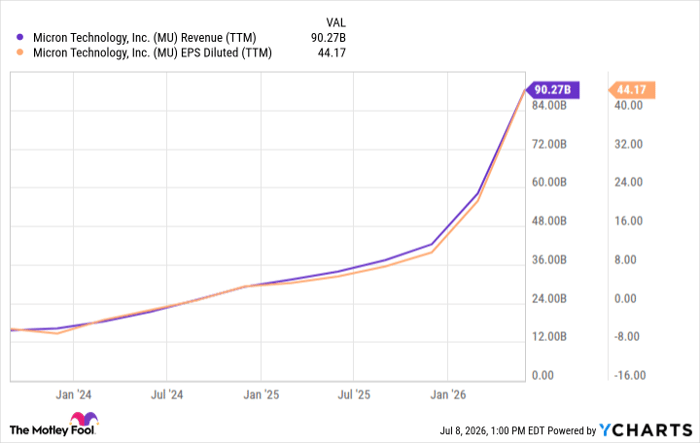
MU Revenue (TTM) Chart

MU Revenue (TTM) data by YCharts.

Equally important, Micron outlined that these strategic customer agreements come with price bands that effectively lock in optimal pricing discipline and ongoing manufacturing efficiencies. In turn, the company is positioned to maintain both healthy revenue growth and expanding gross margins over the coming years.

These dynamics point to a business that is not only growing but also becoming structurally more profitable over time. The combination of accelerating top-line results and protected margin levels supports the view that Micron is part of a sustained upward trajectory in the AI infrastructure ecosystem.

Forget the stock price, look at valuation instead

As of this writing (July 8), shares of Micron have skyrocketed 230% so far this year, making it the second-highest performer in the Nasdsaq-100. However, the stock is now down 22% from recent highs and trades for roughly $943. While this may look expensive, the absolute dollar amount of a stock price reveals little about a company's underlying valuation.

Even after its meteoric gains, Micron trades at a compelling valuation based on the forward price-to-earnings (P/E) multiple. With a forward P/E of just 6.4, I think it's fair to say that much of the company's anticipated growth over the next couple of years has yet to be fully priced into the stock. For reference, other category-leading AI chip stocks such as Nvidia, Broadcom, and Taiwan Semiconductor Manufacturing have consistently traded at forward P/E ranges between 25x and 50x throughout much of the AI revolution.

When growth prospects remain strong but the underlying valuation multiples have not expanded excessively, periods of share-price consolidation often represent attractive entry points. At current levels, Micron's risk-reward setup favors long-term investors willing to look past short-term volatility. I think the dip is an opportunity to accumulate shares in a company whose earnings power and strategic positioning in the high-growth AI memory segment continue to strengthen.

Should you buy stock in Micron Technology right now?

Before you buy stock in Micron Technology, consider this:

The Motley Fool Stock Advisor analyst team just identified what they believe are the 10 best stocks for investors to buy now… and Micron Technology wasn’t one of them. The 10 stocks that made the cut could produce monster returns in the coming years.

Consider when Netflix made this list on December 17, 2004... if you invested $1,000 at the time of our recommendation, you’d have $407,004!* Or when Nvidia made this list on April 15, 2005... if you invested $1,000 at the time of our recommendation, you’d have $1,244,599!*

Now, it’s worth noting Stock Advisor’s total average return is 924% — a market-crushing outperformance compared to 210% for the S&P 500. Don't miss the latest top 10 list, available with Stock Advisor, and join an investing community built by individual investors for individual investors.

See the 10 stocks »

*Stock Advisor returns as of July 10, 2026.

Adam Spatacco has positions in Nvidia. The Motley Fool has positions in and recommends Broadcom, Micron Technology, Nvidia, and Taiwan Semiconductor Manufacturing. The Motley Fool has a disclosure policy.

Disclaimer: For information purposes only. Past performance is not indicative of future results.
placeholder
Bitcoin CME gaps at $35,000, $27,000 and $21,000, which one gets filled first?Prioritize filling the $27,000 gap and even try higher.
Author  FXStreet
Aug 22, 2023
Prioritize filling the $27,000 gap and even try higher.
placeholder
Pinduoduo Earnings Incoming: Morgan Stanley Sees Long-Term Profit Potential​Insights – On November 21, Chinese e-commerce giant Pinduoduo (PDD) will release its Q3 2024 earnings.
Author  Mitrade
Nov 20, 2024
​Insights – On November 21, Chinese e-commerce giant Pinduoduo (PDD) will release its Q3 2024 earnings.
placeholder
Elon Musk’s xAI and Neuralink Launch New Funding Rounds​Billionaire Elon Musk recently raised funds for his two high-profile tech companies, xAI and Neuralink.
Author  Insights
Jun 03, 2025
​Billionaire Elon Musk recently raised funds for his two high-profile tech companies, xAI and Neuralink.
placeholder
Bitcoin briefly loses 2025 gains as crypto plunges over the weekend.Bitcoin experienced a sharp decline this weekend, briefly erasing its 2025 gains and dipping below its year-opening value of $93,507. The cryptocurrency fell to a low of $93,029 on Sunday, representing a 25% drop from its all-time high in October. Although it has rebounded slightly to around $94,209, the pressures on the market remain significant. The downturn occurred despite the reopening of the U.S. government on Thursday, which many had hoped would provide essential support for crypto markets. This year initially appeared promising for cryptocurrencies, particularly after the inauguration of President Donald Trump, who has established the most pro-crypto administration thus far. However, ongoing political tensions—including Trump's tariff strategies and the recent government shutdown, lasting a historic 43 days—have contributed to several rapid price pullbacks for Bitcoin throughout the year. Market dynamics are also being influenced by Bitcoin whales—investors holding large amounts of Bitcoin—who have been offloading portions of their assets, consequently stalling price rallies even as positive regulatory developments emerge. Despite these sell-offs, analysts from Glassnode argue that this behavior aligns with typical patterns seen among long-term investors during the concluding stages of bull markets, suggesting it is not indicative of a mass exodus. Notably, Bitcoin is not alone in its struggles, as Ethereum and Solana have also recorded declines of 7.95% and 28.3%, respectively, since the start of the year, while numerous altcoins have faced even steeper losses. Looking ahead, questions linger regarding the viability of the four-year cycle thesis, particularly given the increasing institutional support and regulatory frameworks now in place in the crypto landscape. Matt Hougan, chief investment officer at Bitwise, remains optimistic, suggesting a potential Bitcoin resurgence in 2026 driven by the “debasement trade” thesis and a broader trend toward increased adoption of stablecoins, tokenization, and decentralized finance. Hougan emphasized the soundness of the underlying fundamentals, pointing to a positive outlook for the sector in the longer term.
Author  Mitrade
Nov 17, 2025
Bitcoin experienced a sharp decline this weekend, briefly erasing its 2025 gains and dipping below its year-opening value of $93,507. The cryptocurrency fell to a low of $93,029 on Sunday, representing a 25% drop from its all-time high in October. Although it has rebounded slightly to around $94,209, the pressures on the market remain significant. The downturn occurred despite the reopening of the U.S. government on Thursday, which many had hoped would provide essential support for crypto markets. This year initially appeared promising for cryptocurrencies, particularly after the inauguration of President Donald Trump, who has established the most pro-crypto administration thus far. However, ongoing political tensions—including Trump's tariff strategies and the recent government shutdown, lasting a historic 43 days—have contributed to several rapid price pullbacks for Bitcoin throughout the year. Market dynamics are also being influenced by Bitcoin whales—investors holding large amounts of Bitcoin—who have been offloading portions of their assets, consequently stalling price rallies even as positive regulatory developments emerge. Despite these sell-offs, analysts from Glassnode argue that this behavior aligns with typical patterns seen among long-term investors during the concluding stages of bull markets, suggesting it is not indicative of a mass exodus. Notably, Bitcoin is not alone in its struggles, as Ethereum and Solana have also recorded declines of 7.95% and 28.3%, respectively, since the start of the year, while numerous altcoins have faced even steeper losses. Looking ahead, questions linger regarding the viability of the four-year cycle thesis, particularly given the increasing institutional support and regulatory frameworks now in place in the crypto landscape. Matt Hougan, chief investment officer at Bitwise, remains optimistic, suggesting a potential Bitcoin resurgence in 2026 driven by the “debasement trade” thesis and a broader trend toward increased adoption of stablecoins, tokenization, and decentralized finance. Hougan emphasized the soundness of the underlying fundamentals, pointing to a positive outlook for the sector in the longer term.
placeholder
Gold declines as Trump scraps Iran memorandum, markets await Fed minutesGold (XAU/USD) trades around $4,050 on Wednesday, down 1.40% on the day at the time of writing, as investors favor the US Dollar (USD) following a fresh deterioration in tensions between the United States (US) and Iran.
Author  FXStreet
Jul 08, Wed
Gold (XAU/USD) trades around $4,050 on Wednesday, down 1.40% on the day at the time of writing, as investors favor the US Dollar (USD) following a fresh deterioration in tensions between the United States (US) and Iran.
goTop
quote