


Could Coca-Cola Issue a Stock Split If It Hits $100 Per Share?
Key Points
Coca-Cola is hovering around an all-time high.
Its last two stock splits occurred when its stock price was around $80 per share.
If Coke issued a stock split, its weighting in the Dow Jones Industrial Average would decrease.
- 10 stocks we like better than Coca-Cola ›
It's been a great year for Coca-Cola (NYSE: KO) investors. As of market close on July 9, the stock is up 18.2% year-to-date (YTD) -- outperforming the Nasdaq-100 and S&P 500 (SNPINDEX: ^GSPC), while its peer, PepsiCo, is down 4% YTD.
Coke reached a new all-time intraday high of $85.68 on July 7. With the stock up over 50% in the last five years, some investors may be wondering if Coke is well on its way to surpassing $100 a share and issuing a stock split.
Where to invest $1,000 right now? Our analyst team just revealed what they believe are the 10 best stocks to buy right now, when you join Stock Advisor. See the stocks »
Here's what's driving Coke to new highs, if a stock split could be in the cards in 2026, and if the blue chip dividend stock is a buy now.

Image source: Getty Images.
Coke is successfully navigating an industrywide slowdown
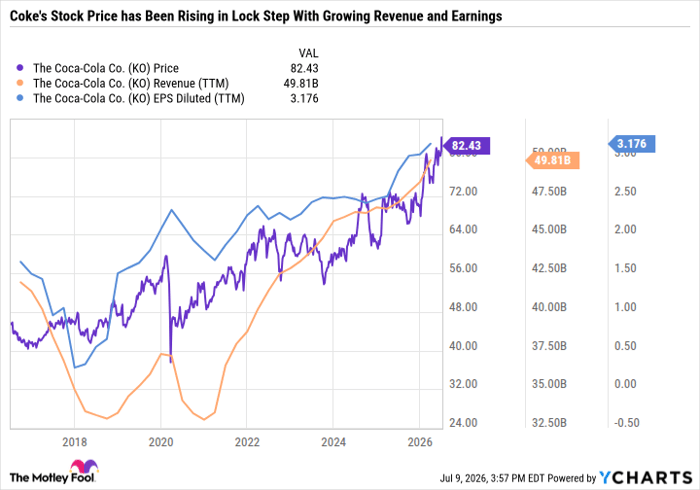
While Coke's full-year 2026 organic revenue guidance of 4% to 5% may not sound like much, it's exceptional relative to Coke's peers.
Higher oil prices in the first half of 2026 added even more inflationary pressure on already strained consumers. What's more, consumer preferences are changing as health and wellness trends impact snacking and soda demand. Competition from private-label brands is yet another challenge for name-brand companies.
KO data by YCharts
Yet despite all of these factors, Coke continues to maintain sky-high margins, steadily grow revenue, and generate gobs of free cash flow, providing a clear runway for dividend growth to extend its 64-year streak of dividend increases.
Earnings growth must bridge the gap to $100 per share
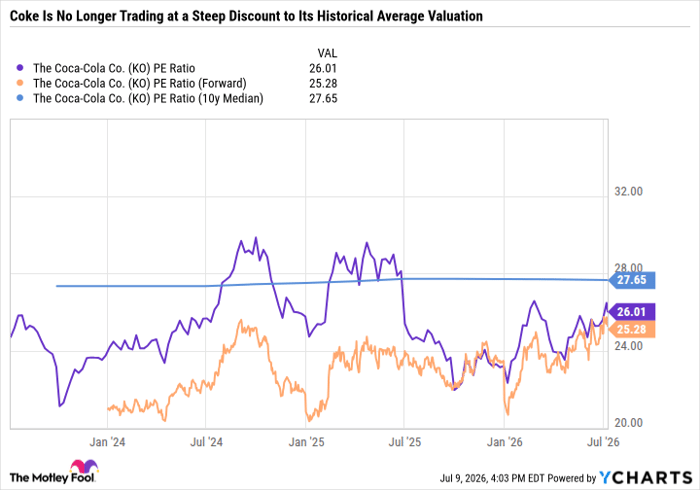
Coke's stock price has been rising due to a combination of earnings growth and a valuation expansion. As investor confidence in Coke has improved, its stock price has risen faster than earnings, bringing its valuation closer to its long-term average.
KO PE Ratio data by YCharts
Coke can still reach $100 per share, but it may depend more on earnings growth going forward than on an expanding multiple. Still, it's worth noting that Coke is already above its split-adjusted price from its last split.
In late July 2012, Coke issued a 2-for-1 stock split, taking its stock price from around $80 to $40 and doubling the share count. Similarly, Coke issued a 2-for-1 stock split at around $82 per share ($20.50 split-adjusted) in May 1996. At $82.62 per share at the time of this writing, Coke is hovering right around the magic number that has signaled past stock splits. But a lot has changed since Coke's last stock split.
A stock split could trigger Coke's deletion from the Dow
Most modern-day S&P 500 company stock splits occur when a share price is in the mid to high triple digits or even over $1,000 per share. Coke is nowhere close to that range. More importantly, the median price of the average stock in the Dow Jones Industrial Average (DJINDICES: ^DJI) is far higher than it used to be.
Coke has been in the Dow since 1987. Back then, consumer goods, industrial, materials, and utility stocks dominated the index.
Today, the Dow is much more tech-focused. Just last month, Alphabet replaced Verizon Communications in the Dow. In a press release, S&P Dow Jones Indices specifically cited Verizon's lower share price as a reason for its removal from the index, noting that Verizon accounted for just 1/2 of 1% of the index. If the index were equally weighted, each component would account for 3.3%, underscoring just how little Verizon moved the needle. But because the Dow is price-weighted, a stock's price, rather than its market cap, determines its weight in the index. So stock splits heavily impact the index weights.
With Verizon out of the Dow, Coke is now the second-lowest-weighted component behind Nike (NYSE: NKE) -- with Coke making up just 0.9% of the index. And with Nike's turnaround progressing far slower than expected, it is at serious risk of being kicked out of the Dow and replaced by a stock like Meta Platforms.
The Dow was around 13,000 when Coke last split its stock in July 2012. Since then, Coke has more than doubled, but the index has quadrupled. With Coke underperforming the Dow since its last split and being one of the lowest-weighted companies, it remains highly unlikely it will issue a stock split, even though It is hovering near a price level seen before its previous two splits.
A foundational blue chip dividend stock to buy now
While a stock split would make it easier for investors to buy a full share of Coca-Cola, they don't need to let speculation about a split dictate their investment decisions. In fact, research by The Motley Fool shows that stock splits have yielded mixed results.
Split or no split, Coca-Cola stands out as one of the most reliable dividend-paying companies for investors to build a portfolio around. What the company lacks in breakneck earnings growth, it makes up for with dependability. Coke can continue supporting divined raises with cash even during industrywide downturns. Its 2.5% yield is right around the average for consumer staples stocks, but Coke's payout is of far higher quality than the average.
Add it all up, and Coke is a solid buy for investors who prioritize dividend quality and passive income.
Should you buy stock in Coca-Cola right now?
Before you buy stock in Coca-Cola, consider this:
The Motley Fool Stock Advisor analyst team just identified what they believe are the 10 best stocks for investors to buy now… and Coca-Cola wasn’t one of them. The 10 stocks that made the cut could produce monster returns in the coming years.
Consider when Netflix made this list on December 17, 2004... if you invested $1,000 at the time of our recommendation, you’d have $407,651!* Or when Nvidia made this list on April 15, 2005... if you invested $1,000 at the time of our recommendation, you’d have $1,252,823!*
Now, it’s worth noting Stock Advisor’s total average return is 922% — a market-crushing outperformance compared to 208% for the S&P 500. Don't miss the latest top 10 list, available with Stock Advisor, and join an investing community built by individual investors for individual investors.
See the 10 stocks »
*Stock Advisor returns as of July 10, 2026.
Daniel Foelber has positions in Nike. The Motley Fool has positions in and recommends Alphabet, Meta Platforms, Nike, and S&P Global. The Motley Fool recommends Verizon Communications. The Motley Fool has a disclosure policy.
Recommended Articles


