


Kevin Warsh Has Grand Ambitions for the Fed, But a "Family Fight" Stands in His Way
Key Points
The new Fed chief wants to change many of the central bank's long-standing practices.
But Warsh is only one of 19 members on the Federal Open Market Committee.
It's unclear if he will gain enough support for his proposals.
- These 10 stocks could mint the next wave of millionaires ›
If you weren't convinced before his confirmation, it is now abundantly clear that new Federal Reserve Chair Kevin Warsh has grand ambitions for the central bank.
Warsh is seeking to change many aspects of how the Fed operates, including how it communicates with the market, uses its balance sheet, and potentially even its view of inflation.
Missed Nvidia in 2009? This Rare Signal Is Flashing Again. In 2009, a "Double Down" signal flashed for a little-known chipmaker called Nvidia. For the first time in years, that same "Total Conviction" signal is flashing for a company 1/100th the size of Nvidia. Continue »
While Warsh will have significant influence over the direction of the Fed, there are still many other members on the Federal Reserve's Board of Governors and Federal Open Market Committee (FOMC). A "family fight" looms.
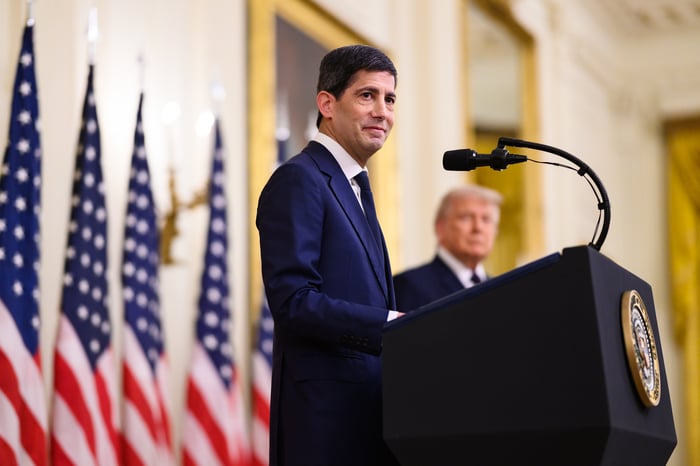
Official White House Photo by Daniel Torok.
How Warsh wants to reshape the Fed
Warsh has already begun to enact change at the Fed. It started at the FOMC's June 16-17 meeting.
After the meeting, the Fed issued a very short policy statement, and Warsh abstained from participating in the Fed's Summary of Economic Projections, which provides the market with insight into how FOMC members view the economy and where interest rates are headed.
Warsh believes the Fed should communicate less with the market, so investors can interpret the data on their own rather than considering what the Fed thinks. This could make the market more volatile if investors have less clarity about what the FOMC will do at future meetings.
Warsh has also expressed a desire to shrink the Fed's balance sheet and rely less on quantitative easing (QE), the processing of pumping money into the economy through large-scale bond purchases. Warsh believes QE has an outsize impact on people with financial assets, whereas interest rates are a monetary tool that affects everyone more broadly.
Warsh has also discussed looking at inflation through a different lens, removing more volatile price changes, so the Fed is looking at inflation through a "trimmed average," which could make inflation look closer to the Fed's 2% preferred target than where it is currently.
At a press conference after the June FOMC meeting, Warsh announced the creation of five task forces to examine Fed communications; the Fed's balance sheet; its use and reliance on existing data sources; productivity and jobs in an era of transformation; and the Fed's inflation frameworks.
Will Warsh have support from other members of the Fed?
Warsh is only one of seven members of the Fed's Board of Governors and one of 19 members of the FOMC, although the FOMC has only 12 voting members.
Even before Warsh's tenure, the FOMC was divided, which makes a certain amount of sense considering the Fed's dual mandate of maximum employment and price stability, which sometimes are at odds with each other.
While the FOMC unanimously decided to keep interest rates steady at its June meeting, Warsh said there had been "a good family fight on it for a couple of days." The recently released FOMC meeting minutes revealed that members have differing views on the appropriate level of interest rates at the end of this year.
A "family fight" is also what Warsh could find as he attempts to enact other changes at the Fed. The minutes showed that a majority of FOMC members noted the advantages of shortening the Fed's policy statement.
But interestingly, at a recent central banking forum, Fed Governor Christopher Waller said, "I continue to believe that forward guidance can be a valuable tool that has, at times, significantly strengthened policymaking and will continue to be useful."
Now, Waller added that forward guidance hasn't always been the right approach, but his comments certainly differ from Warsh's and could hint at potential future disagreements about Fed policy.
I could also see FOMC members disagreeing about using a "trimmed average" lens to view inflation if Warsh brings that recommendation to the table, partly because Americans are still struggling with affordability. Whatever lens the Fed uses to look at inflation won't necessarily change how Americans feel about prices.
The balance sheet is another issue, particularly the speed at which Warsh wants to decrease it. The process can be difficult and can unnerve markets.
Ultimately, as the chair, Warsh's job is to build consensus, so he will need to have a majority of members on his side. Even if Warsh does get his way on policy, the Fed will need to implement it carefully.
But, as with many policy debates, Warsh is likely to face some opposition on the FOMC and in the various task forces, so it's no guarantee he'll get everything he wants.
Where to invest $1,000 right now
When our analyst team has a stock tip, it can pay to listen. After all, Stock Advisor’s total average return is 922%* — a market-crushing outperformance compared to 208% for the S&P 500.
They just revealed what they believe are the 10 best stocks for investors to buy right now, available when you join Stock Advisor.
See the stocks »
*Stock Advisor returns as of July 10, 2026.
The Motley Fool has a disclosure policy.
Recommended Articles


