

Warren Buffett's No. 1 Valuation Tool Recently Made History -- and His $187 Billion Warning to Wall Street Echoes Louder Than Ever

Source The Motley Fool

Key Points

  • Above all else, Warren Buffett was an unwavering stickler for value at Berkshire Hathaway.

  • Buffett's preferred valuation measure hit an all-time high last month, which bodes poorly for Wall Street.

  • Berkshire's now-former billionaire boss was a net seller of equities for 13 consecutive quarters leading up to his retirement as CEO, and stock valuations explain why.

  • 10 stocks we like better than S&P 500 Index ›

On Dec. 31, Berkshire Hathaway's (NYSE: BRKA)(NYSE: BRKB) CEO of more than half a century, Warren Buffett, called it a career. Even though the Oracle of Omaha is no longer involved in his trillion-dollar company's day-to-day operations or oversees its $343 billion investment portfolio, his leadership lessons have left a legacy for successor, Greg Abel, as well as everyday investors.

While Buffett will fondly be remembered for his annual shareholder meeting candor, his long-term vision, and trouncing the returns of the benchmark S&P 500 (SNPINDEX: ^GSPC), it's his unwavering stance on value that really sets him apart.

Where to invest $1,000 right now? Our analyst team just revealed what they believe are the 10 best stocks to buy right now, when you join Stock Advisor. See the stocks »
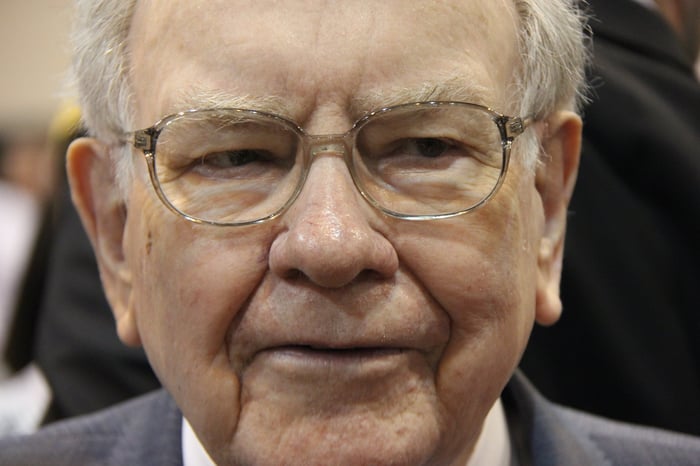
A pensive Warren Buffett surrounded by people at Berkshire Hathaway's annual shareholder meeting.

Warren Buffett retired as Berkshire Hathaway's CEO on Dec. 31, 2025. Image source: The Motley Fool.

Warren Buffett's favorite valuation tool recently made history (not the good kind), bringing his $187 billion warning to Wall Street squarely into focus.

The Buffett indicator is a glaring red flag for Wall Street

Whereas most investors rely on the time-tested price-to-earnings (P/E) ratio to quickly evaluate public companies, Berkshire's now-former billionaire boss preferred the market-cap-to-GDP ratio, which is better known as the Buffett indicator.

This valuation tool, arrived at by dividing the cumulative value of all U.S. stocks by U.S. gross domestic product (GDP), was labeled as "probably the best single measure of where valuations stand at any given moment" by Buffett in a rare 2001 interview with Fortune magazine.

When back-tested to January 1970, the Buffett indicator has averaged approximately 88%. This is to say that the aggregate value of U.S. stocks has averaged 88% of the value of U.S. GDP. On June 1, 2026, the Buffett indicator reached its highest close in history of 238.5%, or roughly 171% above its 55-year average.

Previous instances when the Buffett indicator catapulted higher were all followed by substantial stock market sell-offs.

A New York Stock Exchange floor trader looking up in disbelief at a computer monitor.

Image source: Getty Images.

Warren Buffett's warning echoes louder by the day

As a long-term investor, the Oracle of Omaha always spoke highly of the U.S. economy, stock market, and American spirit. But beneath this unwavering long-term optimism, Buffett's actions occasionally disjoined from his words.

In the 13 quarters (Oct. 1, 2022 – Dec. 31, 2025) leading up to his retirement as Berkshire Hathaway's CEO, Buffett was a persistent net seller of equities. Berkshire's consolidated cash flow statements show Buffett sold approximately $187 billion more in stock than he purchased over this period.

While some investors have postulated that he was building a war chest for his protégé, Abel, the likely catalyst behind this selling was Wall Street's otherworldly stock valuations. No matter how much Buffett values a company's competitive edge, management team, and/or capital-return program, he simply isn't sticking around if he doesn't feel he's getting a good deal.

Warren Buffett is right to be skeptical. According to the time-tested S&P 500 Shiller P/E Ratio, this is the second-priciest stock market on record (dating back to January 1871), trailing only the months leading up to the bursting of the dot-com bubble.

Every previous occasion in which the Shiller P/E has surpassed 30 was eventually followed by a 20% or greater decline in the Dow Jones Industrial Average (DJINDICES: ^DJI), S&P 500, and/or Nasdaq Composite (NASDAQINDEX: ^IXIC).

Buffett's actions often spoke louder than his words, and his $187 billion warning to Wall Street echoes louder with each passing day.

Should you buy stock in S&P 500 Index right now?

Before you buy stock in S&P 500 Index, consider this:

The Motley Fool Stock Advisor analyst team just identified what they believe are the 10 best stocks for investors to buy now… and S&P 500 Index wasn’t one of them. The 10 stocks that made the cut could produce monster returns in the coming years.

Consider when Netflix made this list on December 17, 2004... if you invested $1,000 at the time of our recommendation, you’d have $407,651!* Or when Nvidia made this list on April 15, 2005... if you invested $1,000 at the time of our recommendation, you’d have $1,252,823!*

Now, it’s worth noting Stock Advisor’s total average return is 922% — a market-crushing outperformance compared to 208% for the S&P 500. Don't miss the latest top 10 list, available with Stock Advisor, and join an investing community built by individual investors for individual investors.

See the 10 stocks »

*Stock Advisor returns as of July 10, 2026.

Sean Williams has no position in any of the stocks mentioned. The Motley Fool has positions in and recommends Berkshire Hathaway. The Motley Fool has a disclosure policy.

Disclaimer: For information purposes only. Past performance is not indicative of future results.
placeholder
Bitcoin CME gaps at $35,000, $27,000 and $21,000, which one gets filled first?Prioritize filling the $27,000 gap and even try higher.
Author  FXStreet
Aug 22, 2023
Prioritize filling the $27,000 gap and even try higher.
placeholder
Pinduoduo Earnings Incoming: Morgan Stanley Sees Long-Term Profit Potential​Insights – On November 21, Chinese e-commerce giant Pinduoduo (PDD) will release its Q3 2024 earnings.
Author  Mitrade
Nov 20, 2024
​Insights – On November 21, Chinese e-commerce giant Pinduoduo (PDD) will release its Q3 2024 earnings.
placeholder
Elon Musk’s xAI and Neuralink Launch New Funding Rounds​Billionaire Elon Musk recently raised funds for his two high-profile tech companies, xAI and Neuralink.
Author  Insights
Jun 03, 2025
​Billionaire Elon Musk recently raised funds for his two high-profile tech companies, xAI and Neuralink.
placeholder
Bitcoin briefly loses 2025 gains as crypto plunges over the weekend.Bitcoin experienced a sharp decline this weekend, briefly erasing its 2025 gains and dipping below its year-opening value of $93,507. The cryptocurrency fell to a low of $93,029 on Sunday, representing a 25% drop from its all-time high in October. Although it has rebounded slightly to around $94,209, the pressures on the market remain significant. The downturn occurred despite the reopening of the U.S. government on Thursday, which many had hoped would provide essential support for crypto markets. This year initially appeared promising for cryptocurrencies, particularly after the inauguration of President Donald Trump, who has established the most pro-crypto administration thus far. However, ongoing political tensions—including Trump's tariff strategies and the recent government shutdown, lasting a historic 43 days—have contributed to several rapid price pullbacks for Bitcoin throughout the year. Market dynamics are also being influenced by Bitcoin whales—investors holding large amounts of Bitcoin—who have been offloading portions of their assets, consequently stalling price rallies even as positive regulatory developments emerge. Despite these sell-offs, analysts from Glassnode argue that this behavior aligns with typical patterns seen among long-term investors during the concluding stages of bull markets, suggesting it is not indicative of a mass exodus. Notably, Bitcoin is not alone in its struggles, as Ethereum and Solana have also recorded declines of 7.95% and 28.3%, respectively, since the start of the year, while numerous altcoins have faced even steeper losses. Looking ahead, questions linger regarding the viability of the four-year cycle thesis, particularly given the increasing institutional support and regulatory frameworks now in place in the crypto landscape. Matt Hougan, chief investment officer at Bitwise, remains optimistic, suggesting a potential Bitcoin resurgence in 2026 driven by the “debasement trade” thesis and a broader trend toward increased adoption of stablecoins, tokenization, and decentralized finance. Hougan emphasized the soundness of the underlying fundamentals, pointing to a positive outlook for the sector in the longer term.
Author  Mitrade
Nov 17, 2025
Bitcoin experienced a sharp decline this weekend, briefly erasing its 2025 gains and dipping below its year-opening value of $93,507. The cryptocurrency fell to a low of $93,029 on Sunday, representing a 25% drop from its all-time high in October. Although it has rebounded slightly to around $94,209, the pressures on the market remain significant. The downturn occurred despite the reopening of the U.S. government on Thursday, which many had hoped would provide essential support for crypto markets. This year initially appeared promising for cryptocurrencies, particularly after the inauguration of President Donald Trump, who has established the most pro-crypto administration thus far. However, ongoing political tensions—including Trump's tariff strategies and the recent government shutdown, lasting a historic 43 days—have contributed to several rapid price pullbacks for Bitcoin throughout the year. Market dynamics are also being influenced by Bitcoin whales—investors holding large amounts of Bitcoin—who have been offloading portions of their assets, consequently stalling price rallies even as positive regulatory developments emerge. Despite these sell-offs, analysts from Glassnode argue that this behavior aligns with typical patterns seen among long-term investors during the concluding stages of bull markets, suggesting it is not indicative of a mass exodus. Notably, Bitcoin is not alone in its struggles, as Ethereum and Solana have also recorded declines of 7.95% and 28.3%, respectively, since the start of the year, while numerous altcoins have faced even steeper losses. Looking ahead, questions linger regarding the viability of the four-year cycle thesis, particularly given the increasing institutional support and regulatory frameworks now in place in the crypto landscape. Matt Hougan, chief investment officer at Bitwise, remains optimistic, suggesting a potential Bitcoin resurgence in 2026 driven by the “debasement trade” thesis and a broader trend toward increased adoption of stablecoins, tokenization, and decentralized finance. Hougan emphasized the soundness of the underlying fundamentals, pointing to a positive outlook for the sector in the longer term.
placeholder
Gold declines as Trump scraps Iran memorandum, markets await Fed minutesGold (XAU/USD) trades around $4,050 on Wednesday, down 1.40% on the day at the time of writing, as investors favor the US Dollar (USD) following a fresh deterioration in tensions between the United States (US) and Iran.
Author  FXStreet
Jul 08, Wed
Gold (XAU/USD) trades around $4,050 on Wednesday, down 1.40% on the day at the time of writing, as investors favor the US Dollar (USD) following a fresh deterioration in tensions between the United States (US) and Iran.
goTop
quote