


If I Had $10,000 to Invest Today, Here's the Trillion-Dollar Stock I'd Buy Instead of SpaceX
Key Points
Space Exploration Technologies went public last month, and it's already in the throes of a sell-off.
SpaceX stock is still extremely expensive, so investors can probably find better values elsewhere.
Nvidia supplies the best data center chips for artificial intelligence workloads, and its stock is trading at a very attractive valuation.
- 10 stocks we like better than Nvidia ›
Elon Musk's space transportation, satellite internet connectivity, and artificial intelligence (AI) company, Space Exploration Technologies (NASDAQ: SPCX), went public on June 12, and opened that trading session at $150 per share. In the days that followed, the stock soared to an all-time high of $225.64, but it has since plunged back to about $150 as investors grapple with its sky-high valuation.
SpaceX has a market capitalization of $2 trillion as I write this, and with just $19.3 billion in trailing-12-month revenue, that gives it a price-to-sales (P/S) ratio of 103. That's 16 times more expensive than the average for the tech-heavy Nasdaq-100 index. As a result, I won't be surprised if SpaceX declines from here.
Where to invest $1,000 right now? Our analyst team just revealed what they believe are the 10 best stocks to buy right now, when you join Stock Advisor. See the stocks »
If I had $10,000 to invest in one stock for my diversified portfolio, I'd definitely consider an alternative. Here's why Nvidia (NASDAQ: NVDA) might be a much better buy than SpaceX for the long term.
Image source: Nvidia.
Vera Rubin is in full production
Nvidia supplies the world's best graphics processing units (GPUs) for data centers, and its chips are still the main providers of parallel processing power for AI training and inference workloads. The company's dominance in that niche started in 2022 with the H100 GPU, which was built on the Hopper architecture. But in the years since, Nvidia has launched its Blackwell and Blackwell Ultra GPU architectures, the latter of which can deliver up to 50 times better performance than Hopper-based chips in certain configurations.
And the chipmaker just upped the ante again. It has ramped its newest architecture, Vera Rubin, up to full production and will begin shipping them in commercial quantities in the coming months. That new platform includes the Rubin GPU, the Vera central processing unit (CPU), copious memory, and a series of upgraded networking components, which combine to provide another big leap in AI computing performance. In fact, Nvidia says this new architecture will allow developers to train AI models with 75% fewer GPUs, while reducing inference token costs by up to 90% compared to its Blackwell processors.
Inference tokens represent the text, symbols, and images produced by an AI model in response to a query. So to simplify what the company is saying, Vera Rubin will dramatically reduce the cost of using AI software, which could fuel a surge in its adoption. It will also make AI providers like OpenAI and Anthropic more profitable, which could lead to even more demand for Nvidia's chips.
Vera Rubin is almost certain to be Nvidia's most successful product platform ever. According to CEO Jensen Huang, every frontier model company plans to adopt it at launch. That was not the case for Blackwell when it debuted.
Nvidia is on track for another record year
Nvidia generated $81.6 billion in revenue during its fiscal 2027 first quarter (which ended April 26), representing year-over-year growth of 85%. Its data center business accounted for $75.2 billion of that total, and it grew at an even faster rate of 92%.
Analysts estimate that Nvidia could generate $392 billion in total revenue during its fiscal 2027, and a whopping $554 billion in its fiscal 2028. If the company continues to grow at this pace, it could be bringing in as much money as Walmart -- the world's biggest retailer -- within a few years.
However, there are risks ahead. Concerns are mounting about the sustainability of the AI infrastructure boom, as shortages of GPUs and high-bandwidth memory have significantly driven up the cost of building data centers. AI software providers like Anthropic and Microsoft have implemented passive price increases this year in an effort to pass some of those additional costs to their customers -- who have not responded well to the moves.
The chief operating officer at Uber Technologies recently said it's becoming harder to justify AI spending, after his company burned through its entire 2026 AI budget in just four months. It appears he isn't alone, because a recent survey by UBS Group suggests 60% of businesses are now opting for cheaper AI models that use less computing power. That might be bad news for semiconductor demand going forward.
Buyers today are getting a great price for Nvidia stock
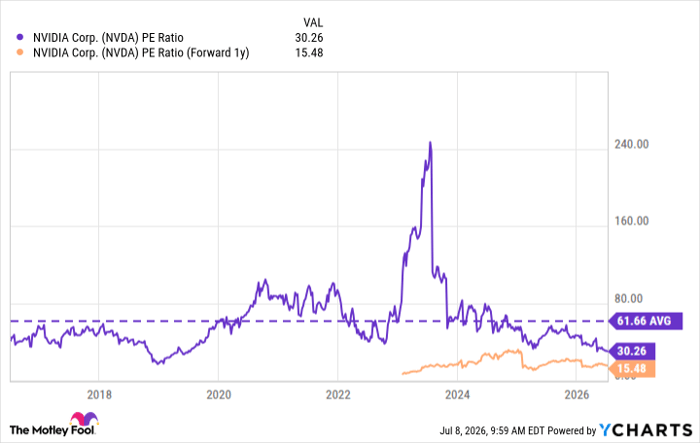
While there are certainly risks ahead, I would argue that Nvidia's attractive valuation makes those risks worth accepting. The stock is trading at a price-to-earnings (P/E) ratio of 30.2, which is half its 10-year average of 61.6.
It's also cheaper than the Nasdaq-100 index, which has a P/E ratio of 35.2, suggesting the chipmaker is undervalued compared to its big-tech peers.
Looking ahead, the consensus among Wall Street analysts is that Nvidia's earnings will grow to $12.76 in its fiscal 2028, giving its stock a forward P/E ratio of just 15.4.
NVDA PE Ratio data by YCharts.
I'm not suggesting this will happen, but if Wall Street's fiscal 2028 estimate proves to be accurate, Nvidia stock would have to double over the next 18 months just to maintain its current P/E ratio, and quadruple to trade in line with its 10-year average P/E.
Of course, the picture will look very different if the AI industry starts buying fewer GPUs. However, I think Nvidia's valuation leaves quite a bit of room for error -- especially if we're comparing it to SpaceX, which is objectively extremely overvalued right now.
Should you buy stock in Nvidia right now?
Before you buy stock in Nvidia, consider this:
The Motley Fool Stock Advisor analyst team just identified what they believe are the 10 best stocks for investors to buy now… and Nvidia wasn’t one of them. The 10 stocks that made the cut could produce monster returns in the coming years.
Consider when Netflix made this list on December 17, 2004... if you invested $1,000 at the time of our recommendation, you’d have $407,651!* Or when Nvidia made this list on April 15, 2005... if you invested $1,000 at the time of our recommendation, you’d have $1,252,823!*
Now, it’s worth noting Stock Advisor’s total average return is 922% — a market-crushing outperformance compared to 208% for the S&P 500. Don't miss the latest top 10 list, available with Stock Advisor, and join an investing community built by individual investors for individual investors.
See the 10 stocks »
*Stock Advisor returns as of July 9, 2026.
Anthony Di Pizio has no position in any of the stocks mentioned. The Motley Fool has positions in and recommends Microsoft, Nvidia, Uber Technologies, and Walmart. The Motley Fool has a disclosure policy.
Recommended Articles


