

How Likely Is a Recession in 2026? Experts Say There's Good and Bad News for Investors.

Source The Motley Fool

Key Points

  • Many economists believe the economy will weaken over the next year.

  • History suggests that investors should exercise caution when buying stocks.

  • The right investing strategy can help protect your portfolio against volatility.

  • These 10 stocks could mint the next wave of millionaires ›

Major indexes, including the S&P 500 (SNPINDEX: ^GSPC), closed out the last month on a high note, experiencing their best quarter in years. However, many economists are not as optimistic about the future.

According to the World Economic Forum's May 2026 economic outlook survey, a whopping 89% of chief economists expect the global economy to slow over the next 12 months. One in five also believes that the decline will be significant.

Where to invest $1,000 right now? Our analyst team just revealed what they believe are the 10 best stocks to buy right now, when you join Stock Advisor. See the stocks »

The good news is that this doesn't necessarily mean a recession is imminent. While economists do believe slower growth could lead to greater volatility, 58% of those surveyed do not expect a recession to begin in the next year.

Whatever the future holds, here's what history suggests investors should do right now to prepare.
Roller coaster car on a stock market chart.

Image source: Getty Images.

History suggests investors should be careful right now

The upside of a surging stock market is that investors reap the rewards as their stocks skyrocket in price. The drawback, however, is that the market is incredibly pricey right now, and some stocks are more likely to be overvalued.

The S&P 500 Shiller CAPE Ratio measures the S&P 500's 10-year inflation-adjusted earnings, providing a snapshot of the index's overall valuation. Higher metrics suggest that the index is valued more richly, while a lower ratio implies it may be undervalued.

While this market indicator isn't an exact science, it can be helpful to see how it's changed over time. Its long-term average is around 17, and it reached a record high of around 44 just before the dot-com bubble burst. As of this writing, it's just over 41.
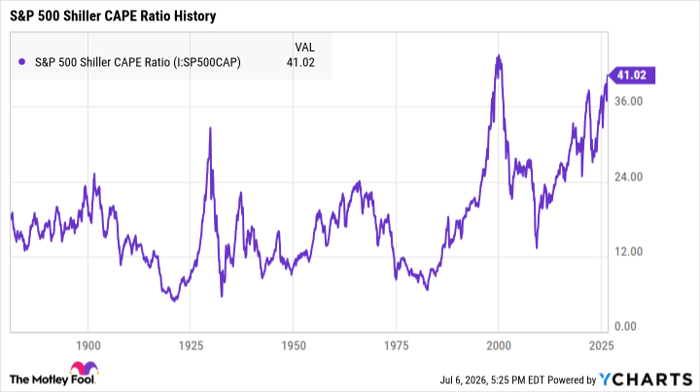
S&P 500 Shiller CAPE Ratio Chart

S&P 500 Shiller CAPE Ratio data by YCharts

Again, this doesn't necessarily mean that a recession or market crash is looming. But it's rare for the S&P 500 to be this richly valued, and overvalued stocks are much riskier buys right now. When a downturn eventually does hit, those stocks have the furthest to fall.

The best move investors can make right now

No matter when the next downturn begins, investing in quality stocks whose prices match their underlying fundamentals is a historically proven way to weather periods of volatility.

Stock price alone doesn't necessarily make for a strong investment. Some stocks are more hype than substance, and if you buy at the top, you could face steep losses if that investment faces a pullback. By focusing on stocks with fair valuations, you'll be better positioned for long-term growth.

There are many factors that go into choosing an ideal stock. Financial metrics such as the price-to-earnings (P/E) ratio and price-to-sales (P/S) ratio are good places to start in determining valuation, but factors such as a competitive advantage and a sustainable business model are equally important for long-term growth.

Now more than ever, it's crucial to choose your stocks wisely. While the market may be historically expensive, there are still plenty of undervalued stocks poised for significant long-term growth. By loading up on quality investments, you'll be better prepared for whatever may be ahead for the market.

Where to invest $1,000 right now

When our analyst team has a stock tip, it can pay to listen. After all, Stock Advisor’s total average return is 917%* — a market-crushing outperformance compared to 209% for the S&P 500.

They just revealed what they believe are the 10 best stocks for investors to buy right now, available when you join Stock Advisor.

See the stocks »

*Stock Advisor returns as of July 9, 2026.

Katie Brockman has no position in any of the stocks mentioned. The Motley Fool has no position in any of the stocks mentioned. The Motley Fool has a disclosure policy.

Disclaimer: For information purposes only. Past performance is not indicative of future results.
placeholder
Bitcoin CME gaps at $35,000, $27,000 and $21,000, which one gets filled first?Prioritize filling the $27,000 gap and even try higher.
Author  FXStreet
Aug 22, 2023
Prioritize filling the $27,000 gap and even try higher.
placeholder
Pinduoduo Earnings Incoming: Morgan Stanley Sees Long-Term Profit Potential​Insights – On November 21, Chinese e-commerce giant Pinduoduo (PDD) will release its Q3 2024 earnings.
Author  Mitrade
Nov 20, 2024
​Insights – On November 21, Chinese e-commerce giant Pinduoduo (PDD) will release its Q3 2024 earnings.
placeholder
Elon Musk’s xAI and Neuralink Launch New Funding Rounds​Billionaire Elon Musk recently raised funds for his two high-profile tech companies, xAI and Neuralink.
Author  Insights
Jun 03, 2025
​Billionaire Elon Musk recently raised funds for his two high-profile tech companies, xAI and Neuralink.
placeholder
Bitcoin briefly loses 2025 gains as crypto plunges over the weekend.Bitcoin experienced a sharp decline this weekend, briefly erasing its 2025 gains and dipping below its year-opening value of $93,507. The cryptocurrency fell to a low of $93,029 on Sunday, representing a 25% drop from its all-time high in October. Although it has rebounded slightly to around $94,209, the pressures on the market remain significant. The downturn occurred despite the reopening of the U.S. government on Thursday, which many had hoped would provide essential support for crypto markets. This year initially appeared promising for cryptocurrencies, particularly after the inauguration of President Donald Trump, who has established the most pro-crypto administration thus far. However, ongoing political tensions—including Trump's tariff strategies and the recent government shutdown, lasting a historic 43 days—have contributed to several rapid price pullbacks for Bitcoin throughout the year. Market dynamics are also being influenced by Bitcoin whales—investors holding large amounts of Bitcoin—who have been offloading portions of their assets, consequently stalling price rallies even as positive regulatory developments emerge. Despite these sell-offs, analysts from Glassnode argue that this behavior aligns with typical patterns seen among long-term investors during the concluding stages of bull markets, suggesting it is not indicative of a mass exodus. Notably, Bitcoin is not alone in its struggles, as Ethereum and Solana have also recorded declines of 7.95% and 28.3%, respectively, since the start of the year, while numerous altcoins have faced even steeper losses. Looking ahead, questions linger regarding the viability of the four-year cycle thesis, particularly given the increasing institutional support and regulatory frameworks now in place in the crypto landscape. Matt Hougan, chief investment officer at Bitwise, remains optimistic, suggesting a potential Bitcoin resurgence in 2026 driven by the “debasement trade” thesis and a broader trend toward increased adoption of stablecoins, tokenization, and decentralized finance. Hougan emphasized the soundness of the underlying fundamentals, pointing to a positive outlook for the sector in the longer term.
Author  Mitrade
Nov 17, 2025
Bitcoin experienced a sharp decline this weekend, briefly erasing its 2025 gains and dipping below its year-opening value of $93,507. The cryptocurrency fell to a low of $93,029 on Sunday, representing a 25% drop from its all-time high in October. Although it has rebounded slightly to around $94,209, the pressures on the market remain significant. The downturn occurred despite the reopening of the U.S. government on Thursday, which many had hoped would provide essential support for crypto markets. This year initially appeared promising for cryptocurrencies, particularly after the inauguration of President Donald Trump, who has established the most pro-crypto administration thus far. However, ongoing political tensions—including Trump's tariff strategies and the recent government shutdown, lasting a historic 43 days—have contributed to several rapid price pullbacks for Bitcoin throughout the year. Market dynamics are also being influenced by Bitcoin whales—investors holding large amounts of Bitcoin—who have been offloading portions of their assets, consequently stalling price rallies even as positive regulatory developments emerge. Despite these sell-offs, analysts from Glassnode argue that this behavior aligns with typical patterns seen among long-term investors during the concluding stages of bull markets, suggesting it is not indicative of a mass exodus. Notably, Bitcoin is not alone in its struggles, as Ethereum and Solana have also recorded declines of 7.95% and 28.3%, respectively, since the start of the year, while numerous altcoins have faced even steeper losses. Looking ahead, questions linger regarding the viability of the four-year cycle thesis, particularly given the increasing institutional support and regulatory frameworks now in place in the crypto landscape. Matt Hougan, chief investment officer at Bitwise, remains optimistic, suggesting a potential Bitcoin resurgence in 2026 driven by the “debasement trade” thesis and a broader trend toward increased adoption of stablecoins, tokenization, and decentralized finance. Hougan emphasized the soundness of the underlying fundamentals, pointing to a positive outlook for the sector in the longer term.
placeholder
Gold declines as Trump scraps Iran memorandum, markets await Fed minutesGold (XAU/USD) trades around $4,050 on Wednesday, down 1.40% on the day at the time of writing, as investors favor the US Dollar (USD) following a fresh deterioration in tensions between the United States (US) and Iran.
Author  FXStreet
Yesterday 10: 13
Gold (XAU/USD) trades around $4,050 on Wednesday, down 1.40% on the day at the time of writing, as investors favor the US Dollar (USD) following a fresh deterioration in tensions between the United States (US) and Iran.
goTop
quote