

Broadcom Secures Over $30 Billion in Apple Orders, Will It Signal a Return to Historic Highs?

Source Tradingkey

TradingKey - Broadcom secures massive Apple order, laying the groundwork for its stock price to return to historical peaks, but faces short-term pressure from liquidity and macroeconomic events.

On July 8, Eastern Time, Broadcom ( AVGO) announced that it has secured an epic five-year deal worth up to $30 billion from Apple ( AAPL ). It is reported that this agreement directly extends the contract to 2031 and is expected to drive the shipment of over 15 billion U.S.-made chips.

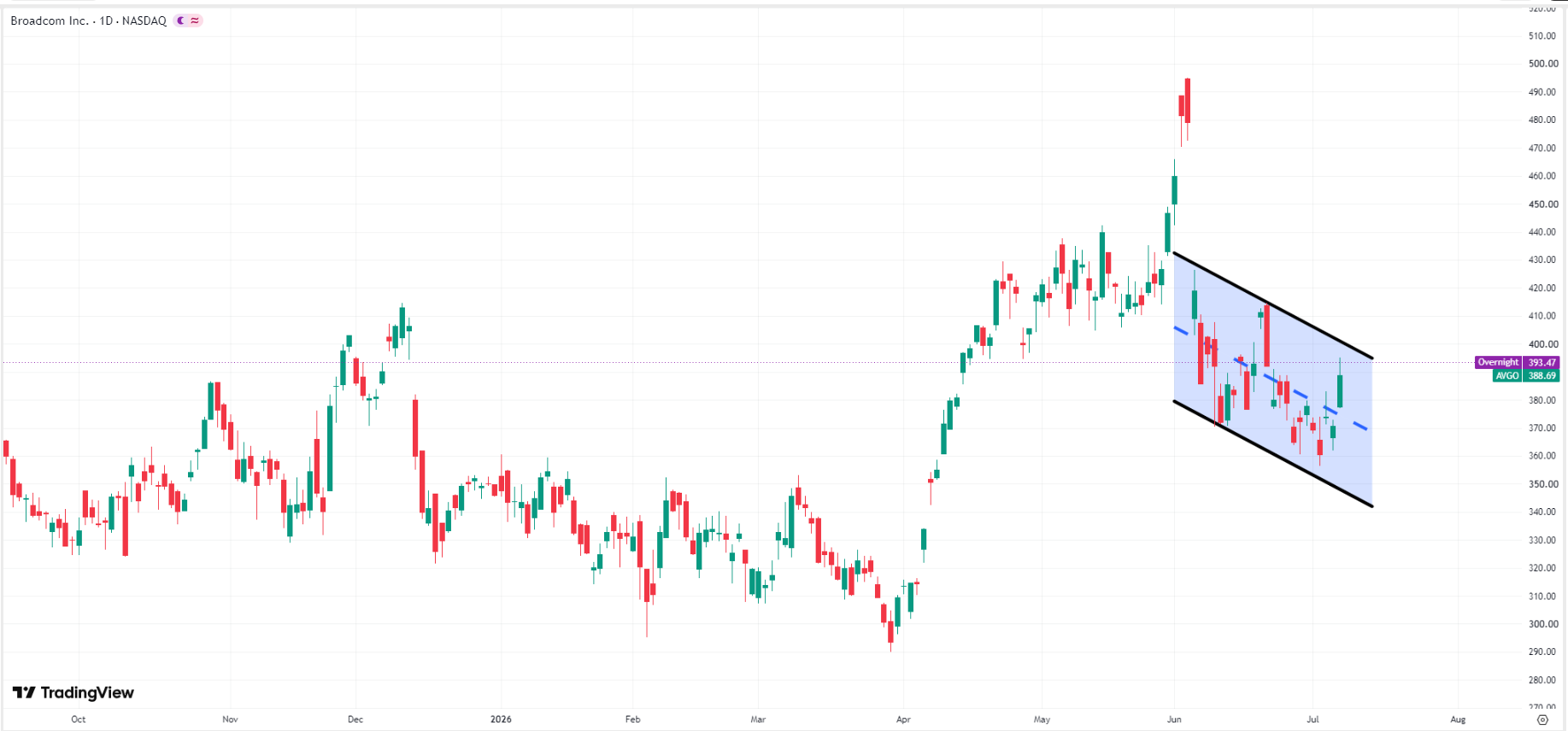
Stimulated by this positive news, Broadcom's stock price once soared by over 6% before narrowing to 4.83% to close at $388.69, hitting a near half-month high and recovering some of its recent losses. On June 3, Broadcom's stock price surged to $495, setting a record high, before continuing to fall to a low of $356 on July 2, resulting in a maximum drawdown of 28%. Currently, it is still down 21% from its peak, so can this positive news propel it back to its peak?

Over the past two years, Wall Street's biggest concern regarding Broadcom has been "Apple's de-Broadcomization." As Apple aggressively pushes for self-developed RF, Wi-Fi, and Bluetooth chips, the market feared Broadcom would repeat the tragedy of Qualcomm ( QCOM) being gradually phased out by Apple's self-developed 5G baseband chips. This $30 billion contract, signed directly through 2031 and including joint development of custom chips, is equivalent to Apple granting Broadcom a long-term golden shield for the next 5 years. This completely eliminates the market's biggest "tail risk," fully opening up room for P/E ratio restoration.

What excites foreign capital most about this order is not just the traditional mobile wireless chips, but custom AI chips (ASICs). Broadcom is the absolute king in the global ASIC field, having previously helped Google ( GOOG) develop TPUs and Meta ( META) develop AI chips. Now, with the addition of Apple, a $1.8 trillion giant, Broadcom's guidance to easily exceed $100 billion in AI chip revenue by fiscal year 2027 has officially transformed from a verbal commitment into a concrete order in black and white, significantly increasing the probability of achievement.

This deal reached between Broadcom and Apple is also a clever political gesture, precisely responding to the White House's pressure for the "re-shoring of semiconductor manufacturing," helping Apple avoid the threat of high 25% import tariffs. For Broadcom, its U.S.-based manufacturing capacity (formerly the HP site) has turned into a highly strategic political asset, which will continue to attract defensive buying from hedge funds in the second half of the year.

Although the fundamentals are impeccable, it remains difficult for Broadcom to break through historical highs in one go in the short term because this deal is long-term and will not be immediately reflected in financial reports. More importantly, SpaceX ( SPCX) was just added to the Nasdaq 100 index this week, and SK Hynix plans to launch a massive $28 billion listing on the US Nasdaq this Friday (July 10), causing global passive funds to conduct technical selling of existing tech giants to free up capital and cover positions.

From a technical analysis perspective, Broadcom's stock price is still in a downward channel, which is a bearish signal. Next, Broadcom's stock price needs to break through and stabilize above the $400 mark to reverse this downward trend and continue rising to challenge its historical peak. However, the recent escalation of the US-Iran conflict has triggered a surge in oil prices, and just-declined inflation expectations have risen again, which poses a huge obstacle to the rise of tech stocks, especially AI stocks, and Broadcom's stock price will inevitably be suppressed by it.broadcom-avgo-price-31501d4e1de2480f81cd4d760fb736fb Broadcom Stock Chart, Source: TradingView
Disclaimer: For information purposes only. Past performance is not indicative of future results.
placeholder
Bitcoin CME gaps at $35,000, $27,000 and $21,000, which one gets filled first?Prioritize filling the $27,000 gap and even try higher.
Author  FXStreet
Aug 22, 2023
Prioritize filling the $27,000 gap and even try higher.
placeholder
Pinduoduo Earnings Incoming: Morgan Stanley Sees Long-Term Profit Potential​Insights – On November 21, Chinese e-commerce giant Pinduoduo (PDD) will release its Q3 2024 earnings.
Author  Mitrade
Nov 20, 2024
​Insights – On November 21, Chinese e-commerce giant Pinduoduo (PDD) will release its Q3 2024 earnings.
placeholder
Elon Musk’s xAI and Neuralink Launch New Funding Rounds​Billionaire Elon Musk recently raised funds for his two high-profile tech companies, xAI and Neuralink.
Author  Insights
Jun 03, 2025
​Billionaire Elon Musk recently raised funds for his two high-profile tech companies, xAI and Neuralink.
placeholder
Bitcoin briefly loses 2025 gains as crypto plunges over the weekend.Bitcoin experienced a sharp decline this weekend, briefly erasing its 2025 gains and dipping below its year-opening value of $93,507. The cryptocurrency fell to a low of $93,029 on Sunday, representing a 25% drop from its all-time high in October. Although it has rebounded slightly to around $94,209, the pressures on the market remain significant. The downturn occurred despite the reopening of the U.S. government on Thursday, which many had hoped would provide essential support for crypto markets. This year initially appeared promising for cryptocurrencies, particularly after the inauguration of President Donald Trump, who has established the most pro-crypto administration thus far. However, ongoing political tensions—including Trump's tariff strategies and the recent government shutdown, lasting a historic 43 days—have contributed to several rapid price pullbacks for Bitcoin throughout the year. Market dynamics are also being influenced by Bitcoin whales—investors holding large amounts of Bitcoin—who have been offloading portions of their assets, consequently stalling price rallies even as positive regulatory developments emerge. Despite these sell-offs, analysts from Glassnode argue that this behavior aligns with typical patterns seen among long-term investors during the concluding stages of bull markets, suggesting it is not indicative of a mass exodus. Notably, Bitcoin is not alone in its struggles, as Ethereum and Solana have also recorded declines of 7.95% and 28.3%, respectively, since the start of the year, while numerous altcoins have faced even steeper losses. Looking ahead, questions linger regarding the viability of the four-year cycle thesis, particularly given the increasing institutional support and regulatory frameworks now in place in the crypto landscape. Matt Hougan, chief investment officer at Bitwise, remains optimistic, suggesting a potential Bitcoin resurgence in 2026 driven by the “debasement trade” thesis and a broader trend toward increased adoption of stablecoins, tokenization, and decentralized finance. Hougan emphasized the soundness of the underlying fundamentals, pointing to a positive outlook for the sector in the longer term.
Author  Mitrade
Nov 17, 2025
Bitcoin experienced a sharp decline this weekend, briefly erasing its 2025 gains and dipping below its year-opening value of $93,507. The cryptocurrency fell to a low of $93,029 on Sunday, representing a 25% drop from its all-time high in October. Although it has rebounded slightly to around $94,209, the pressures on the market remain significant. The downturn occurred despite the reopening of the U.S. government on Thursday, which many had hoped would provide essential support for crypto markets. This year initially appeared promising for cryptocurrencies, particularly after the inauguration of President Donald Trump, who has established the most pro-crypto administration thus far. However, ongoing political tensions—including Trump's tariff strategies and the recent government shutdown, lasting a historic 43 days—have contributed to several rapid price pullbacks for Bitcoin throughout the year. Market dynamics are also being influenced by Bitcoin whales—investors holding large amounts of Bitcoin—who have been offloading portions of their assets, consequently stalling price rallies even as positive regulatory developments emerge. Despite these sell-offs, analysts from Glassnode argue that this behavior aligns with typical patterns seen among long-term investors during the concluding stages of bull markets, suggesting it is not indicative of a mass exodus. Notably, Bitcoin is not alone in its struggles, as Ethereum and Solana have also recorded declines of 7.95% and 28.3%, respectively, since the start of the year, while numerous altcoins have faced even steeper losses. Looking ahead, questions linger regarding the viability of the four-year cycle thesis, particularly given the increasing institutional support and regulatory frameworks now in place in the crypto landscape. Matt Hougan, chief investment officer at Bitwise, remains optimistic, suggesting a potential Bitcoin resurgence in 2026 driven by the “debasement trade” thesis and a broader trend toward increased adoption of stablecoins, tokenization, and decentralized finance. Hougan emphasized the soundness of the underlying fundamentals, pointing to a positive outlook for the sector in the longer term.
placeholder
Gold declines as Trump scraps Iran memorandum, markets await Fed minutesGold (XAU/USD) trades around $4,050 on Wednesday, down 1.40% on the day at the time of writing, as investors favor the US Dollar (USD) following a fresh deterioration in tensions between the United States (US) and Iran.
Author  FXStreet
23 hours ago
Gold (XAU/USD) trades around $4,050 on Wednesday, down 1.40% on the day at the time of writing, as investors favor the US Dollar (USD) following a fresh deterioration in tensions between the United States (US) and Iran.
goTop
quote