


The "Magnificent Seven" Just Delivered a $2.2 Trillion Warning to Wall Street. Should You Listen?
Key Points
The “Magnificent Seven” are stocks most of us recognize, as they make products and services we use daily.
These companies have been benefiting from the artificial intelligence boom.
- 10 stocks we like better than Nvidia ›
The "Magnificent Seven" stocks have become household names over the past few years. They are tech giants powering many of the things we use daily, from Google Search to the top-selling iPhone. These players are: Apple (NASDAQ: AAPL), Amazon (NASDAQ: AMZN), Alphabet (NASDAQ: GOOG) (NASDAQ: GOOGL), Meta Platforms (NASDAQ: META), Microsoft (NASDAQ: MSFT), Nvidia (NASDAQ: NVDA), and Tesla (NASDAQ: TSLA) -- and, due to their heavy weighting in the S&P 500, they've driven the performance of the famous benchmark.
This group of well-established tech stocks has performed generally well during this bull market, with many of them climbing in the double and triple digits in recent years. And their market value has soared into the trillions of dollars. In fact, Nvidia last year became the first company to ever reach a market value of $4 trillion -- it's since surpassed that level.
Missed Nvidia in 2009? This Rare Signal Is Flashing Again. In 2009, a "Double Down" signal flashed for a little-known chipmaker called Nvidia. For the first time in years, that same "Total Conviction" signal is flashing for a company 1/100th the size of Nvidia. Continue »
These stocks have soared as investors piled in to gain exposure to the high-growth area of artificial intelligence (AI), a technology that could be game-changing. And many of the "Magnificent Seven" have seen revenue soar, too, thanks to their involvement in AI. All of this is positive, but the picture for these top companies hasn't been flawless in recent times. In fact, the "Magnificent Seven" just delivered a $2.2 trillion warning to Wall Street. Should you listen? Let's find out.

Image source: Getty Images.
Technology giants
First, a quick summary of the "Magnificent Seven" success story so far. These companies aren't young, unproven players, but instead are technology giants that have demonstrated their ability to keep customers coming back to their products and services and increase earnings over the long term. As I mentioned above, they are the names behind things we use daily -- from Alphabet's Google Search to Apple's iPhone.
On top of this long-established earnings track record, these companies have also become involved in the AI story. Some of them are a key part of this boom, such as chip designer Nvidia and cloud service leader Amazon. Others, such as Apple, have been slower to get in on AI. But in every case, we can imagine these players benefiting from the AI story over time.
These AI companies have delivered strong earnings reports and spoken of ongoing high demand for AI products and services -- and this has been confirmed by other tech giants that aren't in the "Magnificent Seven," from Micron Technology to Broadcom. Still, investors have become a bit more cautious about AI stocks, given the significant sums spent on the AI infrastructure build-out. Tech giants have pledged to spend almost $700 billion this year alone.
The trillion-dollar warning
And all of this brings me to the "Magnificent Seven's" trillion-dollar warning to Wall Street: Together, these seven companies lost more than $2.2 trillion in market capitalization over the month of June.
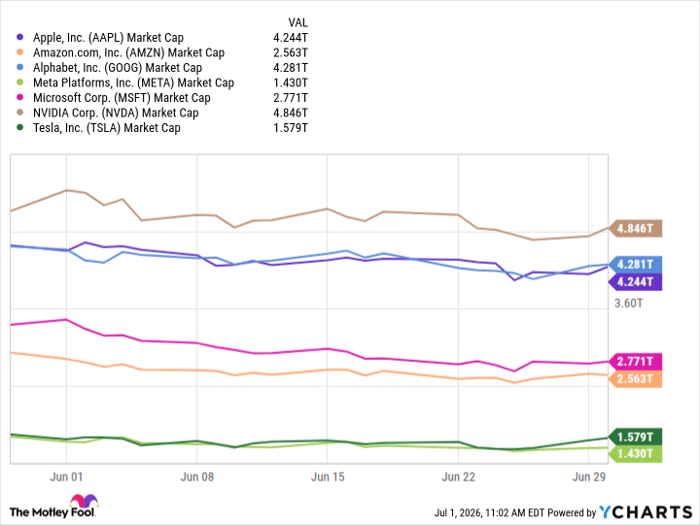
AAPL Market Cap data by YCharts
This is as some investors rotated out of these stocks and others hesitated to buy. Now the question is: Should you listen to this and potentially retreat from these AI giants? Not necessarily.
It's true that investors have become more watchful when it comes to AI stocks after the huge gains we've seen in recent years. Investors worry that any disappointment could hurt earnings prospects and stock performance -- and so some have reduced positions.
I see this as an opportunity for long-term investors to get in on shares of some of the world's most successful technology companies. This doesn't mean every "Magnificent Seven" is a buy today or is right for your investment style, but certain players could be -- and the recent decline creates the opportunity to get in for a reasonable price. For example, Nvidia, trading at 22x forward earnings estimates, looks like a steal for a company that has built an AI empire -- and is likely to hold onto leadership thanks to its focus on innovation.
All of this means that, yes, you should listen to this $2.2 trillion warning and understand that AI stocks may face headwinds at certain points -- and might be more sensitive to negative news than they were a year ago. But quality tech stocks have what it takes to manage the tough times and gain over the long run -- so a moment of declines represents an excellent time to buy.
Should you buy stock in Nvidia right now?
Before you buy stock in Nvidia, consider this:
The Motley Fool Stock Advisor analyst team just identified what they believe are the 10 best stocks for investors to buy now… and Nvidia wasn’t one of them. The 10 stocks that made the cut could produce monster returns in the coming years.
Consider when Netflix made this list on December 17, 2004... if you invested $1,000 at the time of our recommendation, you’d have $418,761!* Or when Nvidia made this list on April 15, 2005... if you invested $1,000 at the time of our recommendation, you’d have $1,195,804!*
Now, it’s worth noting Stock Advisor’s total average return is 918% — a market-crushing outperformance compared to 208% for the S&P 500. Don't miss the latest top 10 list, available with Stock Advisor, and join an investing community built by individual investors for individual investors.
See the 10 stocks »
*Stock Advisor returns as of July 6, 2026.
Adria Cimino has positions in Amazon and Tesla. The Motley Fool has positions in and recommends Alphabet, Amazon, Apple, Broadcom, Meta Platforms, Micron Technology, Microsoft, Nvidia, and Tesla. The Motley Fool has a disclosure policy.
Recommended Articles


