


AMD Stock and Intel Crushed Nvidia in the First Half. Here's My Prediction for the Second Half.
Key Points
Nvidia dominates the AI chip market with its powerful graphics processing units (GPUs).
Now, Nvidia, Intel, and AMD are vying for leadership in the central processing unit (CPU) market for data centers.
- 10 stocks we like better than Nvidia ›
Nvidia (NASDAQ: NVDA) has been the "go-to" artificial intelligence (AI) stock for a number of years. Since this tech giant is the No. 1 designer of AI chips, it's generated mind-boggling revenue growth that's reached record levels and proven itself to be a winner in the AI boom. So it's no surprise that investors have turned to the stock, pushing it to a gain of about 900% over the past five years.
But in the first half of this year, a shift took place. Investors rotated out of some of the biggest AI winners -- like Nvidia -- and picked up shares of AI stocks that hadn't yet gained as much. That movement helped fellow chip companies Advanced Micro Devices (NASDAQ: AMD) and Intel (NASDAQ: INTC) soar. Climbing 171% and 278%, respectively, in the first half, they crushed Nvidia. The AI chip giant advanced 7.2%, which is a pretty small gain for this stock.
Missed Nvidia in 2009? This Rare Signal Is Flashing Again. In 2009, a "Double Down" signal flashed for a little-known chipmaker called Nvidia. For the first time in years, that same "Total Conviction" signal is flashing for a company 1/100th the size of Nvidia. Continue »
Will AMD and Intel keep crushing Nvidia? Here's my prediction for the second half.

Image source: Getty Images.
The AI opportunity
Before we get to my prediction, though, let's catch up on how these companies have approached the AI opportunity so far. Nvidia was the first to market with graphics processing units (GPUs) tailored to the needs of AI, allowing the company to build out its leadership here. Intel and AMD have traditionally been leaders in another type of processor: the central processing unit (CPU), the main processor in computers.
Intel has led here for years and holds more than 59% of total CPU market share, though AMD has gained ground, progressing from a low of about 17% back in 2016 to 38% today.
The GPU was the most relevant of the two chips during the early days of AI, driving the most important tasks such as the training of AI models. And that was fantastic news for Nvidia. AMD and Intel entered the GPU market later, and while AMD has successfully delivered growth here, Intel has experienced difficulty.
That said, Intel aims to turn this around and has taken key steps. The company appointed new chief executive officer Lip-Bu Tan a little over a year ago to drive the company's turnaround strategy and strengthen its position in the AI market, and investors like the progress so far and the good news that's emerged. The U.S. government took a 10% stake in Intel last summer, worth about $10 billion -- a sign of confidence that investors appreciated. In the latest quarter, Intel's revenue climbed 7%, and this was the sixth straight quarter of revenue that beat the company's expectations.
AMD and Intel skyrocket
So, it's not surprising that AMD and Intel, which greatly lagged behind Nvidia from a stock performance perspective, saw their shares skyrocket in the first half of this year.
Now, here's my prediction for the second half. I predict that Nvidia will outpace these rivals. And this is for two reasons: Nvidia's next goal and its valuation. I'll start with the goal, and this is to dominate the $200 billion CPU market -- a market where Nvidia has not been greatly present in the past. In fact, it's launching its first-ever stand-alone CPU this fall as part of the Vera Rubin platform. And at the same time, Nvidia is targeting the personal computing market with a superchip -- also set for fall release -- that includes a GPU and a CPU.
While it may be difficult for Nvidia to take complete leadership of the entire CPU market, I think the company could clearly dominate in the CPU market for data centers. Nvidia already forecasts $20 billion in stand-alone CPU sales this year. It's important to note that the CPU is the key chip needed to power agentic AI -- and agentic AI is expected to be the next AI growth driver. This involves the application of AI to real-world problems, with the agent taking problem-solving steps.
While Nvidia's potential CPU market leadership won't happen overnight, a successful launch of the Rubin platform and high demand could lead to positive stock performance for Nvidia in the second half.
Valuation could also push investors to favor Nvidia over AMD and Intel.
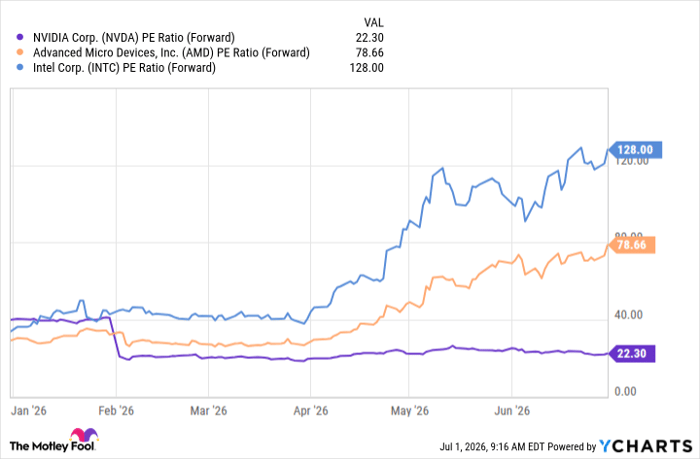
NVDA PE Ratio (Forward) data by YCharts
At about 22x forward earnings estimates, Nvidia looks dirt cheap, while the two chip peers look excessively expensive after their recent gains. All of this prompts me to predict that Nvidia, which saw a pause in its stock market momentum in recent months, may soar in the second half -- and crush AMD and Intel.
Should you buy stock in Nvidia right now?
Before you buy stock in Nvidia, consider this:
The Motley Fool Stock Advisor analyst team just identified what they believe are the 10 best stocks for investors to buy now… and Nvidia wasn’t one of them. The 10 stocks that made the cut could produce monster returns in the coming years.
Consider when Netflix made this list on December 17, 2004... if you invested $1,000 at the time of our recommendation, you’d have $418,761!* Or when Nvidia made this list on April 15, 2005... if you invested $1,000 at the time of our recommendation, you’d have $1,195,804!*
Now, it’s worth noting Stock Advisor’s total average return is 918% — a market-crushing outperformance compared to 208% for the S&P 500. Don't miss the latest top 10 list, available with Stock Advisor, and join an investing community built by individual investors for individual investors.
See the 10 stocks »
*Stock Advisor returns as of July 5, 2026.
Adria Cimino has no position in any of the stocks mentioned. The Motley Fool has positions in and recommends Advanced Micro Devices, Intel, and Nvidia. The Motley Fool has a disclosure policy.
Recommended Articles


