


VDE vs. VPU: Which Vanguard ETF Is a Better Way to Invest in Rising Energy Prices?
Key Points
The Vanguard Energy ETF has outperformed the S&P 500 over the past five years thanks to higher oil prices.
Meanwhile, the Vanguard Utilities ETF has underperformed the S&P 500 over the same period of time.
But both offer solid dividend yields and lower volatility for investors concerned about a stock market sell-off.
- 10 stocks we like better than Vanguard World Fund - Vanguard Energy ETF ›
One surprising side effect of the artificial intelligence (AI) boom has been the rise of investor demand for stocks in the energy and utility sectors. As major tech companies build massive AI data centers, they need a lot of power to run them. That has helped drive a run-up in share prices of energy stocks and utility companies.
The recent tensions in the Middle East during the lead-up to the Iran war also contributed to higher oil prices and higher share prices for oil stocks.
Where to invest $1,000 right now? Our analyst team just revealed what they believe are the 10 best stocks to buy right now, when you join Stock Advisor. See the stocks »
But what does the future hold for these fundamentally important industries? Is now still a good time to buy? Even though utilities and energy companies are essential for powering our vehicles and keeping the lights on, they don't always outperform the rest of the S&P 500 index.
If you're bullish on the future of AI and other economic growth factors creating higher demand for energy, then buying exchange-traded funds (ETFs) like the Vanguard Energy ETF (NYSEMKT: VDE) or the Vanguard Utilities ETF (NYSEMKT: VPU) could be a good move. Let's look at these two popular Vanguard ETFs and see if they might be worth including in your portfolio.

Image source: Getty Images.
Vanguard Energy ETF (VDE): 10 years of 9.2% annualized returns
The Vanguard Energy ETF holds 111 stocks with a heavy weighting toward oil and gas companies. The top three stock holdings are energy majors ExxonMobil (22% of the fund), Chevron (14.2%), and ConocoPhillips (5.8%).
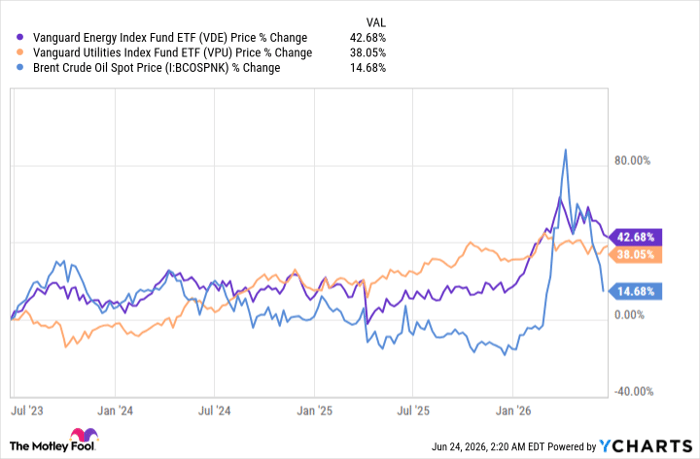
This ETF charges a low expense ratio (0.09%) and has delivered an impressive year-to-date return of 23.5%. It ranks among the best energy ETFs. It has outperformed the S&P 500 for the past five years, with average annual returns of 21.1%.
If you believe that energy prices will be higher in the future, this ETF could be a good choice. Its share price tends to move up and down along with the price of oil, while the Vanguard Utilities ETF is less correlated with the global oil market.
VDE data by YCharts
But over the long run, even the best energy ETFs don't always beat the market. The Vanguard Energy ETF has strongly underperformed the S&P 500 for the past 10 years with average annual returns of 9.2%.
Vanguard Utilities ETF (VPU): 10 years of 9.4% annualized returns
The Vanguard Utilities ETF holds 68 stocks with a strong focus on electric utilities (61.6% of the fund). The top sector holdings also include multi-utilities (24.5%), independent power producers (5.3%), gas utilities (4.7%), and water utilities (2.9%). Like the energy ETF, it charges a low expense ratio of 0.09%.
Unfortunately, this fund's recent performance hasn't been as strong as the energy ETF's. The Vanguard Utilities ETF has delivered 6.84% return year to date, underperforming the S&P 500. It has also lagged the S&P 500 during the past five years (9.56% average annual returns) and 10 years (9.4% average annual returns).
Good reasons to buy VDE or VPU
There's no guarantee that energy prices will keep going up. Energy prices might go down in the future, especially if the Iran war is truly over. And even if the AI data center build-out keeps going strong, buying a utilities ETF might not be the best way to profit from that trend -- utilities tend to have lower margins than AI stocks.
But here's one good reason to buy these funds: dividends. The Vanguard Energy ETF offered a trailing 12-month dividend yield of 2.47%, while the Vanguard Utilities ETF paid a dividend yield of 2.64%. These funds could be worth considering for dividend-focused investors.
Another reason to buy these funds is that they are low-beta relative to the Dow Jones U.S. Total Stock Market index. The Vanguard Energy ETF has a beta coefficient of 0.09 compared to that benchmark, while the Vanguard Utilities ETF has a beta coefficient of 0.42. That means these energy and utility ETFs are likely to be less volatile than the broader stock market.
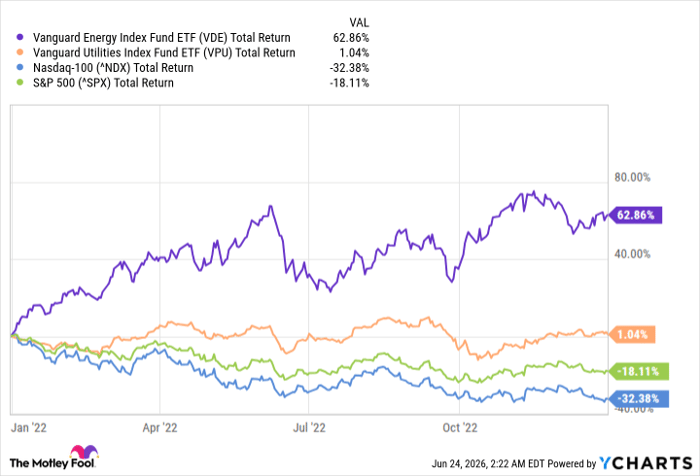
If you're doubtful about the future of AI or wary of big-tech stock valuations, these ETFs could serve as a defensive play against a tech downturn. During the most recent tech bear market in 2022, both of these funds strongly outperformed the S&P 500 and the tech-heavy Nasdaq-100 index.
VDE Total Return Level data by YCharts
History doesn't always repeat itself. There's not always a "safe" place to hide during a stock market sell-off. But if the rest of the stock market goes into a downturn, these funds' holdings might stay steady. Just like what happened in 2022.
Should you buy stock in Vanguard World Fund - Vanguard Energy ETF right now?
Before you buy stock in Vanguard World Fund - Vanguard Energy ETF, consider this:
The Motley Fool Stock Advisor analyst team just identified what they believe are the 10 best stocks for investors to buy now… and Vanguard World Fund - Vanguard Energy ETF wasn’t one of them. The 10 stocks that made the cut could produce monster returns in the coming years.
Consider when Netflix made this list on December 17, 2004... if you invested $1,000 at the time of our recommendation, you’d have $418,761!* Or when Nvidia made this list on April 15, 2005... if you invested $1,000 at the time of our recommendation, you’d have $1,195,804!*
Now, it’s worth noting Stock Advisor’s total average return is 918% — a market-crushing outperformance compared to 208% for the S&P 500. Don't miss the latest top 10 list, available with Stock Advisor, and join an investing community built by individual investors for individual investors.
See the 10 stocks »
*Stock Advisor returns as of July 3, 2026.
Ben Gran has no position in any of the stocks mentioned. The Motley Fool has positions in and recommends Chevron. The Motley Fool recommends ConocoPhillips. The Motley Fool has a disclosure policy.
Recommended Articles


