


Microsoft's AI Revenue Run Rate Just Crossed $37 Billion. Is It the Best AI Stock to Buy Now?
Key Points
Microsoft has delivered solid growth in recent quarters.
The stock is cheaply valued relative to its operating cash flow.
- These 10 stocks could mint the next wave of millionaires ›
Microsoft (NASDAQ: MSFT) is a major player in the AI space, and one that's involved in it in many ways. It's also one of the few companies that's telling investors exactly how much revenue its AI business is generating right now. In its fiscal 2026 third quarter (which ended March 31), its AI annual recurring revenue grew by 123% year over year to surpass $37 billion.
That's impressive, and it's not even the only AI growth lever Microsoft has right now.
Will AI create the world's first trillionaire? Our team just released a report on the one little-known company, called an "Indispensable Monopoly" providing the critical technology Nvidia and Intel both need. Continue »

Image source: Getty Images.
Microsoft has two businesses affected by AI
The most prominent of Microsoft's AI businesses is Copilot, the AI assistant it has integrated into its Microsoft 365 productivity suite, Windows, its Edge browser, and other software and services. It also has other AI tools for other parts of its business, but Copilot gets the most attention.
Another way Microsoft is exposed to AI is via its cloud computing platform, Azure. The basis of a cloud computing infrastructure business is to build excess computing power, then rent that power to customers. Cloud computing got its start with traditional workloads, like business operations, website hosting, and data storage, but now it has evolved to supply a heavy share of AI processing power. Clients can use Microsoft's cloud services to train AI models, and use others' large language models to build applications. There is a huge market for this, and Azure's 40% growth rate reflects this.
Overall, Microsoft grew revenue by 8% in its fiscal Q3, which was a pretty good clip considering its size and maturity. However, I think the stock should be doing a lot better than it is.
The best metric to use to gauge the valuation of an AI hyperscaler like Microsoft is its price-to-operating-cash-flow ratio. This metric ignores capital expenditures, as well as gains or losses from investments. (Microsoft has lately had a ton of gains of this type due to its large OpenAI investment, and those impact its earnings, and thus its price-to-earnings ratio.) From this standpoint, Microsoft stock hasn't been this cheap in a long time.
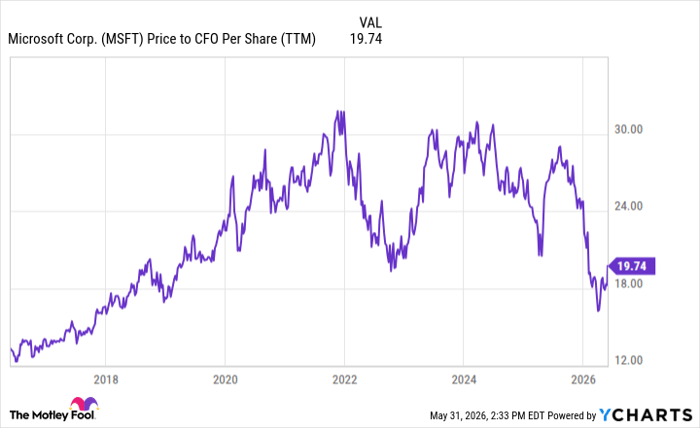
MSFT Price to CFO Per Share (TTM) data by YCharts.
While the stock has rallied a bit from its recent cyclical lows, it's still in a zone that's cheaper on a P/CFO basis than it has been since before COVID-19 was a thing. That shows just how deep a sell-off Microsoft's stock has undergone over the past half-year, and with its business executing at a high level, it looks like a solid buy.
I'm still hesitant to call it the best AI stock to buy now, because every investor's situation is different. But if you're looking for an AI leader with highly predictable returns, I think Microsoft should be at the top of your list.
Don’t miss this second chance at a potentially lucrative opportunity
Ever feel like you missed the boat in buying the most successful stocks? Then you’ll want to hear this.
On rare occasions, our expert team of analysts issues a “Double Down” stock recommendation for companies that they think are about to pop. If you’re worried you’ve already missed your chance to invest, now is the best time to buy before it’s too late. And the numbers speak for themselves:
- Nvidia: if you invested $1,000 when we doubled down in 2009, you’d have $557,033!*
- Apple: if you invested $1,000 when we doubled down in 2008, you’d have $59,133!*
- Netflix: if you invested $1,000 when we doubled down in 2004, you’d have $439,632!*
Right now, we’re issuing “Double Down” alerts for three incredible companies, available when you join Stock Advisor, and there may not be another chance like this anytime soon.
See the 3 stocks »
*Stock Advisor returns as of June 4, 2026.
Keithen Drury has positions in Microsoft. The Motley Fool has positions in and recommends Microsoft. The Motley Fool has a disclosure policy.
Recommended Articles


