


Greg Abel's Latest Pick Speaks Volumes About Berkshire Hathaway's New Strategy
Key Points
New Berkshire Hathaway CEO Greg Abel is already doing things very differently than predecessor, Warren Buffett.
The conglomerate seems at least as interested in outright ownership of promising, high-quality companies as in equity-based partial exposure.
This strategy may offer better, more predictable value to Berkshire shareholders and provide more reliable cash flow to Berkshire Hathaway itself.
- 10 stocks we like better than Berkshire Hathaway ›
Berkshire Hathaway (NYSE: BRKA) (NYSE: BRKB) continues to evolve under CEO Greg Abel's leadership. Sure, the recently announced addition of another $10 billion worth of Alphabet stock is an obvious change. But it's not a particularly noteworthy one, in that Berkshire already owned more than $20 billion worth of Google's parent company.
Rather, the latest pick that speaks volumes about Berkshire's new direction is Sunday's news that it's acquiring the entire publicly traded Taylor Morrison Home (NYSE: TMHC) for $8.5 billion. It will then delist its stock, making it a wholly owned private holding. It's another layer of evidence that Abel and his lieutenants are losing interest in being mere shareholders and, ultimately, at the mercy of the market, and would rather outright own businesses they can control.
Will AI create the world's first trillionaire? Our team just released a report on the one little-known company, called an "Indispensable Monopoly" providing the critical technology Nvidia and Intel both need. Continue »
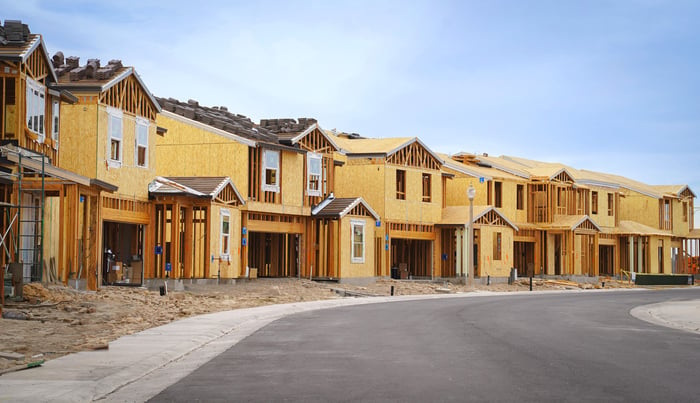
Image source Getty Images.
Same industry, different approach
It's certainly not out of place at Berkshire. The conglomerate already holds stakes in building materials outfit Louisiana Pacific and has recently purchased shares of homebuilder Lennar. Privately, it owns Acme Brick Company, Clayton Homes, and Home Services of America; it's clearly no stranger to the residential real estate business and will obviously benefit from the nation's current housing shortage. (J.P. Morgan analysts believe it could take up to 10 years to shore up the nation's shortage of an estimated 2.8 million homes, for perspective.)
That's not the noteworthy nuance of the decision to acquire homebuilder Taylor Morrison in full, however. No, rather than expanding its stake in Lennar or stepping into one of several other homebuilding stocks, Abel opted to take complete control of one of these names by privatizing a publicly traded company.
Is this a new operating strategy for Berkshire?
Were it the first recent instance, it might be dismissible. It isn't the first time we've seen it in the past few months, though. As a reminder, in January, Berkshire Hathaway also fully acquired Occidental Petroleum's chemical arm, OxyChem.
It's not a misfit either, in that Berkshire already owns Lubrizol and LiquidPower Specialty Products. Still, it's not necessarily a business the conglomerate needed to wholly own. It simply recognized that if it's going to own any of it, it may as well own all of it.
Now, all of a sudden, something I suggested a couple of weeks ago merits deeper consideration. That is, "This is the beginning of a more philosophical shift away from a somewhat broken stock market and toward more outright ownership of cash-generating businesses that Berkshire can wholly control."
Smart strategy right now
It's still too soon to say Greg Abel is all-in on owning more privately held companies at the expense of publicly traded ones; Berkshire's clearly spending even more on newly minted Alphabet shares than he will on Taylor Morrison.
The recent private deals are pretty big ones, though. Berkshire's sidelined cash is still stacking up, too, suggesting Abel and his managers don't see much in the public equity market they feel they have to own at current prices.
This is arguably a good thing in the long run, though. Most stocks are expensive from both cyclical and secular perspectives. The best way to sidestep the risk of a major valuation reset is not to own stocks but instead to plug into a stock's underlying company's cash flow by owning the whole thing.
Should you buy stock in Berkshire Hathaway right now?
Before you buy stock in Berkshire Hathaway, consider this:
The Motley Fool Stock Advisor analyst team just identified what they believe are the 10 best stocks for investors to buy now… and Berkshire Hathaway wasn’t one of them. The 10 stocks that made the cut could produce monster returns in the coming years.
Consider when Netflix made this list on December 17, 2004... if you invested $1,000 at the time of our recommendation, you’d have $439,632!* Or when Nvidia made this list on April 15, 2005... if you invested $1,000 at the time of our recommendation, you’d have $1,316,532!*
Now, it’s worth noting Stock Advisor’s total average return is 960% — a market-crushing outperformance compared to 211% for the S&P 500. Don't miss the latest top 10 list, available with Stock Advisor, and join an investing community built by individual investors for individual investors.
See the 10 stocks »
*Stock Advisor returns as of June 4, 2026.
James Brumley has positions in Alphabet. The Motley Fool has positions in and recommends Alphabet, Berkshire Hathaway, and Lennar. The Motley Fool recommends Occidental Petroleum. The Motley Fool has a disclosure policy.
Recommended Articles


