


Will AI Productivity Gains Allow Fed Chair Kevin Warsh to Cut Interest Rates?
Key Points
AI could eventually enable the Fed to lower rates, but not in the near term.
AI hyperscalers are indifferent to borrowing rates.
- These 10 stocks could mint the next wave of millionaires ›
Brand-new Federal Reserve Chair Kevin Warsh was nominated by President Donald Trump. Trump's stated reasoning for nominating Warsh was the hope that Warsh would start cutting the target value of the federal funds rate, which would lead to lower borrowing rates and stimulate the economy in time for the November 2026 congressional elections.
During the run-up to his nomination and subsequent Senate confirmation, Warsh repeatedly argued that a productivity boom driven by artificial intelligence(AI) would allow the U.S. economy to produce more output without inflation, thus paving the way for the Fed to cut rates.
Will AI create the world's first trillionaire? Our team just released a report on the one little-known company, called an "Indispensable Monopoly" providing the critical technology Nvidia and Intel both need. Continue »
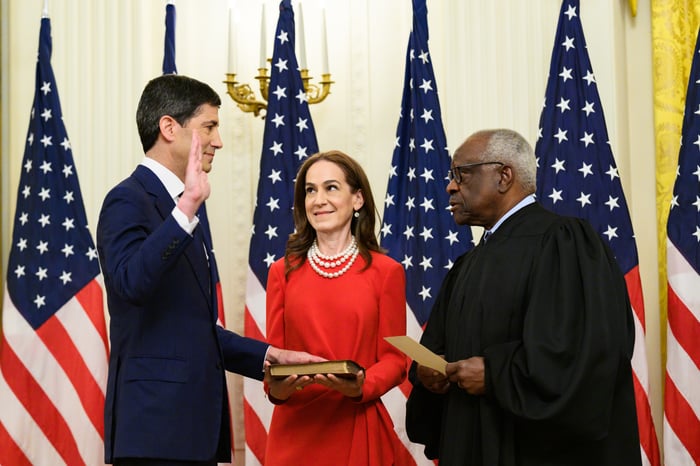
Image source: Official White House Photo by Daniel Torok.
Warsh laid out his arguments last November in an opinion piece in The Wall Street Journal. "AI will be a significant disinflationary force," he wrote, "increasing productivity and bolstering American competitiveness." Warsh also called for "lower interest rates to support households and small and medium-size businesses."
Warsh might be right about AI bringing productivity gains that mitigate inflation during an economic expansion, as well as about the appropriateness of lower interest rates to stimulate growth.
But he's not right in the short term.
Economists at the Fed and elsewhere believe that the massive AI infrastructure build-out, expected to reach $4 trillion globally by 2030, with much of that in the U.S., will boost demand and prices in the near term, not productivity.
That demand -- for chips, copper, energy, and other inputs -- is contributing to a recent surge in inflation, with the Consumer Price Index up 3.8% year over year in April and the Personal Consumption Expenditures Price Index, the Fed's preferred inflation gauge, also up 3.8%. Those measures of inflation are uncomfortably above the Fed's 2% target.
As a result, futures traders are currently pricing in a 56% likelihood that the Federal Funds rate, the one the Fed sets, will be higher, not lower, by the end of 2026.
AI spending is not sensitive to interest rates
In addition, while higher interest rates often lead to decreased spending by consumers and businesses, the hyperscalers -- AI and cloud-computing companies like Meta Platforms and Microsoft -- are far less affected by interest rates and instead are driven by fear of missing out (FOMO) on the AI revolution, according to Apollo Chief Economist Torsten Slok.
"The data center buildout is different," Slok wrote in a note last week. "It doesn't matter what the Fed does. There is FOMO among hyperscalers, and AI spending is not sensitive to higher interest rates."
Basically, the AI spending binge could eventually deliver the productivity gains that allow for lower interest rates. But the build-out of data centers is still in an inflationary stage.
That's going to make it difficult for Warsh to follow through on the rate cuts that Trump wants, at least this year.
Where to invest $1,000 right now
When our analyst team has a stock tip, it can pay to listen. After all, Stock Advisor’s total average return is 983%* — a market-crushing outperformance compared to 212% for the S&P 500.
They just revealed what they believe are the 10 best stocks for investors to buy right now, available when you join Stock Advisor.
See the stocks »
*Stock Advisor returns as of June 4, 2026.
Matthew Benjamin has positions in Microsoft. The Motley Fool has positions in and recommends Meta Platforms and Microsoft. The Motley Fool has a disclosure policy.
Recommended Articles


