


Should You Add a Bond ETF to Your Portfolio Right Now?
Key Points
The iShares Core U.S. Aggregate Bond ETF may not seem appealing with Treasury yields stubbornly high.
However, there are advantages in considering rate-sensitive bond ETFs today.
For diversification, ETFs such as the Vanguard Intermediate-Term Treasury Bond ETF merit consideration.
- 10 stocks we like better than iShares Trust - iShares Core U.s. Aggregate Bond ETF ›
With 10-year Treasury yields up 26 basis points since the start of the year and inflationary pressures reignited due to the war in Iran, the Federal Reserve may not be able to lower interest rates this year. Fed funds futures imply as much.
Those instruments indicate that it's all but a sure thing the central bank will stand pat at the upcoming June and July meetings. That's frustrating to investors holding broad bond exchange-traded funds (ETFs) such as the iShares Core U.S. Aggregate Bond ETF (NYSEMKT: AGG) because when yields fall, bond prices rise. Not enough of that is happening this year.
Will AI create the world's first trillionaire? Our team just released a report on the one little-known company, called an "Indispensable Monopoly" providing the critical technology Nvidia and Intel both need. Continue »
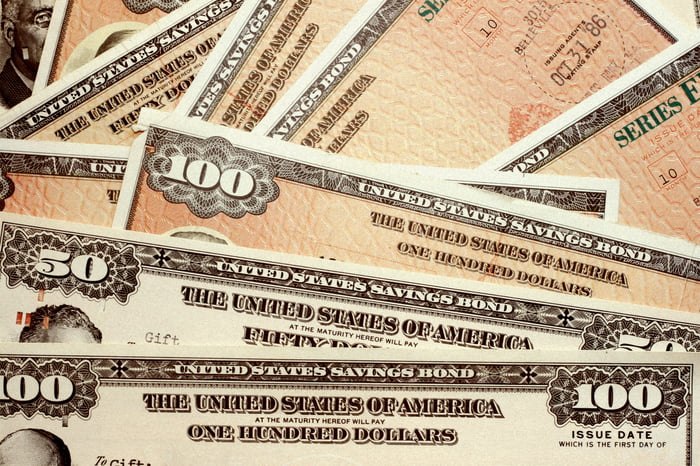
Some bond ETFs are more advantageous than meets the eye even without the Fed cutting rates. Image source: Getty Images.
Still, there are surprisingly compelling reasons to consider the iShares exchange-traded fund (ETF) as well as rivals such as the Vanguard Total Bond Market ETF (NASDAQ: BND).
Learning to love the "Agg"
The iShares ETF tracks the Bloomberg U.S. Aggregate Bond Index, also known as the "Agg." It's a Treasury-heavy index, meaning credit risk isn't an issue, but interest rate risk is. Said another way, declining interest rates often spark price appreciation in broad-based fixed-income funds.
Good news: Higher starting yields can work in investors' favor by helping protect against additional rate increases while potentially setting market participants up for price appreciation when yields decline. Plus, by embracing the relatively low risk 4.5% 30-day SEC yield offered by the iShares ETF today, investors can let their income compound at a higher rate until yields finally decline.
For investors who want a pure play on Uncle Sam-issued debt, the Vanguard Intermediate-Term Treasury Bond ETF (NASDAQ: VGIT) is one of the funds to consider. This Treasury bond ETF has essentially no credit risk because it only holds U.S. government bonds, but the real perk with this fund is its status as an intermediate-term bond ETF.
This ETF's 103 holdings have an average duration of 4.9 years, putting the fund in intermediate-term territory, as its name implies. That's a potentially valuable trait for fixed-income investors because medium-term bonds are often less volatile than their shorter-duration and longer-dated counterparts. Another benefit is that high-grade intermediate-term bonds are often less correlated with equities than short-term and long-duration bonds, meaning this Vanguard ETF can enhance a portfolio's diversification.
Keep it short and sweet
For investors who simply want to reduce rate risk in a big way while still garnering solid income, a variety of short-term bond ETFs merit consideration, including the JPMorgan Short Duration Core Plus ETF (NYSEMKT: JSCP).
This $1.5 billion actively managed ETF carries a 30-day SEC yield of 4.5%, which is impressive given its duration of just 2.8 years and the fact that 80.6% of its holdings are rated AAA, AA, or A.
This ETF may be an attractive alternative for investors looking to move out of money markets or cash, as cash yields are falling and active short-duration ETFs have generated superior returns relative to cash over the past three years.
Should you buy stock in iShares Trust - iShares Core U.s. Aggregate Bond ETF right now?
Before you buy stock in iShares Trust - iShares Core U.s. Aggregate Bond ETF, consider this:
The Motley Fool Stock Advisor analyst team just identified what they believe are the 10 best stocks for investors to buy now… and iShares Trust - iShares Core U.s. Aggregate Bond ETF wasn’t one of them. The 10 stocks that made the cut could produce monster returns in the coming years.
Consider when Netflix made this list on December 17, 2004... if you invested $1,000 at the time of our recommendation, you’d have $449,393!* Or when Nvidia made this list on April 15, 2005... if you invested $1,000 at the time of our recommendation, you’d have $1,366,006!*
Now, it’s worth noting Stock Advisor’s total average return is 983% — a market-crushing outperformance compared to 212% for the S&P 500. Don't miss the latest top 10 list, available with Stock Advisor, and join an investing community built by individual investors for individual investors.
See the 10 stocks »
*Stock Advisor returns as of June 4, 2026.
Todd Shriber has no position in any of the stocks mentioned. The Motley Fool has positions in and recommends Vanguard Total Bond Market ETF. The Motley Fool has a disclosure policy.
Recommended Articles


