


Forget Weight Loss Drugs: Here Is Another Reason to Buy Eli Lilly Stock
Key Points
Eli Lilly has worked hard to diversify its pipeline.
Three new acquisitions will further help decrease its exposure to its core market.
Eli Lilly's vast lineup and pipeline are good reasons to consider buying the stock.
- 10 stocks we like better than Eli Lilly ›
Should you buy Eli Lilly (NYSE: LLY) stock? The bulls will argue that the company is dominating the chronic weight management niche of the pharmaceutical industry, which is projected to continue growing rapidly. The bears will point out that this market might not expand as much as some believe, and that, at any rate, plenty more anti-obesity options will earn approval in the next few years and disrupt Eli Lilly's pricing power. In other words, a lot of the conversation revolves around Eli Lilly's work in weight loss, and with good reason.
However, there are other important things to consider before deciding whether to pull the trigger. Notably, Eli Lilly has been expanding and diversifying its pipeline in recent years in ways that could pay rich dividends down the road. Here's what investors should know.
Will AI create the world's first trillionaire? Our team just released a report on the one little-known company, called an "Indispensable Monopoly" providing the critical technology Nvidia and Intel both need. Continue »
Image source: The Motley Fool.
Investing for the future
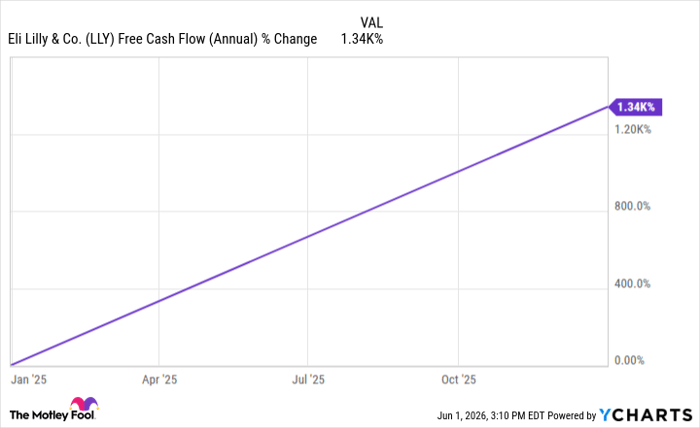
Eli Lilly's free cash flow has soared over the past three years, partly thanks to its success in the weight-loss space.
LLY Free Cash Flow (Annual) data by YCharts
The company is using that money to plan for the future. Eli Lilly has been making strategic acquisitions, mostly outside of its core area of expertise. Thanks to these deals, it has bolstered its oncology, immunology, neuroscience, pain management, and other pipeline areas. Recently, it announced three new acquisitions that will grant it access to some promising infectious disease assets.
Eli Lilly is buying out Curevo, LimmaTech Biologics, and Vaccine Company, all three of which are privately held vaccine-focused biotech companies. The first, Curevo, is a corporation developing a promising shingles vaccine that could address the tolerability issues of current options.
LimmaTech Biologics is developing multiple vaccine candidates against various bacteria. Then there is the Vaccine Company, a biotech with a novel platform working on vaccines for various viruses, including the Epstein-Barr Virus. Eli Lilly could pay up to $3.8 billion in total (including upfront payments and potential milestones) for these three deals.
What this means for investors
The bears are right about at least one thing: Eli Lilly will eventually face competition in the weight-loss market that could erode its pricing power. And even if that weren't a problem, it will eventually lose patent exclusivity on its leading anti-obesity medicine, Zepbound, which should lead to declining sales, at least for a little while. However, the drugmaker is looking ahead and trying to address these challenges before they occur by diversifying its medicine lineup.
Brand-new products in other areas could help reduce Eli Lilly's exposure to its core market and keep its revenue and earnings afloat as its peers launch competing weight-loss therapies. The company is already making some progress along those lines. In the first quarter, several of Eli Lilly's medicines in other areas posted strong sales growth. That includes Ebglyss, a medicine for eczema, Kisunla, a therapy for Alzheimer's disease, and Jaypirca, a cancer drug.
True, for now, these represent a tiny portion of Eli Lilly's total revenue, but that could change over the long run with other brand-new approvals. And that's why Eli Lilly's recent acquisitions are so important. They won't all pay off. But at least some of them will eventually hit the market and become significant growth drivers. Consider, for instance, STC-004, an investigational candidate for the treatment of chronic pain. There are plenty of pain medications out there, but many, including opioid-based drugs, come with severe side effects. STC-004 is a non-opioid candidate.
The pain management niche of the pharmaceutical industry is massive. It will be worth about $90.5 billion this year, according to some estimates. That's the opportunity Eli Lilly could enter, provided STC-004 makes solid progress over the next few years. And that's just one of the many promising products in its pipeline. Meanwhile, the company's financial results remain excellent, and it pays a regular dividend, which has increased by 103.5% over the past five years.
Here's the takeaway for investors: even with Eli Lilly's work in weight loss dominating debates, there are other important reasons to consider the stock. And all things considered, in my view, Eli Lilly remains an attractive long-term option.
Should you buy stock in Eli Lilly right now?
Before you buy stock in Eli Lilly, consider this:
The Motley Fool Stock Advisor analyst team just identified what they believe are the 10 best stocks for investors to buy now… and Eli Lilly wasn’t one of them. The 10 stocks that made the cut could produce monster returns in the coming years.
Consider when Netflix made this list on December 17, 2004... if you invested $1,000 at the time of our recommendation, you’d have $449,393!* Or when Nvidia made this list on April 15, 2005... if you invested $1,000 at the time of our recommendation, you’d have $1,366,006!*
Now, it’s worth noting Stock Advisor’s total average return is 983% — a market-crushing outperformance compared to 212% for the S&P 500. Don't miss the latest top 10 list, available with Stock Advisor, and join an investing community built by individual investors for individual investors.
See the 10 stocks »
*Stock Advisor returns as of June 4, 2026.
Prosper Junior Bakiny has positions in Eli Lilly. The Motley Fool has positions in and recommends Eli Lilly. The Motley Fool has a disclosure policy.
Recommended Articles


