


Broadcom Slumps Nearly 14% After-Hours: Is It an AI-Created Golden Opportunity or a Waterfall?
TradingKey - After the U.S. market close on June 3, Broadcom ( AVGO.US) shares plummeted, at one point diving over 15% before finally closing down 13.78%. Financial data showed that second-quarter revenue reached $22.2 billion, up 48% year-over-year, marking its fastest quarterly growth in nine years. Adjusted earnings per share were $2.44, up 54% year-over-year, while the operating margin climbed to a record 67% and adjusted EBITDA reached $15.2 billion (representing 69% of revenue), both exceeding guidance.
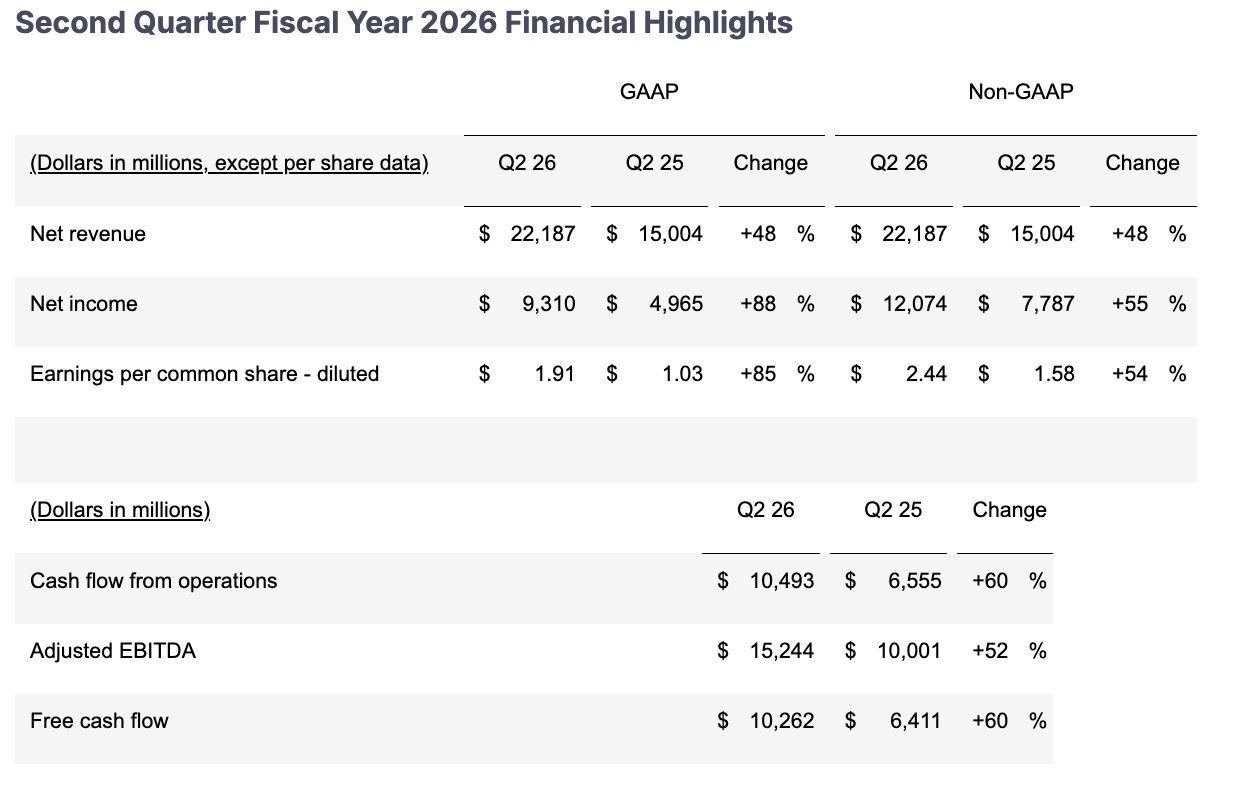
[Broadcom Financial Data, Source: FY2026 Q2 Financial Report ]
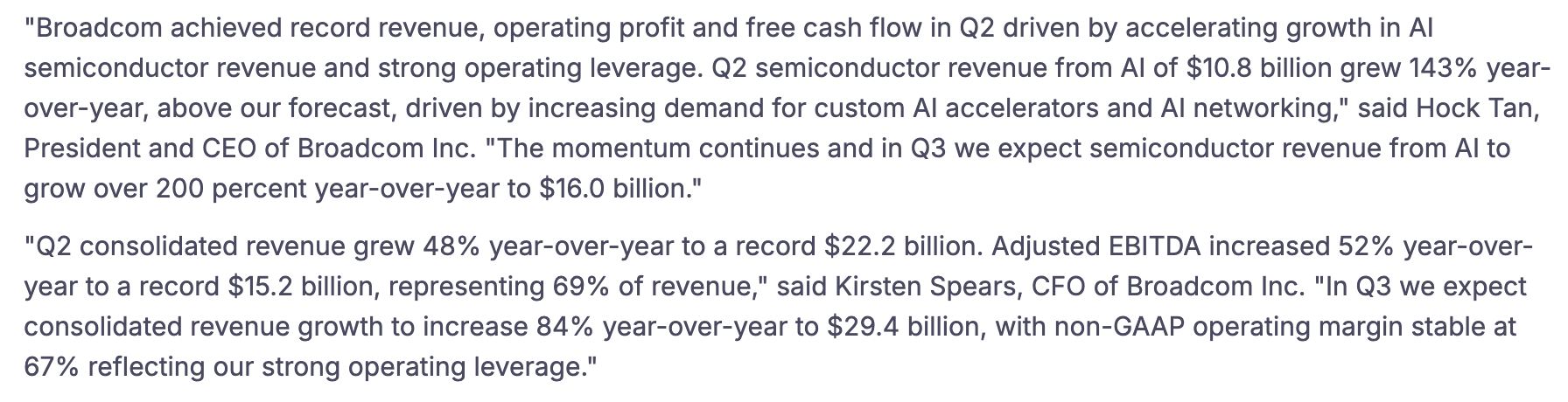
Hock Tan stated that AI semiconductor revenue reached $10.8 billion, up 143% year-over-year, marking thirteen consecutive quarters of growth and accounting for nearly half of total revenue.
Furthermore, operating cash flow was $10.49 billion and free cash flow was $10.26 billion, reflecting extremely robust cash flow performance.
Merely meeting expectations falls short of market expectations.
Following the earnings announcement, the stock suffered a massive sell-off. The crux of the issue was that market expectations were already anchored too high, and Broadcom failed to deliver the 'surprise' the market desired.
Prior to the earnings release, the stock had surged more than 65% from its late-March low, with a year-to-date gain of approximately 40%, adding over $300 billion in market value within just five trading days. Given this razor-thin margin for error, the market was anticipating a report that 'beat across the board,' but the reality was a solid performance that 'largely met expectations.'
Core Divergence in Earnings Reports
The core disagreement regarding this earnings report is focused on two levels.
AI guidance fell short of overly optimistic market expectations. Broadcom expects AI semiconductor revenue to accelerate to $16 billion in the fiscal third quarter, representing a year-over-year increase of over 200%, yet this is still approximately 7% below the average analyst estimate of $17.2 billion; it maintained its full-year fiscal 2026 AI semiconductor revenue guidance at $56 billion, which is lower than some market forecasts of $57.6 billion.
During the second-quarter earnings call, CEO Hock Tan officially confirmed to the market that Broadcom will only provide "chips only" in the future, rather than the previously promised complete AI integrated systems.
This strategic shift directly impacted high market expectations for Anthropic-related chip projects. The guidance provided by Broadcom has yet to fully bridge this gap in expectations.
Market analysis suggests the sharp decline did not stem from weakness in the earnings report itself, but rather because market expectations for Broadcom were already extremely high, and any guidance that failed to beat expectations by a significant margin could trigger profit-taking.
Fundamentals have not stalled.
Behind the sell-off sentiment, the message conveyed by management during the earnings call was far from pessimistic. Hock Tan explicitly stated that "demand for XPUs and networking equipment is simply insatiable," revealing that new AI semiconductor orders for the quarter exceeded $30 billion, far surpassing the $10.8 billion in actual deliveries for the period.
Broadcom disclosed for the first time a detailed blueprint of its deep integration with six core customers: Google signed multi-generational long-term agreements for TPUs and AI networking equipment; Anthropic will acquire over 1 gigawatt of compute capacity, with an additional 5 gigawatts starting in 2027; OpenAI has received its first batch of mass-produced chips and pledged to deploy 1.3 gigawatts by 2027; and Meta will collaborate on the delivery of multiple generations of MTIA XPUs, aiming to deploy 3 gigawatts by the end of 2028.
Hock Tan reiterated that AI semiconductor revenue will "very easily" exceed $100 billion in fiscal year 2027. Visibility for these orders now extends into 2028, and the long-term certainty of the company's fundamentals remains unshaken despite quarterly guidance falling slightly short of expectations.
Golden Opportunity or Waterfall Decline?
Citi believes Broadcom will outperform the market in the second half of the year, with demand visibility extended to 2027, and maintains a "Buy" rating. HSBC raised its FY2026 ASIC revenue forecast to $46 billion and its FY2027 forecast to $100.2 billion, citing the core logic that ASIC revenue momentum will significantly strengthen in the second half of FY2026.
44 out of 45 institutions still maintain "Buy" or "Overweight" ratings, as Wall Street's medium-to-long-term pricing has not been significantly revised despite the marginal weakening of single-quarter guidance.
It should be noted that AI guidance is the core factor dragging down the stock price; despite overall results exceeding expectations, investors have doubts about the growth trajectory of AI revenue. Susquehanna had already lowered its FY2026 AI revenue forecast from $62.5 billion to approximately $55 billion prior to the earnings report, pre-emptively anticipating the direction of this guidance miss.
In the long run, Broadcom's recent plunge is not due to deteriorating fundamentals, but rather a sharp correction in the market's pricing of long-term certainty. The massive gains over the past few months pushed market expectations for AI business growth to unsustainably high levels, where any marginal weakening in guidance would trigger profit-taking. However, fundamental supports, such as an order backlog extending to 2028 and the unchanged $100 billion AI revenue guidance for 2027, remain intact.
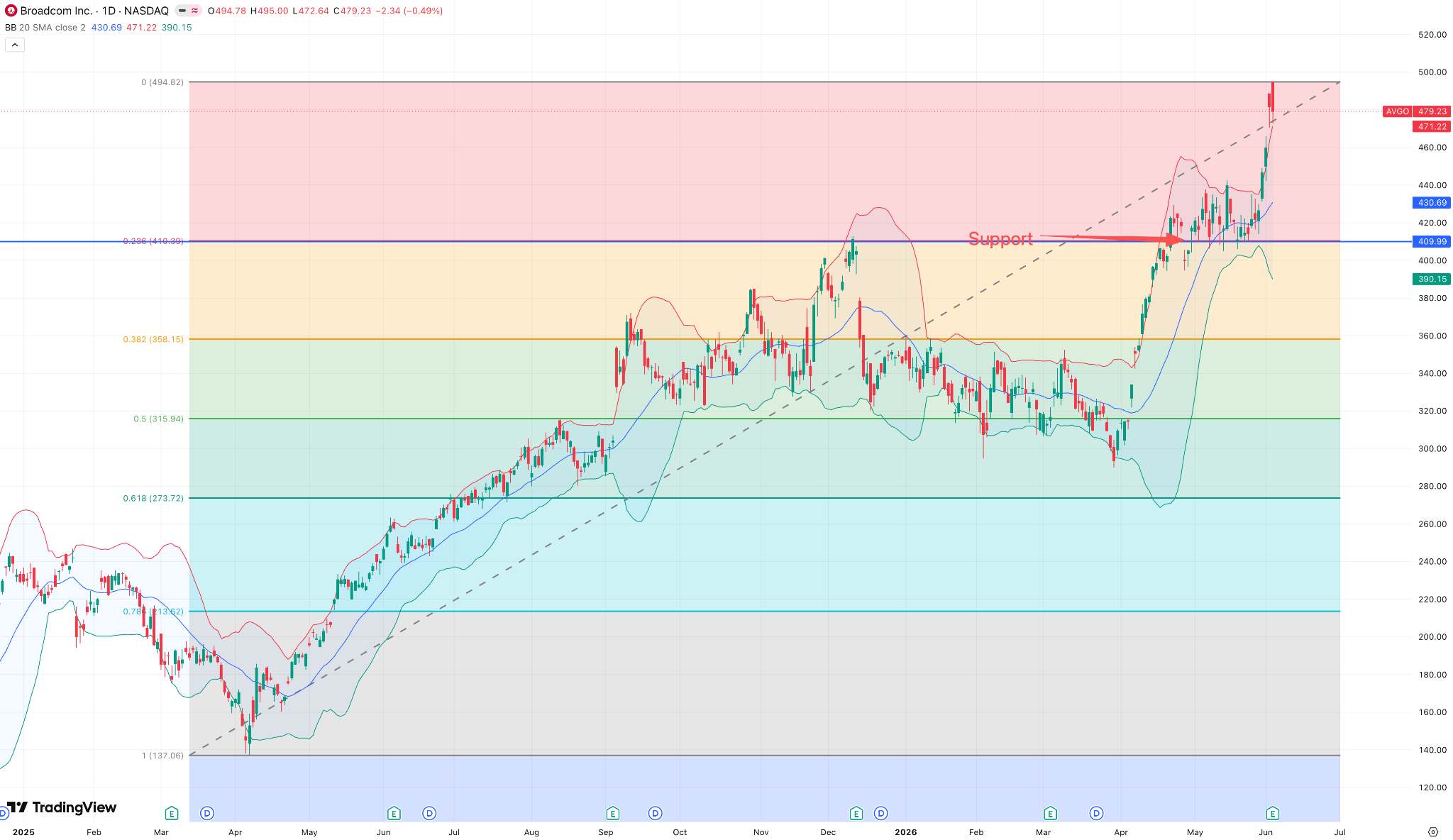
After-hours closing price: $413.21
Support level: $410
For investors focused on the AI infrastructure sector, Broadcom after this pullback offers a window to buy into long-term growth certainty at a more reasonable valuation; for short-term traders, the trade on the gap in expectations triggered by AI guidance has not been fully priced in, and the rebalancing of positions in the days following the earnings report still requires patient observation.
Recommended Articles


