


The Best Dividend ETF to Invest $1,000 in Right Now
Key Points
The Schwab U.S. Dividend Equity ETF (SCHD) has high standards for entry into its portfolio.
The ETF is also much less tech-heavy than the S&P 500 and Nasdaq Composite.
Its dividend yield is routinely higher than that of other popular dividend ETFs.
- 10 stocks we like better than Schwab U.S. Dividend Equity ETF ›
Seeing your stocks appreciate is a great feeling because you can see you're making money, even if it's on paper for the time being. Making money regardless of how a stock price moves can be even better because you're not reliant on the sporadic nature of the market.
One of my favorite ways to invest is in dividend-focused ETFs because they provide steady income while minimizing some of the risks of investing in individual stocks. There are plenty of dividend ETFs to choose from, but the one I'd invest $1,000 in right now is the Schwab U.S. Dividend Equity ETF (NYSEMKT: SCHD).
Will AI create the world's first trillionaire? Our team just released a report on the one little-known company, called an "Indispensable Monopoly" providing the critical technology Nvidia and Intel both need. Continue »
It has the qualities to thrive amid the uncertainty we're witnessing right now in the market, the economy, and geopolitics.
Image source: Getty Images.
An approach that emphasizes quality and sustainability
SCHD is a selective ETF that doesn't pick companies solely for high dividend yields. Instead, it requires companies to have at least 10 consecutive years of dividend increases and a strong balance sheet. That helps ensure it avoids yield traps (high yields because of bad stock performance) and protects against sudden cuts.
The criteria lead SCHD to hold more value companies than high-growth (and expensive) tech companies, which now dominate major indexes like the S&P 500 and Nasdaq Composite. The top five holdings in these indexes are Nvidia, Apple, Microsoft, Amazon, and Alphabet, while SCHD is led by Qualcomm, Texas Instruments, UnitedHealth Group, Coca-Cola, and Merck. Here is how the sector representation differs between the three:
| Sector | Percentage of SCHD | Percentage of S&P 500 | Percentage of Nasdaq Composite |
|---|---|---|---|
| Consumer Staples | 18.7% | 4.9% | 5.7% |
| Health Care | 18.3% | 8.5% | 5.9% |
| Information Technology | 15.6% | 34.9% | 48.8% |
| Energy | 14.7% | 3.4% | 0.6% |
| Industrials | 10.9% | 8.8% | 3.7% |
| Financials | 9% | 10.1% | 3.4% |
| Consumer Discretionary | 6.7% | 10.1% | 13.2% |
| Communication Services | 6% | 11% | 15.5% |
| Utilities | 0% | 2.4% | 1.0% |
| Real Estate | 0% | 0% | 0.7% |
| Materials | 0% | 1.9% | 1.0% |
Data sources: Charles Schwab, Vanguard, and Fidelity. SCHD percentages as of March 31; S&P 500 and Nasdaq Composite as of April 30.
SCHD's focus is on producing income, not outperforming the market
SCHD has typically underperformed the market in terms of stock price growth (though it's noticeably outperforming so far this year), but you can't deny how productive it has been as an income source, which is its main appeal. Of the three dividend ETFs with the most assets under management (AUM) -- SCHD, the Vanguard Dividend Appreciation ETF, and the Vanguard High Dividend Yield ETF -- SCHD's dividend yield has routinely been higher.
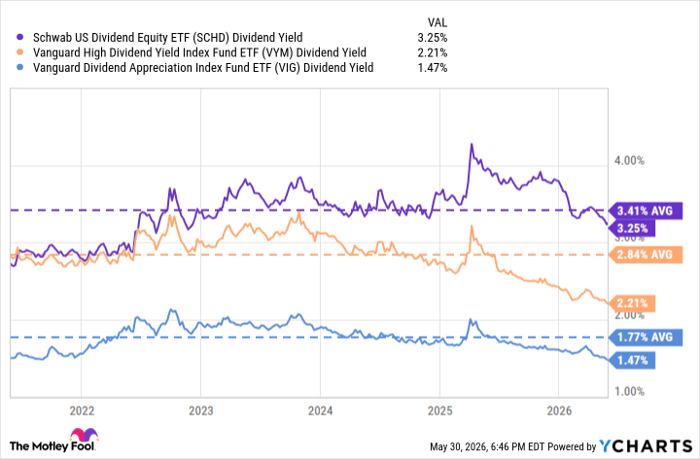
SCHD Dividend Yield data by YCharts
SCHD's dividend yield will inevitably fluctuate, but I fully expect it to maintain an above-average yield (relative to the S&P 500 average) and to return more than most of its peers. Its focus on high-quality companies makes SCHD an ideal ETF to hold regardless of broader market or economic conditions.
A $1,000 investment in SCHD today won't make you rich, but you can trust that it'll compound nicely over time.
Should you buy stock in Schwab U.S. Dividend Equity ETF right now?
Before you buy stock in Schwab U.S. Dividend Equity ETF, consider this:
The Motley Fool Stock Advisor analyst team just identified what they believe are the 10 best stocks for investors to buy now… and Schwab U.S. Dividend Equity ETF wasn’t one of them. The 10 stocks that made the cut could produce monster returns in the coming years.
Consider when Netflix made this list on December 17, 2004... if you invested $1,000 at the time of our recommendation, you’d have $449,393!* Or when Nvidia made this list on April 15, 2005... if you invested $1,000 at the time of our recommendation, you’d have $1,366,006!*
Now, it’s worth noting Stock Advisor’s total average return is 983% — a market-crushing outperformance compared to 212% for the S&P 500. Don't miss the latest top 10 list, available with Stock Advisor, and join an investing community built by individual investors for individual investors.
See the 10 stocks »
*Stock Advisor returns as of June 3, 2026.
Stefon Walters has positions in Apple, Coca-Cola, and Microsoft. The Motley Fool has positions in and recommends Alphabet, Amazon, Apple, Merck, Microsoft, Nvidia, Qualcomm, Texas Instruments, Vanguard Dividend Appreciation ETF, and Vanguard High Dividend Yield ETF. The Motley Fool recommends UnitedHealth Group. The Motley Fool has a disclosure policy.
Recommended Articles


