


1 Thing Broadcom Does Better Than Nvidia
Key Points
Broadcom's chips are custom-built for each of its data center customers.
Switching costs are higher for these custom chips than for Nvidia GPUs.
- 10 stocks we like better than Broadcom ›
Since 2022, Nvidia (NASDAQ: NVDA) has dominated the artificial intelligence accelerator market, and estimates still place its current market share at about 80%. However, other chipmakers are chipping away at its lead. Broadcom (NASDAQ: AVGO), which recently surpassed a market cap of $2 trillion, is now its biggest competitor.
Although Nvidia still offers the most popular general-purpose graphics processing units (GPUs), Broadcom's focus on custom silicon allows it to do one key thing better than its rival.
Will AI create the world's first trillionaire? Our team just released a report on the one little-known company, called an "Indispensable Monopoly" providing the critical technology Nvidia and Intel both need. Continue »
Image source: The Motley Fool.
Custom silicon creates sticky revenue
Nvidia may lead the AI chip market as a whole, but Broadcom is the leader in application-specific integrated circuits (ASICs), with about 70% market share. Broadcom serves as a design partner with hyperscalers and other AI companies that want chips custom-built to their specifications to handle highly specific types of workloads. It has deals with Alphabet, Meta Platforms, OpenAI, and Anthropic.
The development of such custom silicon is a lengthy process, requiring years of joint engineering between the AI company and Broadcom. The resulting chips are designed to fit the buyer's architecture and workload needs. Because the process is so involved, switching costs are high. If a Broadcom partner decided to switch to a different chip designer, it would need to redesign its chip.
Nvidia, on the other hand, sells standardized and versatile processors, including its current Blackwell architecture and the Vera Rubin platform, which combines both a GPU and a CPU, and is expected to ship later this year. Companies that buy Nvidia hardware aren't quite as locked into its ecosystem, though they do tend to build a lot of their software on its proprietary CUDA platform. Still, they could later switch to chips from Advanced Micro Devices, Intel, or a custom chipmaker, much more easily than Broadcom customers could move away from its custom chips.
Broadcom could lead the next phase of the AI build-out
The hyperscalers spending the most on AI infrastructure (Alphabet, Amazon, Meta, and Microsoft) are all investing heavily in custom chips. These are generally more energy efficient and cost less overall because they're built to each hyperscaler's expected needs. Given that Broadcom is the top custom chipmaker and already has partnerships with multiple hyperscalers, it stands to benefit the most from this shift in AI spending.
The company's recent results support this idea. Its AI revenue in the first quarter of 2026 was $8.4 billion, a 106% year-over-year increase. Management expects a jump to $10.7 billion in AI revenue in the second quarter, and has said that it has "line of sight to achieve AI revenue from chips, just chips, in excess of $100 billion in 2027."
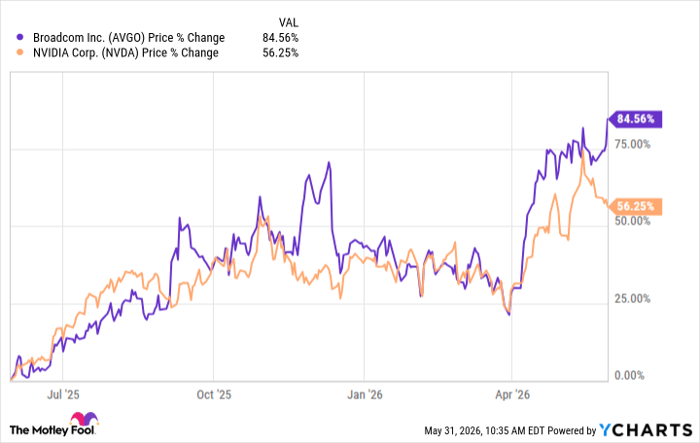
The recent performances of these two semiconductor stocks also show that the market is shifting Broadcom's way. Broadcom has outperformed Nvidia over the last year, with returns of 85% through May 29, 2026.
AVGO data by YCharts
Nvidia, to be clear, has its own advantages. Its earnings are consistently excellent, and it just reported record data center revenue of $75.2 billion for its fiscal Q1 2027 (which ended April 26). That was a 92% year-over-year increase. There's still a massive market of AI companies that are sticking to off-the-shelf solutions as opposed to custom chips.
Both companies are quality investments, and I have both stocks in my own portfolio. But I'm more excited about Broadcom at the moment, and I think it will be one of the biggest winners over the next three to five years.
Should you buy stock in Broadcom right now?
Before you buy stock in Broadcom, consider this:
The Motley Fool Stock Advisor analyst team just identified what they believe are the 10 best stocks for investors to buy now… and Broadcom wasn’t one of them. The 10 stocks that made the cut could produce monster returns in the coming years.
Consider when Netflix made this list on December 17, 2004... if you invested $1,000 at the time of our recommendation, you’d have $462,983!* Or when Nvidia made this list on April 15, 2005... if you invested $1,000 at the time of our recommendation, you’d have $1,375,447!*
Now, it’s worth noting Stock Advisor’s total average return is 993% — a market-crushing outperformance compared to 212% for the S&P 500. Don't miss the latest top 10 list, available with Stock Advisor, and join an investing community built by individual investors for individual investors.
See the 10 stocks »
*Stock Advisor returns as of June 3, 2026.
Lyle Daly has positions in Alphabet, Broadcom, Meta Platforms, and Nvidia. The Motley Fool has positions in and recommends Advanced Micro Devices, Alphabet, Amazon, Broadcom, Intel, Meta Platforms, Microsoft, and Nvidia. The Motley Fool has a disclosure policy.
Recommended Articles


