


This Economic Indicator Called 2 of the Worst Bear Markets in History -- and It's Flashing Red Again
Key Points
The S&P 500 is consistently reaching new all-time highs, but that could mean the market is becoming increasingly overvalued.
Historically, situations like these can sometimes lead to a severe downturn.
Nobody can predict the future, but it's wise to prepare your portfolio just in case.
- 10 stocks we like better than S&P 500 Index ›
The S&P 500 (SNPINDEX: ^GSPC) has reached yet another record high, surging by nearly 20% from its low point in late March, as of this writing.
All of this explosive growth has a hidden downside, however: It could mean that the market is overvalued right now. If that's the case, a pullback could be on the horizon.
Will AI create the world's first trillionaire? Our team just released a report on the one little-known company, called an "Indispensable Monopoly" providing the critical technology Nvidia and Intel both need. Continue »
While nobody can say exactly where stocks are headed in the near term, this economic indicator soared just ahead of the Great Depression and the dot-com bubble burst in the early 2000s -- and it's nearing yet another peak. Here's what that might mean for your investments.

Image source: Getty Images.
The stock market could be sounding a warning
The S&P 500 Shiller CAPE Ratio is a popular metric that compares the current price of the S&P 500 to its 10-year inflation-adjusted earnings, and it attempts to predict how future stock prices will fare.
A higher ratio suggests a higher valuation, and historically, stock prices tend to fall in the years after the CAPE ratio reaches a new peak. The metric surged dramatically in the late 1920s, surpassing 30 just before the market sank into the Great Depression. Then, in 1999, it reached an all-time high of 44 before the dot-com bubble burst, leading to one of the longest bear markets in S&P 500 history.
In recent months, the S&P 500 Shiller CAPE Ratio has been hovering around 40 -- the second highest level this metric has ever been.
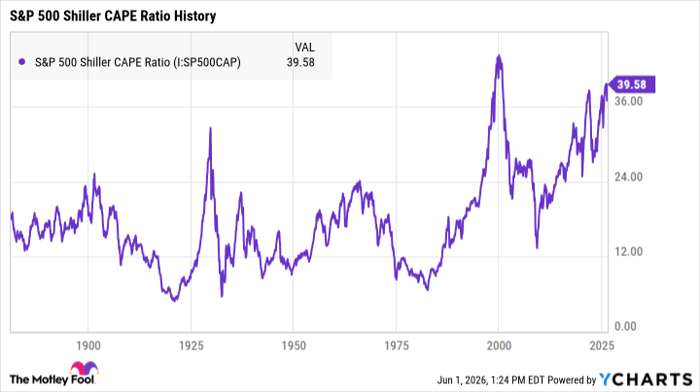
S&P 500 Shiller CAPE Ratio data by YCharts
With company valuations steadily creeping higher over the past couple of decades, it's not entirely surprising that the CAPE ratio is also closing in on a new all-time high. Higher valuations don't necessarily mean the market is overvalued, but with the metric nearing historic levels, investors should exercise caution.
What should investors do right now?
Regardless of how normal higher valuations may be, it's an incredibly expensive time to invest in the stock market. One year ago, for example, the Vanguard S&P 500 ETF cost around $542 per share. As of this writing, it's close to $700 per share. And high-flying stock Micron Technology has soared from around $94 per share one year ago to a staggering $1,034 today.
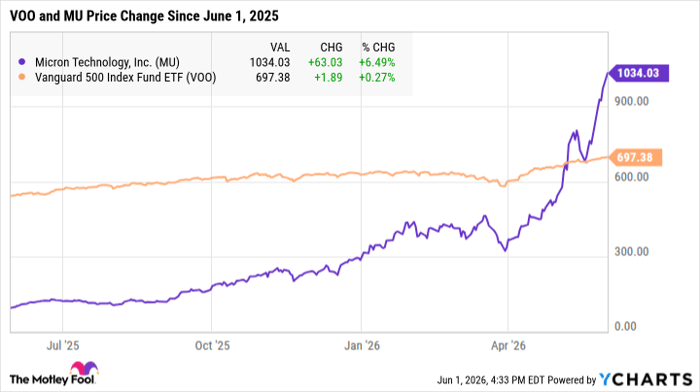
MU data by YCharts
That doesn't necessarily mean it's a bad time to buy, but it's especially important to research your potential investments carefully to ensure they're worth their prices. The market will eventually enter a downturn, and whenever that happens, stocks that are wildly overvalued will probably be hit the hardest.
The best thing investors can do right now is to thoroughly research each stock or fund you plan to buy. The strongest companies are built on robust foundations, and even if they take a tumble during a market pullback, they're more likely to rebound and earn positive long-term returns.
Preparation is key to long-term success in the stock market, and investing in strong companies significantly improves the chances that your portfolio will weather a potential recession or bear market.
Should you buy stock in S&P 500 Index right now?
Before you buy stock in S&P 500 Index, consider this:
The Motley Fool Stock Advisor analyst team just identified what they believe are the 10 best stocks for investors to buy now… and S&P 500 Index wasn’t one of them. The 10 stocks that made the cut could produce monster returns in the coming years.
Consider when Netflix made this list on December 17, 2004... if you invested $1,000 at the time of our recommendation, you’d have $462,983!* Or when Nvidia made this list on April 15, 2005... if you invested $1,000 at the time of our recommendation, you’d have $1,375,447!*
Now, it’s worth noting Stock Advisor’s total average return is 995% — a market-crushing outperformance compared to 212% for the S&P 500. Don't miss the latest top 10 list, available with Stock Advisor, and join an investing community built by individual investors for individual investors.
See the 10 stocks »
*Stock Advisor returns as of June 3, 2026.
Katie Brockman has positions in Vanguard S&P 500 ETF. The Motley Fool has positions in and recommends Micron Technology and Vanguard S&P 500 ETF. The Motley Fool has a disclosure policy.
Recommended Articles


