


What Higher-for-Longer Interest Rates Mean for Bank Stocks
Key Points
Most investors assume that bank stocks will do well if interest rates rise.
But there's much more to it.
Larger banks also operate other businesses aside from lending, which can also be affected by rates.
- These 10 stocks could mint the next wave of millionaires ›
Between 2008 and 2022, investors and analysts following bank stocks lamented that rates had been at zero or near-zero since the Great Recession, depressing bank earnings.
However, higher interest rates haven't exactly led to banks crushing it since that time. Obviously, the Silicon Valley Bank debacle in March 2023 raised fresh concerns about bank balance sheets, many of which were carrying unrealized bond losses.
Will AI create the world's first trillionaire? Our team just released a report on the one little-known company, called an "Indispensable Monopoly" providing the critical technology Nvidia and Intel both need. Continue »
While the Federal Reserve lowered its overnight benchmark lending rate (the federal funds rate) on multiple occasions last year, the Fed is now projected to leave rates in the current range of 3.50% to 3.75% for the rest of the year, with a rate hike now expected early next year.
Here's what that means for bank stocks.

Image source: Getty Images.
More than just higher rates -- it's about the yield curve
Many people will simply tie higher interest rates to success with bank stocks, but it's much more nuanced than that. It has more to do with the yield curve, which maps the various yields of U.S. Treasury bills, notes, and bonds.
The longer a bond's duration, the higher the yield, because investors are lending money for longer and therefore need to be compensated at a higher rate to account for inflation.
But yields are influenced by the market demand for that specific bond or economic expectations, so they can fluctuate. While they're heavily influenced by the federal funds rate, they can move independently of it.
Most banks benefit when the yield curve is steep, meaning longer-term bonds yield more than shorter-term ones. That's because banks typically borrow on the shorter end of the curve and lend long-term.
Even though rates rose intensely in 2022 and 2023, the yield curve became inverted, which is a bad scenario for banks. A good place to look when assessing bank stocks is the difference between the yields on the two-year and 10-year U.S. Treasury notes.
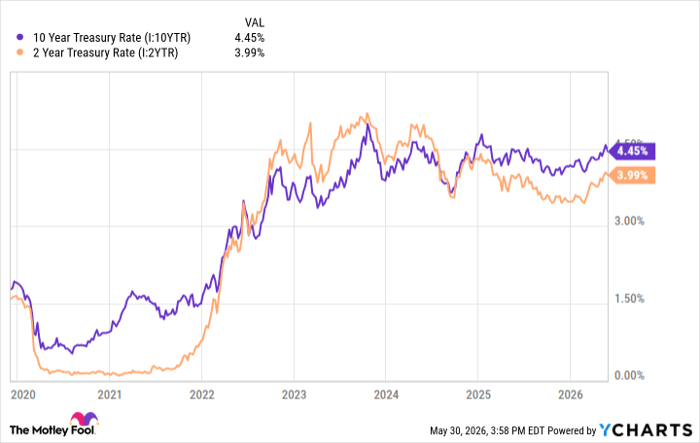
10 Year Treasury Rate data by YCharts
As you can see, the curve was inverted for a long time but began steepening in 2025. It looks to have narrowed a bit as of lately, but it isn't in a bad spot for banks.
In its first-quarter earnings results reported in mid-April, JPMorgan Chase guided for $103 billion in net interest income (NII) for the full year, a nearly 8% jump from last year.
NII is closely tied to rates and yields because it represents the spread banks earn from the difference between taking in deposits, issuing loans, and buying bonds.
Other ways rates can affect banks
In addition to NII, large banks like JPMorgan operate other businesses, such as investment banking and asset and wealth management.
Lower rates typically favor greater capital markets activity, bolstering initial public offerings and mergers and acquisitions, while market volatility can be more favorable for bank trading desks. The asset and wealth management desks of a bank tend to do well during bull markets.
Normally, lower rates lead to greater capital market activity and better stock market performance. This year, however, the market and capital markets have hung in there, but seemingly more to extraneous factors such as artificial intelligence.
Global IPO volume jumped 40% year over year in the first quarter of 2026, although the Iran war and expected higher-for-longer rate environment could slow things down for the rest of the year.
The other way that rates can affect banks is through their influence on consumers and businesses. The higher interest rates are, the higher borrowing costs are, and the more pressure consumers, businesses, and real estate will face, which can lead to depressed loan demand and higher loan losses.
Consumers are also grappling with affordability issues right now. Of course, these are just trends and not necessarily what happens every time.
Ultimately, a higher-for-longer rate environment with a steeper yield curve should boost NII but could also lead to higher loan losses and less consumer spending, though so far, consumers have held up pretty well.
As far as what happens to capital markets and the stock market, that's anyone's guess. Both are heavily influenced by AI, and no one knows how that will end.
Where to invest $1,000 right now
When our analyst team has a stock tip, it can pay to listen. After all, Stock Advisor’s total average return is 995%* — a market-crushing outperformance compared to 212% for the S&P 500.
They just revealed what they believe are the 10 best stocks for investors to buy right now, available when you join Stock Advisor.
See the stocks »
*Stock Advisor returns as of June 3, 2026.
JPMorgan Chase is an advertising partner of Motley Fool Money. Bram Berkowitz has no position in any of the stocks mentioned. The Motley Fool has positions in and recommends JPMorgan Chase. The Motley Fool has a disclosure policy.
Recommended Articles


