


These 2 Dividend ETFs Are Beating the S&P 500 -- Which Should You Buy?
Key Points
The Schwab U.S. Dividend Equity ETF and iShares Core High Dividend ETF have both outperformed the S&P 500 index so far in 2026.
Both dividend funds have delivered 14% annualized returns over the past three years.
The Schwab fund is more tech-heavy, which could make it the wrong choice for investors who want a lower-volatility portfolio.
- 10 stocks we like better than iShares Trust - iShares Core High Dividend ETF ›
Dividend stocks don't always beat the rest of the stock market. In the past few years, investors have placed a premium on growth stocks, like major tech names and artificial intelligence (AI) stocks. High-yield dividend stocks are often outside of this part of the market.
Instead of rapid growth, dividend stocks tend to offer lower volatility and steady income. The best dividend stocks are often in slower-growing sectors like energy, pharmaceuticals, and financial services.
Will AI create the world's first trillionaire? Our team just released a report on the one little-known company, called an "Indispensable Monopoly" providing the critical technology Nvidia and Intel both need. Continue »
But so far in 2026, two popular exchange-traded funds (ETFs) focused on dividend stocks are outperforming the broader S&P 500 index. The Schwab U.S. Dividend Equity ETF (NYSEMKT: SCHD) has delivered a total return of 19.7% year to date, while the iShares Core High Dividend ETF (NYSEMKT: HDV) has returned 14.1%.
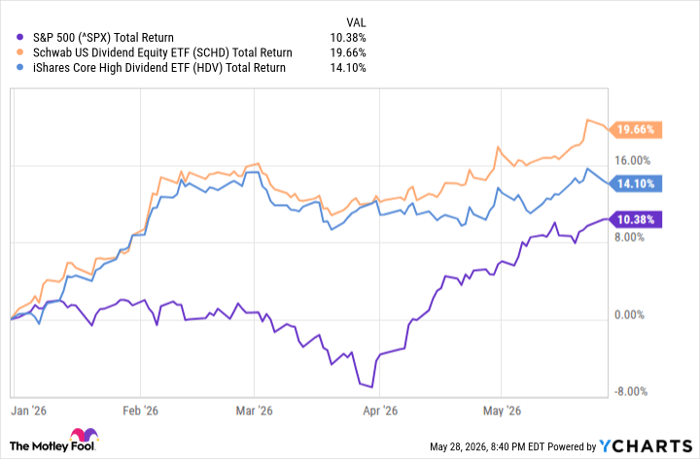
^SPX data by YCharts.
Both funds focus on U.S. stocks that are expected to pay higher-than-average dividend yields. And so far in 2026, they're delivering great results. Let's see which of these dividend stock ETFs is a better buy.

Image source: Getty Images.
1. iShares Core High Dividend ETF -- 74 stocks, 2.9% dividend yield
The iShares Core High Dividend ETF is a low-cost index fund that tracks a Morningstar index of high-yield dividend stocks. Its expense ratio is only 0.08%, and as of May 27, it holds 74 stocks that have delivered a trailing-12-month dividend yield of 2.9%.
This fund is heavy on non-tech stocks. Its top holdings by sector include:
- Consumer staples (24.5% of the fund)
- Energy (20.8%)
- Healthcare (16.9%)
- Financials (10.7%)
- Utilities (9%)
Information technology stocks make up only 8.7% of this ETF's assets. If you're concerned that other index funds like S&P 500 ETFs have become too top-heavy with AI and tech stocks, this fund could be a better way to diversify into other parts of the market.
The iShares fund's top five stock holdings (as of May 27) are:
- Energy majors ExxonMobil, at 8.1% of the fund, and Chevron, at 6.1%
- Healthcare stocks Johnson & Johnson at 5.7%, and AbbVie at 5.6%
- Consumer staples conglomerate Philip Morris, at 4.6%
The only tech stock in this ETF's top 10 holdings is Texas Instruments, which represents just over 4% of the fund's assets.
The iShares Core High Dividend ETF has delivered annualized returns of 14% over the past three years and 11.4% over the past five. During both of those longer time frames, the fund has underperformed the S&P 500.
2. Schwab U.S. Dividend ETF -- 103 stocks, 3.3% dividend yield
The Schwab U.S. Dividend ETF offers exposure to 103 stocks on the Dow Jones U.S. Dividend 100 Index, which tracks high-yield dividend stocks. This fund has delivered a trailing dividend yield of 3.3%.
Compared to the iShares fund, the Schwab U.S. Dividend ETF is a little heavier on tech stocks. Its top five sectors (as of March 31) are:
- Consumer staples (19.4% of the fund)
- Healthcare (18.8%)
- Energy (16.9%)
- Industrials (11.5%)
- Information technology (11.1%)
The Schwab U.S. Dividend ETF's top two stock holdings are both AI-related: Qualcomm (about 6.3% of the fund) and Texas Instruments (about 6.1%). Together, these two semiconductor stocks make up 12.4% of the fund's assets. The rest of the top five stock holdings are UnitedHealth Group (5.1% of the fund), Coca-Cola (4.1%), and Merck (3.9%).
This ETF has delivered annualized returns (by net asset value) of 14% over the past three years and about 9.1% over the past five years. Like the iShares fund, it has underperformed the S&P 500 index over those longer periods.
Why buy HDV instead of SCHD?
I don't own either of these ETFs, but if I had to choose one, I would buy the iShares Core High Dividend ETF. That's because my strategy in buying dividend funds would be to avoid AI stocks.
Buying HDV would let me get into other parts of the market that might be less affected by a possible tech downturn. The iShares fund is more diversified away from AI, while the Schwab fund has 12.4% of its assets in two semiconductor stocks.
Both dividend ETFs have strengths and upsides. Both charge low expense ratios. And both rank among the best dividend index funds. But the Schwab fund feels a little too top-heavy with AI stocks, which I believe defeats the purpose of buying a dividend fund. Based on this investing strategy, I'd go with the iShares Core High Dividend ETF.
Should you buy stock in iShares Trust - iShares Core High Dividend ETF right now?
Before you buy stock in iShares Trust - iShares Core High Dividend ETF, consider this:
The Motley Fool Stock Advisor analyst team just identified what they believe are the 10 best stocks for investors to buy now… and iShares Trust - iShares Core High Dividend ETF wasn’t one of them. The 10 stocks that made the cut could produce monster returns in the coming years.
Consider when Netflix made this list on December 17, 2004... if you invested $1,000 at the time of our recommendation, you’d have $463,900!* Or when Nvidia made this list on April 15, 2005... if you invested $1,000 at the time of our recommendation, you’d have $1,294,401!*
Now, it’s worth noting Stock Advisor’s total average return is 978% — a market-crushing outperformance compared to 211% for the S&P 500. Don't miss the latest top 10 list, available with Stock Advisor, and join an investing community built by individual investors for individual investors.
See the 10 stocks »
*Stock Advisor returns as of June 2, 2026.
Ben Gran has no position in any of the stocks mentioned. The Motley Fool has positions in and recommends AbbVie, Chevron, Merck, Qualcomm, and Texas Instruments. The Motley Fool recommends Johnson & Johnson, Philip Morris International, and UnitedHealth Group. The Motley Fool has a disclosure policy.
Recommended Articles


