


Party Like It's 1896: The Dow Turned 130, and Investors Can Celebrate with this ETF
Key Points
The Invesco Dow Jones Industrial Average Dividend ETF is a dividend-weighted spin on the Dow.
The dividend yield on the Invesco ETF is nearly double that of the traditional Dow Jones index.
It's proven an effective approach as the ETF has been an impressive performer over the long haul.
- 10 stocks we like better than Invesco Exchange-Traded Fund Trust - Invesco Dow Jones Industrial Average Dividend ETF ›
Happy belated birthday to the Dow Jones Industrial Average (DJINDICES: ^DJI). The original benchmark of U.S. blue chip stocks turned 130 years old on May 26.
The 30-stock index has long since been passed by the S&P 500 as the benchmark collection of domestic stocks. In addition to the obvious factor of breadth (500-plus stocks vs. 30), professional and retail investors alike focus on the S&P 500 because it is weighted by market capitalization, harnessing the market's collective wisdom. Conversely, Dow components are weighted by price, meaning the index member with the highest price tag -- in this case, Goldman Sachs -- receives the highest weight, and so on.
Will AI create the world's first trillionaire? Our team just released a report on the one little-known company, called an "Indispensable Monopoly" providing the critical technology Nvidia and Intel both need. Continue »

Celebrate the Dow's milestone birthday with this dividend ETF. Image source: Getty Images.
But there's another way of tracking the Dow. The Invesco Dow Jones Industrial Average Dividend ETF (NYSEMKT: DJD) offers an alternative to the price-weighted Dow.
Drilling down on DJD
The $451 million Invesco exchange-traded fund (ETF) turns 12 years old in December and tracks the Dow Jones Industrial Average Yield Weighted. As its name implies, the gauge weights Dow stocks by their respective "12-month dividend yield over the prior 12 months."
So it goes without saying that only blue chip dividend stocks are eligible for inclusion in this ETF. Sorry, Amazon. Until a dividend is initiated, you can't join the Dow dividend ETF.
Of course, weighting stocks by yield and not price results in material differences between the Invesco fund and the traditional Dow. For example, the dividend ETF's 30-day SEC yield of 2.57% is nearly double the 1.38% found on the standard Dow.
A higher yield is nice, but some investors may wonder whether a Dow ETF that assigns a 9.6% weight to Verizon Communications is a better alternative to the tried-and-true Dow. When comparing by the Sharpe ratio, which measures risk-adjusted performance, this dividend ETF shines.
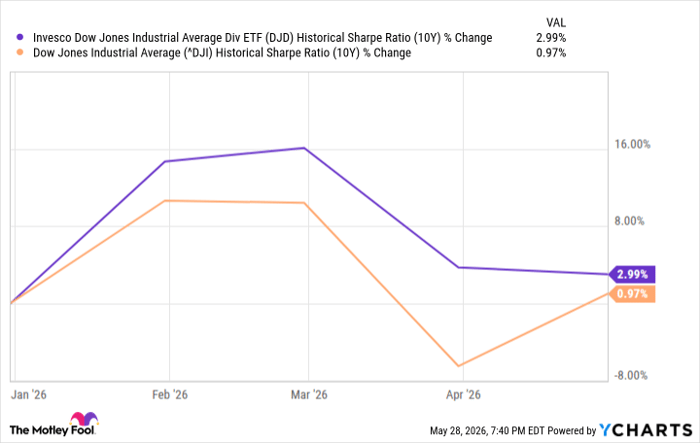
DJD Historical Sharpe Ratio (10Y) data by YCharts
From a pure performance perspective, the Invesco fund delivered for equity income investors. For the decade ended April 30, just seven other dividend ETFs outpaced this Dow dividend offering. That's even more impressive when you consider that the ETF allocates more than 31% of its lineup to defensive healthcare and consumer staples stocks. The standard Dow devotes just 17.3% of its weight to those sectors.
It's inexpensive to celebrate with DJD
This dividend ETF is arguably more versatile than it's given credit for by some investors. It can fill a void for investors who are heavily allocated to low-yielding growth stocks, as its weight to technology stocks is just 13.3% compared to 37.7% in the S&P 500.
Likewise, investors with significant Amazon exposure or those seeking a more defensive or value-oriented tilt to their portfolios may want to consider this fund.
This ETF may also be appealing to cost-conscious investors. Its annual fee is just 0.07%, or $7 on a $10,000 investment. That's toward the lower end for passive domestic dividend ETFs, which typically have yearly expense ratios ranging from 0.06% to 0.15%.
Should you buy stock in Invesco Exchange-Traded Fund Trust - Invesco Dow Jones Industrial Average Dividend ETF right now?
Before you buy stock in Invesco Exchange-Traded Fund Trust - Invesco Dow Jones Industrial Average Dividend ETF, consider this:
The Motley Fool Stock Advisor analyst team just identified what they believe are the 10 best stocks for investors to buy now… and Invesco Exchange-Traded Fund Trust - Invesco Dow Jones Industrial Average Dividend ETF wasn’t one of them. The 10 stocks that made the cut could produce monster returns in the coming years.
Consider when Netflix made this list on December 17, 2004... if you invested $1,000 at the time of our recommendation, you’d have $463,900!* Or when Nvidia made this list on April 15, 2005... if you invested $1,000 at the time of our recommendation, you’d have $1,294,401!*
Now, it’s worth noting Stock Advisor’s total average return is 978% — a market-crushing outperformance compared to 211% for the S&P 500. Don't miss the latest top 10 list, available with Stock Advisor, and join an investing community built by individual investors for individual investors.
See the 10 stocks »
*Stock Advisor returns as of June 1, 2026.
Todd Shriber has no position in any of the stocks mentioned. The Motley Fool has positions in and recommends Amazon and Goldman Sachs Group. The Motley Fool recommends Verizon Communications. The Motley Fool has a disclosure policy.
Recommended Articles


