


2 of the Best Transportation Stocks in 2026
Key Points
Both FedEx and J.B. Hunt are less vulnerable to rising fuel prices than many transportation companies because their business models allow them to offset or adapt to higher energy costs.
J.B. Hunt’s intermodal business is benefiting from growing “road-to-rail” freight conversion as customers search for more fuel-efficient shipping solutions.
Unlike speculative growth stocks, FedEx and J.B. Hunt are mature transportation businesses with durable infrastructure, real cash flow, and proven operating models.
- 10 stocks we like better than FedEx ›
Transportation stocks are rarely the most exciting names on Wall Street.
They don't instigate the same kind of excitement you might find in artificial intelligence or biotech stocks, but railroads, logistics firms, and freight operators consistently move trillions of dollars' worth of goods around the world. And there's nothing boring about that.
Will AI create the world's first trillionaire? Our team just released a report on the one little-known company, called an "Indispensable Monopoly" providing the critical technology Nvidia and Intel both need. Continue »
In fact, in 2026, there are two transportation stocks in particular that really stand out thanks to improving margins, pricing power, infrastructure advantages, and most importantly, lower exposure to surging fuel costs.
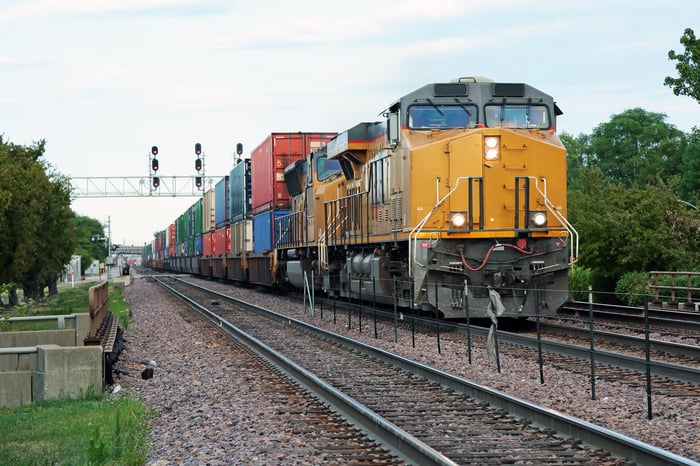
Image source: Getty Images.
Less than a truckload
For years, FedEx (NYSE: FDX) struggled with bloated costs, uneven margins, and an overly complicated operational structure.
In response, management spent the last several years aggressively streamlining the business through network consolidation, facility optimization, and large-scale cost-cutting efforts. As a result, the numbers have started to improve.
FedEx recently reported fiscal Q2 2026 earnings of $4.82 per share, beating analyst expectations by roughly 17%, while raising full-year adjusted EPS guidance to between $17.80 and $19.00.
But that's just the beginning.
One thing that's making FedEx more attractive is its FedEx Freight spinoff.
If you're unfamiliar, FedEx Freight specializes in "less-than-truckload" shipping, meaning it combines smaller shipments from multiple customers onto the same truck rather than dedicating an entire trailer to a single load.
FedEx Freight is expected to generate roughly $8.7 billion in annual revenue while targeting operating margins around 12%, making it one of the strongest less-than-truckload freight businesses in North America.
This is also the result of the company being less exposed to fuel-price volatility, because fuel surcharges are built into much of its shipping network.
In other words, when diesel or jet fuel prices rise sharply, FedEx often offsets part of that increase by charging customers more rather than absorbing the full cost itself. With oil prices likely to remain elevated for the foreseeable future due to geopolitical tensions and global supply uncertainty, this is not trivial.
Meanwhile, FedEx stock has surged more than 70% over the past year as investors rotate back into industrial and logistics stocks.
That combination of improving margins, restructuring execution, and freight-network scale is why FedEx remains one of the best transportation stocks in 2026.
Intermodal advantage
In an environment where fuel prices are likely to remain elevated for most of the year, J.B. Hunt Transport Services (NASDAQ: JBHT) could become one of the biggest beneficiaries in the freight industry.
That's because the company focuses heavily on intermodal shipping, which combines trucking and rail transportation to improve fuel efficiency and lower shipping costs.
Instead of relying entirely on long-haul trucking, freight containers are moved long distances by rail and then transferred to trucks for local delivery, significantly reducing diesel consumption. And right now, demand for intermodal shipping is rising as higher fuel costs and tighter trucking capacity push more freight customers toward rail-based transportation.
J.B. Hunt recently reported first-quarter 2026 revenue of $3.06 billion, up 5% year over year, while operating income climbed 16%. Earnings per share jumped 27% to $1.49.
The company's intermodal division remains its largest profit driver, generating approximately $1.5 billion in quarterly revenue. Operating income in the segment rose 21% year over year.
But again, you can't understate rising fuel costs here.
In recent earnings commentary, management specifically noted growing "road-to-rail conversion" as customers attempt to reduce transportation expenses amid higher diesel prices.
Unlike airlines or pure trucking operators, J.B. Hunt could actually benefit from higher fuel prices if more freight customers migrate toward intermodal solutions.
That positioning is exactly why the stock stands out in 2026.
Indeed, transportation stocks rarely generate the excitement of AI stocks or biotech start-ups.
But they often provide something equally important: established businesses with durable infrastructure, real cash flow, and pricing power.
In 2026, FedEx stands out due to its restructuring turnaround and logistics scale, while J.B. Hunt can actively capitalize on rising demand for intermodal shipping as fuel prices remain elevated.
These are not speculative moonshots. These are mature transportation businesses with durable infrastructure, real cash flow, and proven operating models that can safely handle extended fuel price volatility and even benefit from it to some degree.
Should you buy stock in FedEx right now?
Before you buy stock in FedEx, consider this:
The Motley Fool Stock Advisor analyst team just identified what they believe are the 10 best stocks for investors to buy now… and FedEx wasn’t one of them. The 10 stocks that made the cut could produce monster returns in the coming years.
Consider when Netflix made this list on December 17, 2004... if you invested $1,000 at the time of our recommendation, you’d have $460,826!* Or when Nvidia made this list on April 15, 2005... if you invested $1,000 at the time of our recommendation, you’d have $1,345,285!*
Now, it’s worth noting Stock Advisor’s total average return is 983% — a market-crushing outperformance compared to 207% for the S&P 500. Don't miss the latest top 10 list, available with Stock Advisor, and join an investing community built by individual investors for individual investors.
See the 10 stocks »
*Stock Advisor returns as of May 12, 2026.
Jeff Siegel has no position in any of the stocks mentioned. The Motley Fool recommends FedEx. The Motley Fool has a disclosure policy.
Recommended Articles


