


Inflation Just Hit Its Highest Level Since 2023. Here's What It Means for Your Portfolio.
Key Points
Inflation clocked in at 3.8% in April, driven by surging energy prices.
Stocks fell on the news, but have delivered monster gains over the last six weeks.
Fed Chair Jerome Powell has been sanguine about the energy shock, saying they are usually short-lived.
- 10 stocks we like better than S&P 500 Index ›
The April inflation report just threw a bucket of cold water on Wall Street's hot streak.
Coming into this morning, the S&P 500 (SNPINDEX: ^GSPC) had jumped 17% since the market bottom on March 30 from the Iran war, while the Nasdaq Composite (NASDAQINDEX: ^IXIC) had surged 26% as semiconductor stocks have gone parabolic. As of 1:54 p.m. ET, the S&P 500 was down 0.6% today, and the Nasdaq had lost 1.4%.
Will AI create the world's first trillionaire? Our team just released a report on the one little-known company, called an "Indispensable Monopoly" providing the critical technology Nvidia and Intel both need. Continue »
Rising gas prices have certainly been no secret, and they could now be the biggest risk facing the market. Before discussing that further, let's review the key numbers from the April Consumer Price Index (CPI) report.
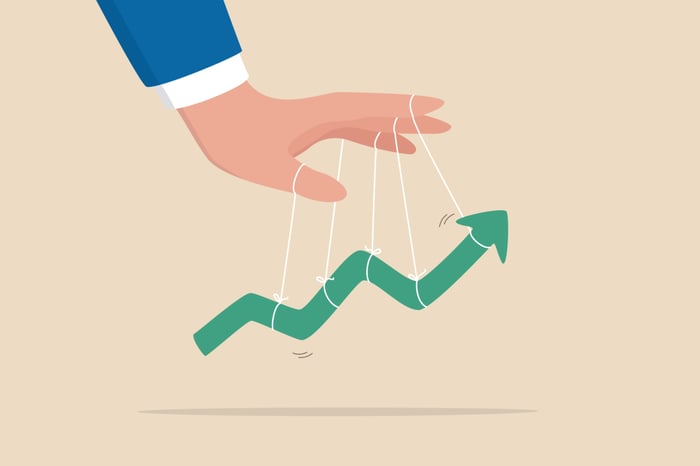
Image source: Getty Images.
What was April inflation?
For the month, prices rose 0.6%, or 3.8% on a year-over-year basis, essentially matching estimates and registering the highest reading since May 2023.
Energy prices soared 17.9% from a year ago, with gasoline up 28.4%, while core inflation, which excludes the volatile food and energy categories, rose 0.4% from March, or 2.8% from a year ago, showing core inflation accelerated as well. Food was also up 0.5% from March. Year-over-year, the fastest-growing non-energy prices were transportation, up 4.3%, and apparel, which rose 4.2%.
What inflation means for the stock market
Inflation represents a headwind for stocks for a number of reasons. First, higher prices act as a brake on the economy. The U.S. economy is driven by consumer spending, which makes up 70% of GDP, and higher prices naturally deter spending, especially on discretionary items like apparel, restaurants, and travel.
However, beyond its impact on the consumer economy, higher inflation generally makes it more likely that the Federal Reserve will raise interest rates, which cools the economy by deterring businesses and consumers from borrowing and spending to coax prices lower. Higher interest rates also tend to lead investors to rotate out of stocks and into bonds, since bond yields rise as interest rates go up.
It's unclear if this round of inflation will impact the Federal Funds rate. Outgoing Fed Chair Jerome Powell has indicated energy shocks like the current one are typically short-lived and therefore don't demand a response from the Fed, though presumably that could change if the crisis in the Middle East lasts longer than expected.
Generally, rising inflation is correlated with falling stock prices. Going back to the 1970s, stocks plunged in 1973-74 as the Arab oil embargo contributed to a spike in inflation. Stocks fell again in 1977 as prices began to rise, but then gained in the late 1970s alongside inflation. More recently, stocks tumbled in 2022 as inflation rose and pandemic tailwinds faded.
What should you do about inflation?
At this point, there's no reason to change your strategy or reorient your portfolio. This was just one month's report, and the cause of higher inflation -- the closing of the Strait of Hormuz -- is clear.
If inflation is sustained, it could start to do more meaningful damage to the economy and the stock market, but it's too early to assume that. The situation in Iran remains fluid, and the AI boom seems set to carry on, even with elevated oil prices.
Today's a good day to think long-term and leave your portfolio alone. The April inflation number is just one data point of many.
Should you buy stock in S&P 500 Index right now?
Before you buy stock in S&P 500 Index, consider this:
The Motley Fool Stock Advisor analyst team just identified what they believe are the 10 best stocks for investors to buy now… and S&P 500 Index wasn’t one of them. The 10 stocks that made the cut could produce monster returns in the coming years.
Consider when Netflix made this list on December 17, 2004... if you invested $1,000 at the time of our recommendation, you’d have $460,826!* Or when Nvidia made this list on April 15, 2005... if you invested $1,000 at the time of our recommendation, you’d have $1,345,285!*
Now, it’s worth noting Stock Advisor’s total average return is 983% — a market-crushing outperformance compared to 207% for the S&P 500. Don't miss the latest top 10 list, available with Stock Advisor, and join an investing community built by individual investors for individual investors.
See the 10 stocks »
*Stock Advisor returns as of May 12, 2026.
Jeremy Bowman has no position in any of the stocks mentioned. The Motley Fool has no position in any of the stocks mentioned. The Motley Fool has a disclosure policy.
Recommended Articles


