


AGNC Investment's 13% Dividend Yield Looks Tempting. Should Income Investors Actually Trust It?
Key Points
AGNC Investment is a mortgage REIT, which is a highly specialized subset of the REIT sector.
The mREIT is covering its 13%+ yield, but history is very clear about the long-term reliability of the dividend.
- 10 stocks we like better than AGNC Investment Corp. ›
AGNC Investment (NASDAQ: AGNC) is a well-respected mortgage real estate investment trust (REIT). In fact, over the long-term, the stock's total return has been very impressive, largely keeping pace with the S&P 500 Index's (SNPINDEX: ^GSPC) return.
AGNC is a solid option for investors looking to add some diversification to their portfolios. But the mREIT is not a great option for those seeking a reliable dividend stock. Here's why the 13%+ yield isn't likely to be a good option for income-focused investors.
Will AI create the world's first trillionaire? Our team just released a report on the one little-known company, called an "Indispensable Monopoly" providing the critical technology Nvidia and Intel both need. Continue »

Image source: Getty Images.
Total return requires dividend reinvestment
From a total return perspective, AGNC has done very well for investors. But total return requires dividend reinvestment. If you spend the dividends you collect, your results will be different. Notably, the mREIT's dividend has been highly volatile over time and has been trending downward for over a decade.
The stock price tends to track the dividend, meaning that investors who bought AGNC and used the dividend to cover living expenses have been left with less capital and income. Not the ideal mix for most dividend investors.
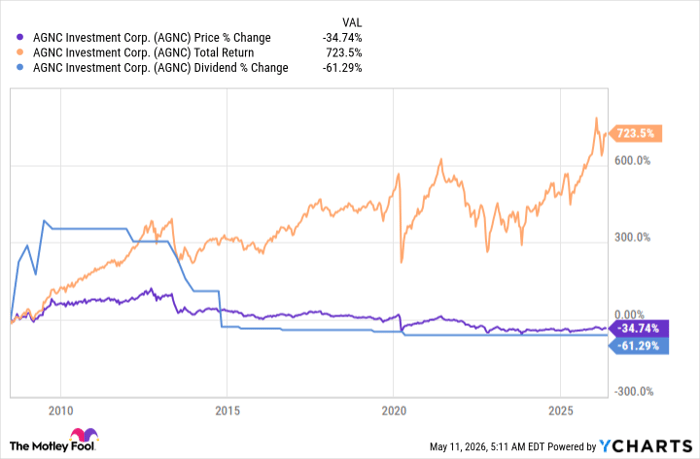
AGNC data by YCharts
Part of the problem here is the basic nature of mortgage REITs. AGNC manages a portfolio of mortgage securities that were created by pooling mortgages. Mortgages are self-amortizing loans, so each interest payment is really a mixture of interest and principal repayment. The dividends you collect from AGNC effectively contain a return of capital.
That said, the $0.42 net spread and dollar roll income per common share earned in the first quarter more than covered AGNC's $0.36 in dividends. That's a complicated metric, but it is basically similar to adjusted earnings for an industrial company. There's no immediate risk to the dividend. However, the net book value per share declined $0.50 in the quarter to $8.38. In the first quarter of 2016, roughly a decade ago, the net book value per share was $22.09 per share, and the dividend was $0.60 per share.
Dividend investors should tread with caution with AGNC
All in, AGNC Investment isn't a particularly reliable dividend stock. It is really a total return investment. It is particularly sensitive to changes in interest rates, as well, given their impact on bond values and the housing market. With a new Federal Reserve head on the horizon and the potential for rate changes, AGNC could be entering a turbulent period.
While many doubt that new Fed chair Kevin Warsh will be able to cut rates, such cuts would be a mixed blessing for AGNC. The value of the portfolio would likely increase, and the mREIT's borrowing costs would decline, but the interest the mREIT earns on new investments would come under pressure. The outcome might be supportive of the dividend from a big-picture perspective, but it would only further highlight the inherent volatility of AGNC as a dividend stock, given that rates go both up and down over time.
Should you buy stock in AGNC Investment Corp. right now?
Before you buy stock in AGNC Investment Corp., consider this:
The Motley Fool Stock Advisor analyst team just identified what they believe are the 10 best stocks for investors to buy now… and AGNC Investment Corp. wasn’t one of them. The 10 stocks that made the cut could produce monster returns in the coming years.
Consider when Netflix made this list on December 17, 2004... if you invested $1,000 at the time of our recommendation, you’d have $460,826!* Or when Nvidia made this list on April 15, 2005... if you invested $1,000 at the time of our recommendation, you’d have $1,345,285!*
Now, it’s worth noting Stock Advisor’s total average return is 983% — a market-crushing outperformance compared to 207% for the S&P 500. Don't miss the latest top 10 list, available with Stock Advisor, and join an investing community built by individual investors for individual investors.
See the 10 stocks »
*Stock Advisor returns as of May 12, 2026.
Reuben Gregg Brewer has no position in any of the stocks mentioned. The Motley Fool has no position in any of the stocks mentioned. The Motley Fool has a disclosure policy.
Recommended Articles


