


Is Taiwan Semiconductor Manufacturing a Buy, Sell, or Hold in 2026?
Key Points
Taiwan Semiconductor dominates the pure foundry market with 72% share.
The company's net profit margin exceeds 50%.
Its revenue growth streak is set to continue through 2026, with 30% growth over 2025 targeted.
- 10 stocks we like better than Taiwan Semiconductor Manufacturing ›
Even with all the chaos in the market this year so far, artificial intelligence (AI) stocks, both hardware and software, continue to surge to new highs.
While there are great stocks on both sides of the AI industry, and even a few like Alphabet that operate as both hardware and software companies, hardware remains the stronger way to play AI by my math.
Will AI create the world's first trillionaire? Our team just released a report on the one little-known company, called an "Indispensable Monopoly" providing the critical technology Nvidia and Intel both need. Continue »
After all, it doesn't matter which AI program a company adopts; they all need semiconductor chips, processors, and memory cards. And the biggest name in the hardware game is Taiwan Semiconductor Manufacturing (NYSE: TSM).
What's the Taiwanese giant's secret sauce? Read on and I'll tell you.
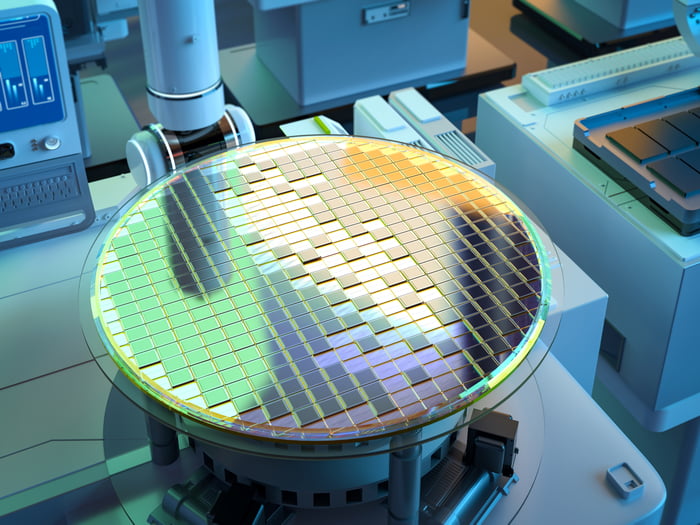
Image source: Getty Images.
Sometimes it pays to bet on Goliath
Taiwan alone accounts for 60% of all global semiconductor production and is responsible for producing 90% of the world's advanced semiconductor chips. Taiwan Semiconductor is the reason why.
The company controls 72% of the pure foundry chip market. Its nearest competitor, Samsung, controls just 7%.
As a pure foundry company, Taiwan Semiconductor doesn't design any of the chips it produces; it simply does the manufacturing work for other companies. And its list of clients is a who's who of everyone important in the AI hardware space.
To name just a few, Taiwan Semiconductor manufactures chips for Apple, Broadcom, Nvidia, and Qualcomm.
And while most of its manufacturing is done in Taiwan, the company has a global factory footprint. For instance, the company is in the process of expanding a gigantic factory in Arizona. That plant is where Nvidia's advanced Blackwell chips are produced.
"Giant" simply doesn't cut it at a certain point, and this absolute Goliath of the industry has blown well past that point. It has the balance sheet to prove it.
For 2025, the company generated over $122 billion in revenue and managed a net profit margin of 44.5%, and it has a total debt-to-equity ratio of 0.2, which is impressive considering that running all those semiconductor factories doesn't come cheap.
Taiwan Semiconductor released its results for the first quarter of 2026 on April 16 and, based on those results, its dominant hold on the semiconductor industry isn't coming to an end anytime soon. For the quarter, it generated net revenue of $35.9 billion, up 40.6% over Q1 2025.
Also in Q1 2026, Taiwan Semiconductor's earnings per share (EPS) surged 58.3%, and its net profit margin grew to 50.5%, which, again, is impressive considering the capital-intensive nature of the company's business.
For Q2, the company is targeting an operating margin of 56.5% to 58.5% and total revenue of $39 billion to $40.2 billion. For the remainder of this year, Taiwan Semiconductor is targeting 30% revenue growth over 2025.
So, is Taiwan Semiconductor a buy in 2026? Any way you slice it, the answer is yes, and many investors agree with me because, at the time of this writing, the stock is already up 30% year to date with no signs of slowing down.
Should you buy stock in Taiwan Semiconductor Manufacturing right now?
Before you buy stock in Taiwan Semiconductor Manufacturing, consider this:
The Motley Fool Stock Advisor analyst team just identified what they believe are the 10 best stocks for investors to buy now… and Taiwan Semiconductor Manufacturing wasn’t one of them. The 10 stocks that made the cut could produce monster returns in the coming years.
Consider when Netflix made this list on December 17, 2004... if you invested $1,000 at the time of our recommendation, you’d have $471,827!* Or when Nvidia made this list on April 15, 2005... if you invested $1,000 at the time of our recommendation, you’d have $1,319,291!*
Now, it’s worth noting Stock Advisor’s total average return is 986% — a market-crushing outperformance compared to 207% for the S&P 500. Don't miss the latest top 10 list, available with Stock Advisor, and join an investing community built by individual investors for individual investors.
See the 10 stocks »
*Stock Advisor returns as of May 10, 2026.
James Hires has positions in Alphabet. The Motley Fool has positions in and recommends Alphabet, Apple, Broadcom, Nvidia, Qualcomm, and Taiwan Semiconductor Manufacturing. The Motley Fool has a disclosure policy.
Recommended Articles


