


Dara Khosrowshahi Just Delivered Incredible News for Uber Stock Investors
Key Points
Almost 200 million people use Uber every month for ride-hailing, food delivery, and commercial freight delivery.
Now, the company is turning to autonomous vehicles to reduce the enormous cost of its human drivers.
Buying Uber stock might be one of the best ways for investors to capture value from this revolution.
- 10 stocks we like better than Uber Technologies ›
Uber Technologies (NYSE: UBER) operates the world's largest ride-hailing network, in addition to highly successful food delivery and commercial freight platforms. The company is facing the biggest transformation in its history thanks to autonomous vehicles and robots, which could lead to substantially higher revenue and earnings over the long term.
Uber released its operating results for the first quarter of 2026 (ended March 31) on May 6, and in his prepared remarks to investors, CEO Dara Khosrowshahi provided a very bullish progress update on the company's transition to autonomous solutions. Here's what he said, and what it means for Uber stock in the long run.
Will AI create the world's first trillionaire? Our team just released a report on the one little-known company, called an "Indispensable Monopoly" providing the critical technology Nvidia and Intel both need. Continue »

Image source: Getty Images.
Uber's autonomous business is scaling fast
Developing a safe and functional self-driving car is only part of the challenge for companies trying to succeed in the autonomous era. They also have to build a network capable of providing rides in a timely fashion whenever customers request them. Uber has all of this infrastructure in place already, which is why around 30 companies have chosen to deploy their autonomous cars and robots into its network.
The arrangement is a win for all parties. Uber's autonomous partners get immediate access to its 199 million monthly active users, saving them the trouble of building their own networks from scratch. And Uber gets to maintain its asset-light business model, because it will simply take a cut of every ride facilitated by its platform without having to develop its own autonomous vehicles in-house.
But that's not all. Uber reported $53.7 billion in gross bookings during the first quarter, which represented the dollar value of every ride, food order, and commercial delivery paid for through its platform. Based on historical data, around 44% (or $23.6 billion) of those bookings would have been paid to the human drivers who operate in its network, which is Uber's single highest cost.
After stripping out other costs, like the money paid forward to restaurants and retailers for their products, Uber was left with $13.2 billion in revenue in the first quarter. Then, after accounting for operating expenses like marketing, the company's operating income was just $1.9 billion. Simply put, Uber only pockets a fraction of its gross bookings.
If Uber completely eliminated the cost of its human drivers by deploying self-driving vehicles, it would have earned around $23.6 billion in extra revenue during the first quarter. Of course, it would have paid some of that money to the owners of the autonomous vehicles in its network, but that expense will probably be far cheaper than human drivers in the long run. Plus, self-driving vehicles can operate around the clock, meaning they can bring in a constant stream of bookings with minimal downtime.
Here's the good news. Khosrowshahi said autonomous trips on the Uber platform soared tenfold year over year during the first quarter. Self-driving cars are now live in eight global cities, with plans to expand to 15 cities by year-end. At this rate of growth, it won't be long before they have a substantial positive impact on the business.
It's not too late to buy Uber stock
Uber has partnered with some of the early leaders in the autonomous space, including Alphabet's Waymo. Waymo was one of the first providers to win regulatory approval to operate a fully autonomous ride-hailing service in the U.S., and it's now completing over 500,000 paid trips every week. Uber is also getting in on the ground floor in Europe, after partnering with Verne, which just launched the region's first autonomous ride-hailing service.
The autonomous transition is just getting underway, and Khosrowshahi said he expects it to be a multitrillion-dollar opportunity for Uber over the long term. As a result, the stock might be a great buy right now, especially given its attractive valuation. Uber's price-to-sales (P/S) ratio is just 3, which is a 25% discount to its average of 4.1 since the company went public in 2019.
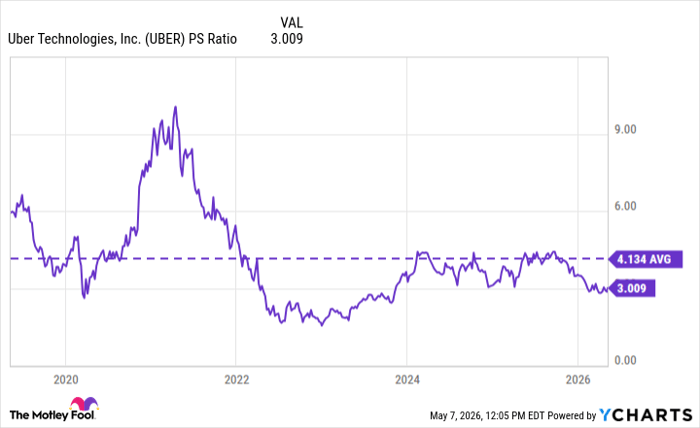
UBER PS Ratio data by YCharts
Uber is significantly cheaper than Tesla, which is another stock investors are buying to expose their portfolios to the autonomous revolution. That company is not only building its own self-driving robotaxis, but it also wants to develop its own ride-hailing network to potentially compete with Uber. However, with a P/S ratio of 14.8, Tesla's valuation is almost 5 times higher than Uber's.
As a result, buying Uber stock might be the best way for investors to capture the tremendous potential value from autonomous vehicles.
Should you buy stock in Uber Technologies right now?
Before you buy stock in Uber Technologies, consider this:
The Motley Fool Stock Advisor analyst team just identified what they believe are the 10 best stocks for investors to buy now… and Uber Technologies wasn’t one of them. The 10 stocks that made the cut could produce monster returns in the coming years.
Consider when Netflix made this list on December 17, 2004... if you invested $1,000 at the time of our recommendation, you’d have $471,827!* Or when Nvidia made this list on April 15, 2005... if you invested $1,000 at the time of our recommendation, you’d have $1,319,291!*
Now, it’s worth noting Stock Advisor’s total average return is 986% — a market-crushing outperformance compared to 207% for the S&P 500. Don't miss the latest top 10 list, available with Stock Advisor, and join an investing community built by individual investors for individual investors.
See the 10 stocks »
*Stock Advisor returns as of May 10, 2026.
Anthony Di Pizio has no position in any of the stocks mentioned. The Motley Fool has positions in and recommends Alphabet, Tesla, and Uber Technologies. The Motley Fool has a disclosure policy.
Recommended Articles


