


Medicare Advantage Is Tempting at 65. Here Is Why I Am Choosing Not to Enroll.
Key Points
When enrolling in Medicare, you need to choose between original Medicare and a Medicare Advantage plan.
There are pros and cons for each.
Don't miss the enrollment deadline.
- The $23,760 Social Security bonus most retirees completely overlook ›
As you approach age 65, you need to think about Medicare and what choices you will make when you enroll in the health insurance program. You can sign up for Medicare during a certain seven-month period: the month in which you turn 65, and the three months before and after it. Don't be late, because the penalty for missing the deadline can be severe.
I'm occasionally asked what I plan to do when I enroll in Medicare -- and my answer has actually changed over time.
Will AI create the world's first trillionaire? Our team just released a report on the one little-known company, called an "Indispensable Monopoly" providing the critical technology Nvidia and Intel both need. Continue »
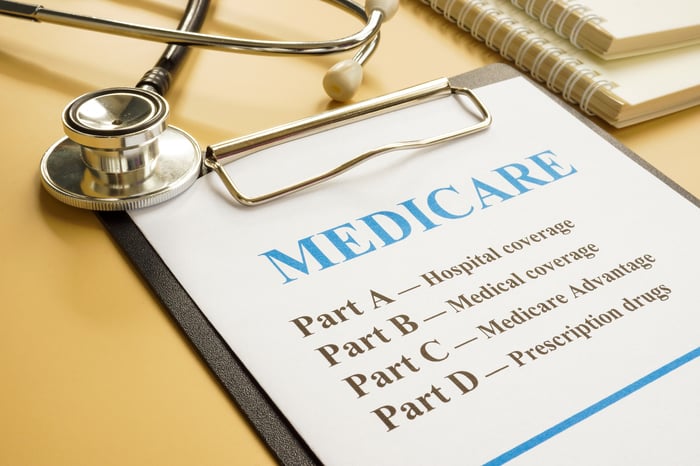
Image source: Getty Images.
Setting the stage -- original Medicare versus Medicare Advantage
First let's review the difference between the two options. When you enroll, you have to select either original Medicare, which features Part A (hospital coverage) and Part B (physician/medical insurance), or a Medicare Advantage plan, sometimes referred to as Part C. Those who sign up for original Medicare will typically add Part D, which covers prescription drugs, and they will frequently add a "Medigap" supplemental coverage plan, too.
Here are some upsides and downsides to each alternative:
Original Medicare
|
Pros |
Cons |
|---|---|
|
You often pay only 20% of expenses. |
There is no out-of-pocket spending cap, so you might end up spending many thousands, unless you buy a Medigap plan. |
|
It's generally accepted by every provider, anywhere in the U.S. |
Coverage is somewhat limited, with some routine exams not covered. |
|
You typically won't need a referral to see a specialist. |
Does not cover hearing, vision, or dental care. |
|
You generally won't need to have prior authorization for certain services or supplies. (This may be changing, though.) |
Medicare is testing prior authorization requirements in some states and may roll it out nationwide. |
Source: Author research.
Medicare Advantage
|
Pros |
Cons |
|---|---|
|
You can switch out of it to original Medicare at least annually. |
If you switch into original Medicare later, you may have to pay more for a Medigap plan -- or you may be denied that coverage altogether. |
|
Every Medicare enrollee pays for Part B coverage (which costs most enrollees $202.90 monthly in 2026), but otherwise, premiums can be as low as $0. |
If you're traveling, you'll likely not have providers in-network near you, though you're covered if you need to go to an emergency room. |
|
It typically offers more than original Medicare, such as coverage for hearing, vision, dental, and/or prescription drugs. |
Restricted to a network of providers and facilities, unless you pay more. |
|
Your out-of-pocket spending will be capped. The 2026 limit is $9,250 for in-network expenses (excluding drugs) or $14,750 if your plan allows you to see some out-of-network providers. Some plans may feature lower caps. |
You'll likely face co-pays at many appointments. |
|
Medicare Advantage plans are rated for quality, so you can shop for the best plans near you. |
You'll often need a referral to see a specialist. |
|
Having a Medicare Advantage plan can be simpler than having Original Medicare, plus Plan D, plus a supplemental plan. |
Your plan may deny you some care that original Medicare might have covered. (About 7.7% of prior authorization requests in 2024 were denied, though many decisions were reversed on appeal, per a Kaiser Family Foundation report. More recently, Health Affairs found denial rates surging to 17%, aided by artificial intelligence (AI).) |
Source: Author research.
My choice: original Medicare
I had been leaning toward a Medicare Advantage plan for many years -- as it has plenty of advantages, as you can see above. My mom is on a Medicare Advantage plan, too, and it's been great, costing her very little while offering dental, vision, and hearing coverage.
Here's why I'm now on team original Medicare: It's mainly because of the "Medigap," or supplemental, plans that many original Medicare enrollees sign up for. Original Medicare is quite generous, covering most of our medical expenses -- typically paying 80% and leaving members paying just 20%. That sounds pretty good. But...what if, say, you end up in the hospital for a while and are presented with a $600,000 bill for that? If you have to pay 20% of that, that's $120,000!
That kind of problem is why people buy those Medigap plans. The plans are offered by private insurance companies to cover and pay for some or much of what original Medicare doesn't. There are a variety of plans, offering different degrees of coverage, at costs generally ranging from around $100 to $300 per month.
Medicare members are allowed to switch between original Medicare and Medicare Advantage plans, during an annual election period. I had originally planned to start with a Medicare Advantage plan and then switch to original Medicare later if I wanted, getting a Medigap plan then. But I've now learned that my plan might not work so well: If you don't sign up for original Medicare at the outset, choosing a Medigap plan then, you may not be allowed to buy one later, or you might have to pay a lot more for it.
The best time to buy a Medigap plan is when you initially enroll in Medicare -- and in original Medicare. At that time, you can't be refused due to any pre-existing condition.
So that's why I'm planning on starting out with original Medicare -- and sticking with it. That's a key way that I'll be trying to keep my retirement healthcare costs down. Which Medicare plan to enroll in is a critical decision, so take some time to read up on it, consult with knowledgeable folks about it, and then decide what will serve you best.
The $23,760 Social Security bonus most retirees completely overlook
If you're like most Americans, you're a few years (or more) behind on your retirement savings. But a handful of little-known "Social Security secrets" could help ensure a boost in your retirement income.
One easy trick could pay you as much as $23,760 more... each year! Once you learn how to maximize your Social Security benefits, we think you could retire confidently with the peace of mind we're all after. Join Stock Advisor to learn more about these strategies.
View the "Social Security secrets" »
The Motley Fool has a disclosure policy.
Recommended Articles


