


Trump Administration Brokers. Intel and Apple Reach Chipmaking Agreement, Shares Surge More Than 13%
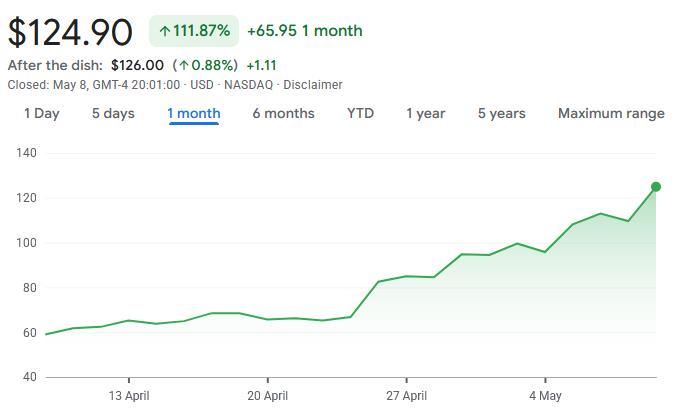
TradingKey - On Friday, Intel ( INTC) shares surged following news of a preliminary partnership agreement with Apple ( AAPL ), with the stock price jumping more than 13% intraday before closing up 13.96%, bringing its market capitalization to $627.8 billion.
Even more strikingly, its stock price has tripled since April, and with a cumulative gain of over 25% this week, it marked the first time since 1980 that the stock has recorded three consecutive weeks of gains exceeding 20%.
According to reports, Apple and Intel have reached a preliminary agreement for Intel to manufacture chips for some of Apple's devices. For Intel, Apple's endorsement is undoubtedly a significant boost for its revitalized foundry business; having previously struggled with lagging process technology and yield issues, this collaboration signifies that its 18A process has gained approval from the industry's most demanding customer.
Notably, the U.S. government played a key role as a catalyst in this partnership. As a major shareholder with an approximate 10% stake in Intel, the U.S. government has facilitated multiple collaborations between Intel and tech giants over the past year to promote the domestic chip manufacturing industry. Through active government mediation, Intel has now established partnerships with Apple, Nvidia ( NVDA) and all of Elon Musk's related ventures.
Apple and Intel Join Forces
After more than a year of intensive negotiations, Apple and Intel recently finalized a preliminary chip foundry agreement. However, specific details of the cooperation have not yet been disclosed, and it remains unknown which Apple products Intel will manufacture chips for.
The completion of this partnership was driven by strong support from the U.S. government. Last summer, the Trump administration converted nearly $9 billion in federal subsidies into Intel equity, becoming the largest single shareholder with a 10% stake.
Since then, U.S. Commerce Secretary Howard Lutnick has met multiple times over the past year with Apple CEO Tim Cook, Nvidia CEO Jensen Huang, and SpaceX chief Elon Musk to lobby them to enter into business partnerships with Intel. President Trump even personally recommended Intel to Cook during a White House meeting.
"I am bullish on Intel," he said, claiming that the U.S. government has already profited by tens of billions of dollars from its investment in Intel.
Trump stated: "Once we entered the fray, Apple followed suit, Nvidia joined in, and many of the industry's elite companies chose to partner with Intel."
Attracted by government backing, Intel had already reached agreements with Nvidia and Elon Musk’s companies. Last September, Nvidia invested $5 billion in Intel to collaborate on custom data center CPUs for Nvidia. Musk and Intel announced they would co-build a chip manufacturing plant in Texas to serve Tesla ( TSLA) and SpaceX's Terafab project.
Now that Apple has also finalized a deal, Intel has secured a trio of major tech giant partners.
In fact, Apple and Intel have a long-standing history; starting in 2005, Apple's Mac computers used Intel's x86 architecture CPUs. However, due to Intel's slow progress on the 10nm process, Apple launched its proprietary M1 chip in 2021 and gradually phased out Intel CPUs from the Mac product line.
Intel's Path to Resurgence
Over the past decade, Intel has suffered a series of blows, including technical roadmap missteps, frequent management turnover, and failed merger integrations. Its two core businesses—chip design and foundry services—have long underperformed. It was not until March 2025, when Lip-Bu Tan took over as CEO, that the former chip giant began its arduous path to revival.
Tan's early tenure was rocky; Donald Trump had publicly called for his replacement due to his ties to China. However, he gradually earned trust through a pragmatic communication style. Subsequently, the U.S. government announced it would take a 10% stake in Intel by converting nearly $9 billion in federal subsidies into equity, an endorsement that injected critical momentum into the company's future development.
After taking the helm at Intel, Tan quickly launched a series of sweeping reforms.
He overhauled the executive team, poaching senior executive Wei-Jen Lo from TSMC while replacing the product head and appointing new executives to lead the data center processor and client computing businesses, respectively. He also established a new custom chip division.
In terms of technology investment, he continued to double down on the company's most advanced "14A" process node in an effort to narrow the technical gap with industry leaders.
These measures have begun to bring positive changes to Intel. Its stock price has surged, making it the best-performing stock in the Philadelphia Semiconductor Index this year. Since the U.S. government's investment, the value of its stake has grown by approximately 500%.
Intel's advanced packaging business has also successfully attracted major customers such as Amazon ( AMZN ), Cisco ( CSCO ), and other major clients. Industry analysts believe that Intel may have passed its most difficult period and is now able to compete in the market as a reliable second-source supplier.
Apple Accelerates Expansion of Chip Foundry Channels
Currently, all of Apple's proprietary chips are still exclusively manufactured by TSMC ( TSM ), covering the full range of devices including iPhone, iPad, and Mac. However, in the face of ongoing chip supply pressures, Apple is actively expanding its backup supplier channels.
Apple CEO Tim Cook mentioned in the last two earnings calls that insufficient advanced chip capacity is the primary reason why iPhones cannot meet market demand, and this tightness is expected to persist through the current quarter, impacting the production of several Mac models. He also revealed that it might take several months for the Mac mini and Mac Studio models to reach a supply-demand balance; last Friday, the day after the earnings call, Apple raised the starting price of the Mac mini.
Apple has long been TSMC's core major customer, but as demand for TSMC's advanced process capacity from AI chip design companies like NVIDIA surges, Apple's bargaining power in securing stable foundry capacity has diminished.
With demand for AI chips currently skyrocketing, TSMC's wafer capacity is gradually becoming saturated. Global tech companies are competing intensely in the semiconductor field, and Apple is no exception.
Ben Bajarin, a chip analyst at Creative Strategies, believes that "Intel is the only company capable of serving as a reliable second supplier to expand capacity for Apple."
In February this year, David Tom, Apple's head of global procurement, was asked in an interview about whether the company is moving forward with Intel-manufactured chips; he responded, "We are always in communication with Intel," but did not disclose specific details of the negotiations. For Apple, reaching a foundry partnership with Intel would mean that its era of total reliance on TSMC for advanced chips has come to an end.
Intel is indeed rapidly ramping up capacity. Its new chip manufacturing plant in Chandler, Arizona, has begun mass production using Intel's most advanced 18A process, aiming to compete with TSMC's 2nm process, which is currently only produced in Taiwan.
Bajarin speculates that Apple is likely to wait for Intel's next-generation 18A-P process, which is expected to reach mass production as early as next year. He believes Intel's current 18A process "still has room for optimization," while 18A-P "has improved upon many existing issues."
Evercore ISI analyst Amit Daryanani believes these unconfirmed partnership rumors are a positive signal for Apple, providing "long-term supply chain resilience, more foundry choices, and greater flexibility during future device production ramps."
Recommended Articles


