


The Best AI Chips Stocks to Buy Right Now in 2026
Key Points
Micron Technology and Sandisk are witnessing remarkable demand for their memory chips.
The two companies are also benefiting from a highly favorable pricing environment.
Intel's processors are gaining ground in AI data centers for their efficiency in handling inference workloads.
- 10 stocks we like better than Intel ›
The proliferation of artificial intelligence (AI) has supercharged the semiconductor industry in recent years. That isn't surprising, as chips are the basic building blocks of AI applications.
From training AI models to running inference applications to storing and moving data, chips are essential at every step of the AI lifecycle. Simply put, there won't be any large language models (LLMs) or AI software to boost productivity in the absence of semiconductors, which explains why the PHLX Semiconductor Sector index's 273% gain over the past three years has obliterated the 78% jump in the S&P 500 index.
Will AI create the world's first trillionaire? Our team just released a report on the one little-known company, called an "Indispensable Monopoly" providing the critical technology Nvidia and Intel both need. Continue »
The good news for investors is that AI chips remain in high demand to support the build-out of AI data center infrastructure and edge hardware. Market research firm Gartner projects that the semiconductor industry's revenue could grow by 64% in 2026 to $1.32 trillion. That's why it is a good time to buy some top semiconductor stocks, and here are three to consider now.

Image source: Intel.
Storage and memory demand are going to fuel terrific growth for these companies
Spending on memory chips is poised to jump from $216 billion last year to $633 billion in 2026, according to Gartner. Memory chips are used for both computing tasks and for storing large datasets to support AI workloads. The demand for both these kinds of chips is so strong that Micron Technology (NASDAQ: MU) and Sandisk (NASDAQ: SNDK) are enjoying exponential growth.
Micron makes both dynamic random-access memory (DRAM), a key component in AI accelerator chips that enable them to process massive data volumes quickly, and NAND flash storage chips. DRAM is the larger component of Micron's business, accounting for 79% of its top line in the last reported quarter.
The favorable pricing and demand in both DRAM and NAND explain why Micron's earnings in the second quarter of fiscal 2026 (which ended on Feb. 26) jumped by almost 8x year over year to $12.20 per share. Micron's guidance of $19.15 in earnings per share for the current quarter points toward a stronger year-over-year jump of 10x.
Meanwhile, AI data centers are running out of chips to store the huge amounts of data needed for AI model training and inference. This has turned out to be a massive tailwind for Sandisk, which reported its fiscal 2026 Q3 results (for the three months ended April 3) on April 30. The company's revenue rose 251% year over year to $5.95 billion. Even better, it posted non-GAAP (adjusted) earnings of $23.41 per share, compared with a loss of $0.30 per share in the year-ago period.
The need for storage in AI data centers is so solid that Sandisk's customers are now awarding long-term contracts. The company has signed five multiyear supply agreements this year already. The contractual value of the three contracts that it signed in the previous quarter was worth an impressive $42 billion. That's quite substantial, considering that Sandisk has clocked just over $13 billion in revenue over the past year.
Also, the favorable memory pricing environment isn't going away, as supply shortages are expected to last at least until next year. This tells us why Sandisk's earnings are on track to increase by over 20x in the current fiscal year, followed by a 2.6x jump in the next one, as per consensus estimates.
So, buying this AI stock is a no-brainer as it is poised to jump higher following a 5x surge this year.
Inference demand has supercharged this semiconductor giant once again
It initially appeared that Intel (NASDAQ: INTC) could miss out on the AI gravy train, but a jump of over 5x in its stock price over the past year clearly shows it has become one of the hottest chip stocks on the market. The reason behind Intel's surge is simple -- the company's turnaround strategy is bearing fruit, and the demand for its processors is exceeding supply.
Intel's server central processing units (CPUs) are now being deployed in AI data centers to run inference workloads. Additionally, Intel has been developing custom AI processors, and this move is paying off nicely for the company. Intel's revenue from sales of application-specific integrated circuits (ASICs) nearly doubled on a year-over-year basis in Q1. This business has already achieved a $1 billion annual revenue run rate.
Investors will do well to note that the market for server CPUs and ASICs is growing nicely, as these chips are better at performing inference tasks in a more cost-efficient manner compared to graphics cards. So, Intel's data center and AI (DCAI) business segment could keep growing at a healthy pace in the long run, following a 22% year-over-year increase in revenue in the previous quarter to $5.1 billion.
The growing traction of the company's AI chips has led analysts to become bullish about its prospects.
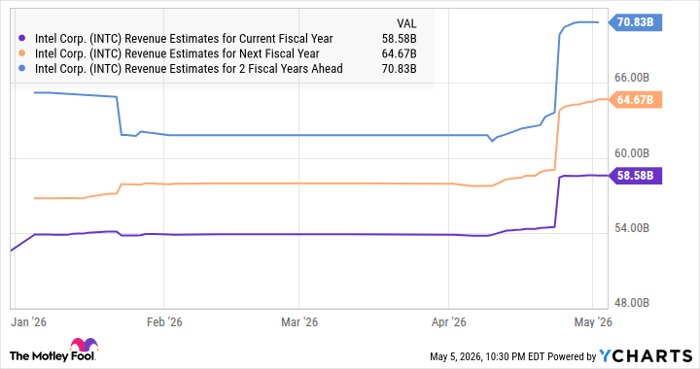
INTC Revenue Estimates for Current Fiscal Year data by YCharts
So, don't be surprised to see Intel stock sustain its impressive momentum for the rest of the year, as it improves production capacity and churns out more AI chips to meet the solid demand it is witnessing.
Should you buy stock in Intel right now?
Before you buy stock in Intel, consider this:
The Motley Fool Stock Advisor analyst team just identified what they believe are the 10 best stocks for investors to buy now… and Intel wasn’t one of them. The 10 stocks that made the cut could produce monster returns in the coming years.
Consider when Netflix made this list on December 17, 2004... if you invested $1,000 at the time of our recommendation, you’d have $475,926!* Or when Nvidia made this list on April 15, 2005... if you invested $1,000 at the time of our recommendation, you’d have $1,296,608!*
Now, it’s worth noting Stock Advisor’s total average return is 981% — a market-crushing outperformance compared to 205% for the S&P 500. Don't miss the latest top 10 list, available with Stock Advisor, and join an investing community built by individual investors for individual investors.
See the 10 stocks »
*Stock Advisor returns as of May 8, 2026.
Harsh Chauhan has no position in any of the stocks mentioned. The Motley Fool has positions in and recommends Intel and Micron Technology. The Motley Fool recommends Gartner. The Motley Fool has a disclosure policy.
Recommended Articles


