


Nvidia vs. Palantir: The Better AI Stock to Own in 2026
Key Points
Nvidia and Palantir have seen their share prices soar in the triple and quadruple digits in recent years.
Their shares struggled earlier this year amid various headwinds.
- 10 stocks we like better than Nvidia ›
Nvidia (NASDAQ: NVDA) and Palantir Technologies (NASDAQ: PLTR) both were superstars in the early days of the artificial intelligence (AI) boom. This is because they were among the first to benefit from the revenue opportunity -- and as a result, investors rushed to get in on their shares. Nvidia stock has soared more than 500% over the past three years, while Palantir has surged 1,700%.
But in recent times, these AI powerhouses have faced a variety of challenges, from investors worrying about their valuations to concerns that demand for AI would decline. On top of this, war in Iran and uncertainty about the U.S. economy prompted many investors to turn away from riskier stocks -- such as AI players.
Will AI create the world's first trillionaire? Our team just released a report on the one little-known company, called an "Indispensable Monopoly" providing the critical technology Nvidia and Intel both need. Continue »
All of this has weighed on the performance of both Nvidia and Palantir. Nvidia, after falling in the first quarter, has returned to positive territory and is up about 5% year to date. Palantir, however, hasn't yet recovered and today is down more than 20% since the start of the year.
Considering the full picture, which of these two stocks is the best to own in 2026? Let's find out.

Image source: Getty Images.
The case for Nvidia
Nvidia sells the key product that's powering the AI revolution, and that's the AI chip. These chips are needed to make key tasks happen, such as the training and inference of models. Of course, many chip designers exist, but Nvidia dominates the market because it sells the most powerful of AI chips.
In a wise decision about a decade ago, Nvidia decided to design graphics processing units (GPUs) specifically for AI. This put it in the leading position from the get-go, and the company's commitment to innovation has kept it ahead of rivals.
All of this has translated into surging revenue and high profitability. In the latest quarter, for example, Nvidia delivered a 73% increase in revenue to $68 billion, and this is with gross margin consistently exceeding 70%.
As for maintaining its lead well into the future, Nvidia is taking smart steps. The company is continually broadening its reach by offering a wide range of AI products, so that customers can turn to Nvidia for all of their AI needs.
Meanwhile, the declines in the stock have brought it to a dirt cheap valuation, trading at only 23x forward earnings estimates.
The case for Palantir
Palantir sells government and commercial customers software that helps them turn their data -- even very disparate data -- into a valuable partner. This software aggregates and analyzes a customer's data and puts it to work, helping that customer tackle many tasks, such as reorganizing workflow or predicting maintenance of equipment. The possibilities are endless.
All of this has helped Palantir's offerings appeal to a wide range of customers, from the U.S. government to hospitals and corporations. And Palantir's introduction of its Artificial Intelligence Platform (AIP) a few years ago, a system that adds large language models to the process, supercharged growth. Customers see this as a fast, easy way to apply AI to their needs, so they've rushed to Palantir.
Palantir's earnings reflect this, with revenue and profit climbing quarter after quarter -- and customer count and deal size also are on the rise. In the company's early days, it relied mainly on government contracts for business, but these days the government and commercial businesses are delivering enormous levels of growth.
Palantir's stock decline has led to a drop in valuation, but valuation remains considerably high at today's level of 94x forward earnings estimates.
Which stock is the best one to own in 2026?
Both of these players offer investors bright long-term prospects. But if we're betting on 2026 performance, I would favor Nvidia. For two reasons. First, I think Palantir's valuation may continue to weigh on the stock, while Nvidia's valuation offers a clear, cheap entry point.
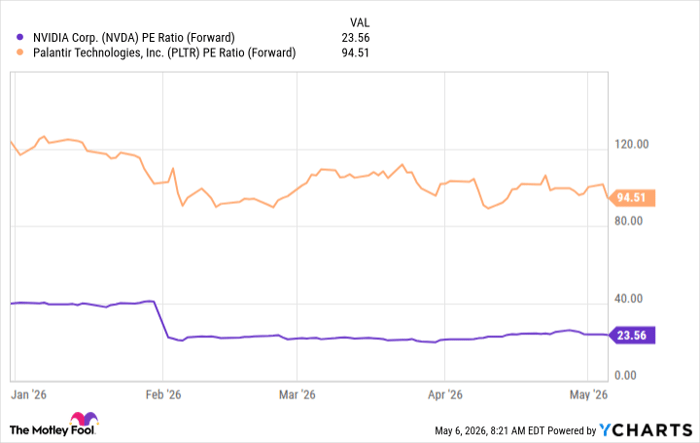
NVDA PE Ratio (Forward) data by YCharts
Second, Nvidia stock has recovered some momentum in the second quarter while Palantir remains in the doldrums. Investors are still hesitating to return to this software player, so a rebound may take some time. I also think investors may like the fact that Nvidia is directly benefiting from big tech's investment in AI infrastructure this year -- and that could translate into gains for Nvidia stock in 2026.
Should you buy stock in Nvidia right now?
Before you buy stock in Nvidia, consider this:
The Motley Fool Stock Advisor analyst team just identified what they believe are the 10 best stocks for investors to buy now… and Nvidia wasn’t one of them. The 10 stocks that made the cut could produce monster returns in the coming years.
Consider when Netflix made this list on December 17, 2004... if you invested $1,000 at the time of our recommendation, you’d have $476,034!* Or when Nvidia made this list on April 15, 2005... if you invested $1,000 at the time of our recommendation, you’d have $1,274,109!*
Now, it’s worth noting Stock Advisor’s total average return is 974% — a market-crushing outperformance compared to 206% for the S&P 500. Don't miss the latest top 10 list, available with Stock Advisor, and join an investing community built by individual investors for individual investors.
See the 10 stocks »
*Stock Advisor returns as of May 7, 2026.
Adria Cimino has no position in any of the stocks mentioned. The Motley Fool has positions in and recommends Nvidia and Palantir Technologies. The Motley Fool has a disclosure policy.
Recommended Articles


