


I Bought Atlassian Stock When It Was Down 87%, and Now It's Soaring. These Were My Reasons.
Key Points
Atlassian stock slumped 87% as Wall Street feared artificial intelligence would upend the software industry.
However, the company reported accelerating revenue growth, which sparked a sharp reversal in its stock.
Despite a 50% gain from its recent low point, Atlassian stock looks cheap and could soar further from here.
- 10 stocks we like better than Atlassian ›
Atlassian (NASDAQ: TEAM) created a suite of applications designed to foster collaboration and streamline workflows within large organizations. One of them is Jira, which helps software developers track bugs and ship updates, and another is Confluence, a digital town square where employees across departments can discuss work and host important documents.
Atlassian stock was down by as much as 87% from its all-time high in April, as Wall Street believed the growing adoption of artificial intelligence (AI) would upend its business. Analysts thought AI coding assistants would allow businesses to build their own versions of Jira and Confluence. Plus, they believed if AI shrank the workforce, then any software company that charges customers on a per-user basis would lose a ton of revenue.
Will AI create the world's first trillionaire? Our team just released a report on the one little-known company, called an "Indispensable Monopoly" providing the critical technology Nvidia and Intel both need. Continue »
I felt both concerns were overblown, so I bought the stock in April at around $58. It closed at $89 on Friday, May 1, a gain of around 50%, as Atlassian's operating results for its fiscal 2026 third quarter (ended March 31) revealed accelerating revenue growth. Below, I'm going to share the two main reasons I decided to buy the stock -- and why it's still a good buy from here.

Image source: Getty Images.
1. I believed AI would help, not hinder, Atlassian's business
Technology companies grow through innovation, so they rarely stand still. Atlassian has actually developed an entire AI platform over the last couple of years, which enhances existing products like Jira and Confluence. It's called Rovo, and it has a growing list of capabilities.
Rovo can be a virtual assistant that generates and summarizes content in Jira and Confluence. It can also be a coding assistant to help software developers accelerate their workflows. Rovo also features a search function that can instantly locate key information from across the entire organization, even if it isn't stored in an Atlassian software product.
Over 350,000 organizations use Atlassian, including 85% of the Fortune 500, so the tech giant has an incredible amount of intricate data on how they manage their operations. This allows Rovo to be more helpful than most generic AI assistants, and it's proving to be very popular, because Atlassian customers who were using the platform during the third quarter grew their annual recurring revenue (ARR) at twice the pace of those who weren't.
Atlassian generated $1.8 billion in total revenue during the quarter, which was a 32% increase from the year-ago period. It crushed Wall Street's revenue estimate of $1.7 billion, and that growth rate marked an acceleration from 23% in the previous quarter.
Simply put, I thought AI would be a tailwind for Atlassian's business, and the company's third-quarter results validated my theory.
2. Atlassian offers more than just software
In my opinion, the idea that every organization will eventually replace all of their third-party software applications with alternatives they developed in-house using AI was completely nonsensical. There is a ton of infrastructure that goes along with deploying software successfully, which isn't cheap nor easy to implement.
Atlassian has agreements with cloud computing giants Amazon and Alphabet to host products like Jira, Confluence, and Rovo. This allows customers to tap into state-of-the-art data centers to unlock the computing capacity they need, with a high degree of reliability.
This also has security benefits, because platforms like Amazon Web Services and Google Cloud offer industry-leading protection against hackers and cyber threats. But Atlassian also offers a security layer on top called Atlassian Guard, which encrypts sensitive data and maintains a zero-trust posture for all employees to reduce the risk of breaches.
Further, any business that uses AI to build software still needs an in-house team of developers and engineers to fix bugs and ship upgrades, which can be very expensive. Atlassian offers around-the-clock technical support that is built into its subscription prices, so its products are not only more affordable, but also more convenient compared to in-house solutions.
Finally, there is also reputational risk for a business building and deploying its own software. A bank, for example, might be able to create its own version of Jira, but if it suffers a data breach, then it foots all of the financial consequences and the reputational damage. By using third-party software from a provider like Atlassian, it can offset some of that risk.
It's not too late to buy Atlassian stock
Even after the 50% rally from its recent low, Atlassian stock is trading at a price-to-sales (P/S) ratio of just 3.7, which is close to its cheapest valuation since it went public in 2015.
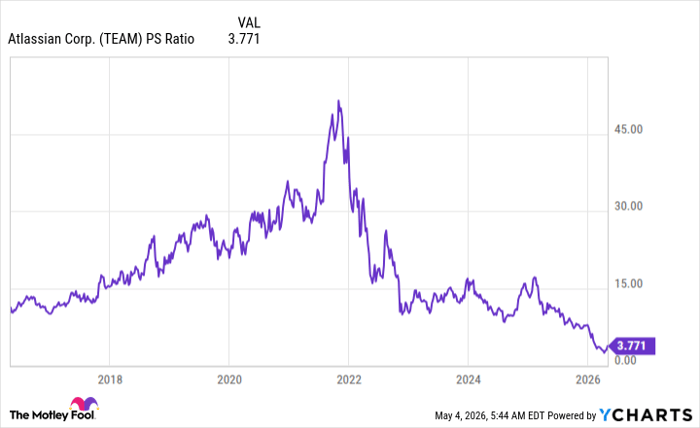
TEAM PS Ratio data by YCharts
As a result, there could still be plenty of upside in the tank for Atlassian stock. The average price target among the 39 analysts tracked by The Wall Street Journal is $125.07, implying a further potential return of 40% over the next 12 months. I think that is more than achievable, especially if the company's financial results continue to top expectations.
Should you buy stock in Atlassian right now?
Before you buy stock in Atlassian, consider this:
The Motley Fool Stock Advisor analyst team just identified what they believe are the 10 best stocks for investors to buy now… and Atlassian wasn’t one of them. The 10 stocks that made the cut could produce monster returns in the coming years.
Consider when Netflix made this list on December 17, 2004... if you invested $1,000 at the time of our recommendation, you’d have $490,864!* Or when Nvidia made this list on April 15, 2005... if you invested $1,000 at the time of our recommendation, you’d have $1,216,789!*
Now, it’s worth noting Stock Advisor’s total average return is 963% — a market-crushing outperformance compared to 201% for the S&P 500. Don't miss the latest top 10 list, available with Stock Advisor, and join an investing community built by individual investors for individual investors.
See the 10 stocks »
*Stock Advisor returns as of May 6, 2026.
Anthony Di Pizio has positions in Atlassian. The Motley Fool has positions in and recommends Alphabet, Amazon, and Atlassian. The Motley Fool has a disclosure policy.
Recommended Articles


