


Apple Just Gave Investors a $100 Billion Reason to Rethink the AI Spending Race
Key Points
Apple's board authorized an additional $100 billion share repurchase program on top of what was left from the existing one.
Apple's capital expenditures totaled just $4.3 billion in the first half of fiscal 2026.
Fiscal second-quarter revenue rose 17% year over year.
- 10 stocks we like better than Apple ›
Tech giant Apple (NASDAQ: AAPL) announced stellar fiscal second-quarter results last week. But there's one element of the report -- beyond the headlines about strong iPhone sales and robust guidance -- worth a closer look. Last week, alongside its fiscal second-quarter results, the iPhone maker said its board authorized an additional $100 billion in share repurchases on top of the remaining balance from its existing authorization. Additionally, the board also raised the dividend by 4%.
Put another way, the company's capital return program is continuing.
Will AI create the world's first trillionaire? Our team just released a report on the one little-known company, called an "Indispensable Monopoly" providing the critical technology Nvidia and Intel both need. Continue »
The move stands in sharp contrast to what is happening across much of big tech right now, where rivals are committing hundreds of billions of dollars to AI infrastructure. Apple is taking a different path: staying disciplined with its spending on capital expenditures while returning huge sums to shareholders.
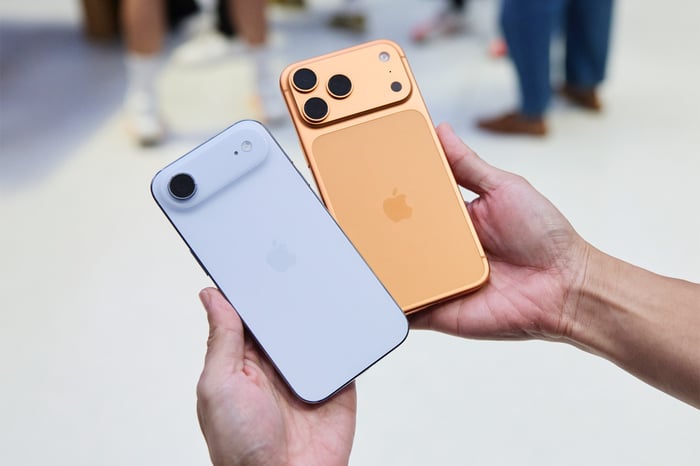
Image source: Apple.
A different kind of AI play
While Amazon expects 2026 capital expenditures of about $200 billion, Alphabet is guiding to $180 billion to $190 billion, and Meta Platforms anticipates $125 billion to $145 billion -- all largely tied to AI -- Apple's spending picture looks modest. Through the first half of fiscal 2026, Apple's capital expenditures totaled only about $4.3 billion. Annualized, that's a rounding error for a company of its size.
Yet Apple isn't ignoring AI. Its A19 and A19 Pro chips include neural accelerators built for AI workloads, and Apple Intelligence is now woven across the company's product lineup. The tech giant has also leaned into a partnership with Alphabet to power an upcoming version of Siri with Gemini. But Apple's bet on AI is happening at the edge -- on the device itself -- rather than through massive data center buildouts -- a less capital-intensive approach.
The financial result of that discipline is striking. Apple generated more than $82 billion in operating cash flow during the first half of fiscal 2026. Of that, just $4.3 billion went toward capital expenditures. The rest is available for the business and shareholders -- and Apple has been returning a meaningful amount of it. In the first six months of fiscal 2026, the company returned about $45 billion to investors through dividends and share buybacks.
Strong fundamentals support the capital returns
Of course, capital returns only work if the underlying business holds up. And fiscal Q2 made it clear that Apple's business is firing on all cylinders.
For the fiscal second quarter of 2026 (the period ended March 28, 2026), Apple's revenue rose 17% year over year -- a March-quarter record. And earnings per share climbed 22%. iPhone revenue -- Apple's biggest product category -- also jumped about 22% year over year to $57 billion, accounting for more than half of the quarter's revenue. This strong growth in iPhone revenue was fueled by what Cook called the "most popular lineup in our history [...]" Additionally, Apple's high-margin services business -- which includes the App Store, Apple TV, iCloud, Apple Music, and AppleCare -- grew 16% year over year to a record $31 billion.
And Apple's growth was broad-based geographically. One standout region was Greater China, where revenue rose about 28% year over year to $20.5 billion -- a sharp turnaround from a region that was a frequent source of investor worry not long ago. Every other geographic segment posted double-digit growth.
The momentum could continue, too. Management guided for fiscal Q3 revenue to grow 14% to 17% year over year. This strong outlook came even as Cook warned that "we expect significantly higher memory costs" in the period -- a reminder that Apple is not immune to the supply pressures rippling through tech as AI demand strains memory components.
Ultimately, fiscal Q2 reinforced the bigger story for long-term shareholders. Apple is growing revenue and earnings at double-digit rates while generating huge free cash flow, which it's returning to investors at a scale few companies can match. Ultimately, I think this disciplined approach to AI, paired with the impressive business momentum on display in fiscal Q2, helps explain why Apple stock still seems like a good long-term investment -- even with shares trading near all-time highs.
Should you buy stock in Apple right now?
Before you buy stock in Apple, consider this:
The Motley Fool Stock Advisor analyst team just identified what they believe are the 10 best stocks for investors to buy now… and Apple wasn’t one of them. The 10 stocks that made the cut could produce monster returns in the coming years.
Consider when Netflix made this list on December 17, 2004... if you invested $1,000 at the time of our recommendation, you’d have $496,473!* Or when Nvidia made this list on April 15, 2005... if you invested $1,000 at the time of our recommendation, you’d have $1,216,605!*
Now, it’s worth noting Stock Advisor’s total average return is 968% — a market-crushing outperformance compared to 202% for the S&P 500. Don't miss the latest top 10 list, available with Stock Advisor, and join an investing community built by individual investors for individual investors.
See the 10 stocks »
*Stock Advisor returns as of May 4, 2026.
Daniel Sparks and his clients' positions in Apple. The Motley Fool has positions in and recommends Alphabet, Amazon, Apple, and Meta Platforms. The Motley Fool has a disclosure policy.
Recommended Articles


