


Trump Wants to Control the Fed. History Says That's How Bear Markets Are Born.
Key Points
There's ample reason to believe that President Trump wants to control the Fed in order to reduce interest rates.
History shows that ill-advised rate cuts lead to economic declines and bear markets.
- These 10 stocks could mint the next wave of millionaires ›
Does President Trump want to control the Federal Reserve's decisions on interest rates? There's ample reason to think so.
In August 2024, then-candidate Trump said that he wanted a direct role in the Fed's decisions. Trump told reporters, "I think that, in my case, I made a lot of money, I was very successful, and I think I have a better instinct than, in many cases, people that would be on the Federal Reserve or the chairman."
Will AI create the world's first trillionaire? Our team just released a report on the one little-known company, called an "Indispensable Monopoly" providing the critical technology Nvidia and Intel both need. Continue »
Earlier this year, President Trump pushed for the Fed to meet outside of its normal schedule to cut interest rates immediately. He has repeatedly criticized Fed Chair Jerome Powell for not cutting rates. Trump has publicly stated his expectation that his nominee to replace Powell, Kevin Marsh, will reduce interest rates.
But what will happen if Trump gets his way? History says that when political leaders influence central banks' decisions, bear markets tend to be born.
Image source: Getty Images.
History lessons
Trump isn't the only U.S. president to try to influence the Federal Reserve. In 1969, President Richard Nixon nominated Arthur Burns to be the next Fed chair. Burns stepped into the role in early 1970. The audio tapes from Nixon's days in the White House later revealed that he exerted pressure on Burns to provide a monetary stimulus to the economy prior to the 1972 presidential election. There are also some indications that Nixon's director of the Office of Management and Budget, George Schultz, spoke with Burns about lowering rates.
The Fed lowered interest rates under Burns' leadership. Nixon won reelection in a landslide. However, lower rates contributed to higher inflation. The Fed had to raise interest rates multiple times in the period immediately after the November 1972 election. One year later, the U.S. economy entered into recession. By late 1973, the S&P 500 (SNPINDEX: ^GSPC) was in a bear market. The index eventually plunged 48% below its previous peak.
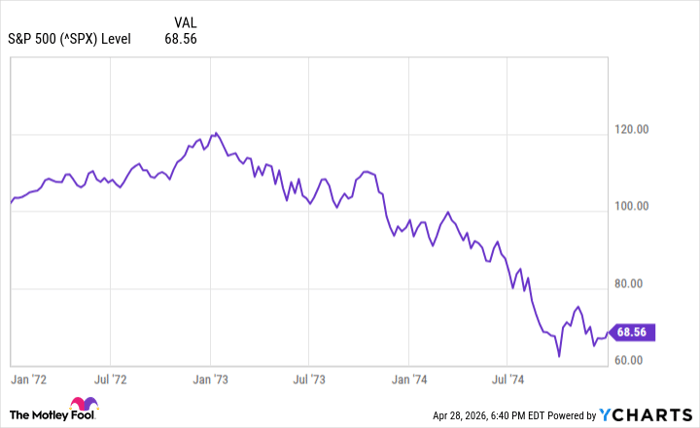
^SPX data by YCharts
To be fair, the Arab oil embargo in 1973 played a big role in the recession and bear market. However, the Fed's rate cuts didn't help matters. Economist Burton Abrams chronicled the interactions between Nixon and Burns in a 2006 paper published in the Journal of Economic Perspectives. He concluded that the episode "illustrates the danger of permitting too much discretion in the implementation of monetary policy."
International examples are also instructive, especially in the case of Turkey, where President Erdogan has been a vocal proponent of low interest rates. Erdogan fired or replaced five of his nation's central bank governors over a five-year period beginning in 2019, with some of the moves due to the central bank raising rates or refusing to lower them. Turkey's central bank ultimately gave in to Erdogan's pressure tactics and slashed rates in late 2021. The country's currency subsequently collapsed. Turkey's inflation rate skyrocketed to over 85%.
The risks
If the Fed lowers interest rates at the wrong time, its move can do much more harm than good. Pressure for rapid rate cuts could reignite inflation, particularly when the war with Iran and tariffs are already pushing the prices of many products higher.
There's also another potential problem. Philip Lane, chief economist of the European Central Bank, stated at a fireside chat this year at the University of Virginia's Darden School of Business, "It is self-defeating for any government to believe they should drive a central bank away from delivering its mandate." Lane explained, "[I]f people believed that that's actually going to happen, the bond market would reprice. They would raise long-term interest rates because they're expecting the inflation rate will go up."
Lane's reasoning makes sense. Financial markets loathe uncertainty. If investors think that the White House controls the Fed's actions and has the power to make it take actions that aren't wise, they'll demand a higher risk premium to own U.S. Treasury bonds. And, as Lane indicated, interest rates will move higher.
In addition, concerns about a politically compromised Federal Reserve could devalue the U.S. dollar. It's not out of the question that foreign investors could dump U.S. stocks in response, causing a bear market to ensue.
It isn't just a Trump issue
Worries about the Federal Reserve losing independence have increased recently because of President Trump's actions. However, this isn't just a Trump issue. Attempts by any politician to control a nation's central bank can lead to economic instability and stock market disruption.
Some might point to the S&P 500's continued streak of strong earnings. However, bear markets aren't only caused by earnings declines; they can also result from a decline of institutional trust.
Trump's Fed chair nominee, Warsh, recently told the U.S. Senate Banking Committee that he would "absolutely not" be a puppet for the president as Fed chair. If Warsh is confirmed, investors should hope that he's right. But they might also want to be prepared if he was wrong.
Where to invest $1,000 right now
When our analyst team has a stock tip, it can pay to listen. After all, Stock Advisor’s total average return is 968%* — a market-crushing outperformance compared to 202% for the S&P 500.
They just revealed what they believe are the 10 best stocks for investors to buy right now, available when you join Stock Advisor.
See the stocks »
*Stock Advisor returns as of May 3, 2026.
Keith Speights has no position in any of the stocks mentioned. The Motley Fool has no position in any of the stocks mentioned. The Motley Fool has a disclosure policy.
Recommended Articles


