


President Donald Trump Vowed Not to Touch Social Security -- but He May Have Indirectly Broken That Promise
Key Points
The fund responsible for doling out monthly benefits to retired workers and survivors of deceased workers is projected to exhaust its asset reserves by 2033.
While Trump's "Big, Beautiful Bill" is increasing take-home pay/benefits for some Americans, it's simultaneously pilfering from Social Security's proverbial cookie jar.
Ongoing demographic shifts are a far bigger problem for Social Security's financial well-being.
- The $23,760 Social Security bonus most retirees completely overlook ›
Since the first retired-worker benefit was mailed in January 1940, Social Security has been providing a financial foundation for aging workers who could no longer do so for themselves. However, this long-standing social program isn't on the best financial footing.
While several factors have been chipping away at Social Security's foundation for decades, it's the latest $169 billion surprise, courtesy of President Donald Trump, that's rightly garnering attention.
Will AI create the world's first trillionaire? Our team just released a report on the one little-known company, called an "Indispensable Monopoly" providing the critical technology Nvidia and Intel both need. Continue »

President Trump delivering remarks. Image source: Official White House Photo by Shealah Craighead, courtesy of the National Archives.
Sweeping Social Security benefit cuts are rapidly approaching
For 85 years, the Social Security Board of Trustees has published an annual report detailing the financial ins and outs of America's leading retirement program. In addition to tracking how Social Security generates income and where those dollars end up, the Trustees Report also makes educated guesses about the future solvency of Social Security's trust funds: the Old-Age and Survivors Insurance trust fund (OASI) and Disability Insurance trust fund (DI).
Since 1985, every Trustees Report has cautioned of a long-term (75-year) unfunded obligation. In other words, there wouldn't be enough income collected in the 75 years following the release of a report to cover projected outlays, including annual cost-of-living adjustments (COLAs).
This estimated funding shortfall has consistently grown over four decades to $25.1 trillion.
However, the more pressing concern for beneficiaries is the forecasted depletion of the OASI's asset reserves (i.e., the excess income collected since inception that hasn't been paid out as benefits or used for administrative expenses).
Based on the 2025 Trustees Report, the fund responsible for dishing out monthly benefits to retired workers and the survivors of deceased workers is expected to exhaust its asset reserves by 2033.
To be clear, the OASI doesn't require a penny in its asset reserves to continue paying benefits. Social Security is in absolutely no danger of bankruptcy, halting benefits, or insolvency.
But the exhaustion of the OASI's asset reserves would signal that the existing payout schedule, inclusive of COLAs, isn't sustainable. If these asset reserves are gone by 2033, sweeping benefit cuts of up to 23% may await retired workers and survivors of deceased workers.
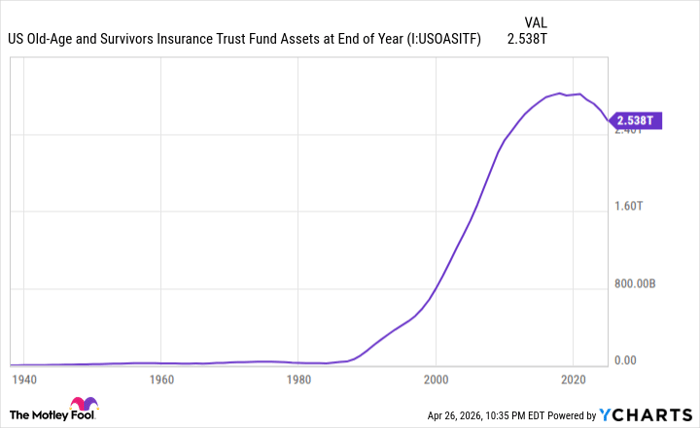
The OASI's asset reserves are on pace to be depleted by 2033. US Old-Age and Survivors Insurance Trust Fund Assets at End of Year data by YCharts.
Trump's "Big, Beautiful Bill" comes with a $169 billion surprise for Social Security
Although President Trump has vowed not to touch Social Security, his flagship tax and spending law from his second, non-consecutive term, the "Big, Beautiful Bill," may have indirectly broken that promise.
The Big, Beautiful Bill, or BBB for short, implemented a host of temporary tax breaks and credits. While this isn't an encompassing list, the three most prominent tax changes are active from 2025 through 2028:
- Eligible seniors aged 65 and above can take an additional $6,000 off of their taxable income ($12,000 for married couples filing jointly).
- The "no tax on tips" law enables eligible workers to receive a dollar-for-dollar deduction of up to $25,000 on their tips.
- The "no tax on overtime" law allows select workers to claim dollar-for-dollar deductions on up to $12,500 in overtime pay for single filers and $25,000 for couples filing jointly.
While the BBB is increasing take-home pay/benefits for some Americans, it's simultaneously pilfering from Social Security's proverbial cookie jar.
Social Security has three funding sources, the most important of which is the 12.4% payroll tax on earned income. In 2024, more than 91% of the nearly $1.42 trillion collected by Social Security came from the payroll tax on wages and salaries (but not investment income). The BBB temporarily reducing the income subject to the payroll tax, coupled with making standard deductions permanently higher, is set to adversely impact Social Security's payroll tax income.
In late July 2025, Sen. Ron Wyden (D-OR) sent a request to the Social Security Administration's Office of the Actuary (OACT) to estimate how Trump's Big, Beautiful Bill would affect America's top retirement program. The OACT responded one week later with a chilling forecast.
According to the OACT, the reduced income tied to the BBB is projected to increase costs for the combined OASI and DI by $168.6 billion from calendar years 2025 through 2034. Adding to an already mammoth funding obligation shortfall is also expected to push forward the OASI's asset reserve exhaustion timeline to the fourth quarter of 2032.
In short, Trump's flagship tax law sped up the estimated timeline to Social Security benefit cuts.

Image source: Getty Images.
The Big, Beautiful Bill is the latest stumbling block for Social Security
However, President Trump's indirectly broken Social Security promise is a relative drop in the bucket compared to the demographic changes that are truly haunting this program.
Some of these changes have been ongoing for years, such as the retirement of baby boomers from the labor force and increased longevity. When retired-worker payments began in 1940, no one expected that the average retiree 85 years later would be collecting benefits for decades. The program simply wasn't designed for this.
But other demographic shifts aren't as easy to spot.
For example, the U.S. fertility rate hit an all-time low in 2024, according to data from the Centers for Disease Control and Prevention. While this won't impact the program immediately, it's expected to put pressure on the worker-to-beneficiary ratio in the coming decades.
Legal migration into the U.S. has also fallen off significantly since the late 1990s. Most migrants coming to America are young and will spend decades in the labor force, contributing to Social Security via the payroll tax. Fewer legal migrants translates to less payroll tax income.
Income inequality is a problem, too. In the mid-1980s, approximately 90% of earned income was subject to the payroll tax. But as of 2024, this had declined to only 83% of earnings.
These demographic changes account for the lion's share of Social Security's financial shortcomings.
The $23,760 Social Security bonus most retirees completely overlook
If you're like most Americans, you're a few years (or more) behind on your retirement savings. But a handful of little-known "Social Security secrets" could help ensure a boost in your retirement income.
One easy trick could pay you as much as $23,760 more... each year! Once you learn how to maximize your Social Security benefits, we think you could retire confidently with the peace of mind we're all after. Join Stock Advisor to learn more about these strategies.
View the "Social Security secrets" »
The Motley Fool has a disclosure policy.
Recommended Articles


