


The Likelihood of a Stock Market Crash Under President Donald Trump Is Rapidly Rising -- and There's One Undeniable Catalyst to Blame
Key Points
Outsize returns for the Dow Jones Industrial Average, S&P 500, and Nasdaq Composite have become the norm during Donald Trump's tenure in the White House.
Several factors have lit a fire under the stock market, including Trump's flagship tax and spending law, the Tax Cuts and Jobs Act, which led to record S&P 500 share buybacks.
However, the inflationary effects of the Iran war may alter the Federal Reserve's stance on interest rates and upend a historically expensive stock market.
- 10 stocks we like better than S&P 500 Index ›
In case you missed it, Wall Street history was made a little over one week ago. The benchmark S&P 500 (SNPINDEX: ^GSPC) and growth-stock-dominated Nasdaq Composite (NASDAQINDEX: ^IXIC) both soared to record-closing highs on April 24, with the ageless Dow Jones Industrial Average (DJINDICES: ^DJI) one good day away from joining its peers.
Wall Street's major stock indexes hitting new highs and delivering outsize returns is nothing new under President Donald Trump. During his first term, the Dow, S&P 500, and Nasdaq Composite gained 57%, 70%, and 142%, respectively. Although the Dow or S&P 500 has finished higher in 26 of the previous 33 presidential terms, annualized returns for these indexes have been higher under Trump than under most other presidents.
Will AI create the world's first trillionaire? Our team just released a report on the one little-known company, called an "Indispensable Monopoly" providing the critical technology Nvidia and Intel both need. Continue »
While several factors are fueling this rally (not all of which have Trump's fingerprints on them), one undeniable catalyst is threatening to ruin the party. One decision made by President Trump has shifted the puzzle pieces enough to put the possibility of a stock market crash squarely on the table.

President Trump delivering remarks. Image source: Official White House Photo by Daniel Torok.
Stocks have outperformed with Trump in the White House for five years (and counting)
But before digging into the spark that could light this match, it's imperative to understand why stocks have outperformed with Donald Trump in the White House.
The first thing to note is that not every upside catalyst is related to President Trump or policies his administration has enacted. Arguably, the premier growth driver for Wall Street is the evolution of artificial intelligence (AI), which has been ongoing for years.
Empowering software and systems with the tools to make split-second, autonomous decisions is a potential game changer for most sectors and industries. AI can revolutionize supply chains, production lines, and innovation, and represents an addressable opportunity of more than $15 trillion by 2030, according to PwC analysts.
Additionally, corporate earnings growth has consistently outpaced analysts' expectations. To be fair, the bar tends to be set low, enabling public companies to easily step over consensus profit forecasts. Nevertheless, having most S&P 500 companies exceed expectations is a recipe for stock market gains.
S&P 500 buybacks were $249.0b in 3Q25, up 6.2% from 2Q25 and up 9.9% from 3Q24; top 20 S&P 500 companies accounted for 49.5% of 3Q25 share repurchases, down from 51.3% in 2Q25
-- Liz Ann Sonders (@LizAnnSonders) December 19, 2025
@SPDJIndices pic.twitter.com/dwa0aikdw2
However, President Trump has played a role in fueling the Dow's, S&P 500's, and Nasdaq Composite's rise. The Tax Cuts and Jobs Act (TCJA), signed into law in December 2017, permanently lowered the peak marginal corporate income tax rate from 35% to 21%.
The lowest peak corporate income tax rate since 1939 has allowed businesses to retain more of their earnings. While some companies have used this extra capital to hire, acquire, and reinvest in innovation, the most notable impact of the TCJA has been a significant uptick in share buybacks by S&P 500 companies. Research from The Motley Fool indicates that share repurchases reached an estimated all-time high of more than $1 trillion in 2025.
While upside catalysts do exist, a decision made by President Trump threatens to wipe out these gains.

Image source: Getty Images.
The ingredients for a stock market crash under Trump are firmly in place
Although Trump has overseen double-digit annualized stock returns during his time in the Oval Office, he's also presided over two crash events: the five-week COVID-19 crash in February-March 2020, and the "tariff tantrum" during the first week of April 2025. Short-lived elevator-down declines have become somewhat commonplace under Trump -- and the next one may be brewing.
A little over two months ago, on Feb. 28, Trump gave the order for the U.S. military, along with Israel, to commence attacks against Iran. Shortly after this conflict began, Iran effectively closed the Strait of Hormuz to commercial vessels, disrupting the flow of 20 million barrels of liquid petroleum per day (roughly 20% of global demand).
Though there have been advances in ending the Iran war, including a two-week ceasefire that's been extended indefinitely by President Trump, as of this writing on April 25, the damage of the president's decision to attack Iran has already been done.
While wars are known to heighten uncertainty and can lead to the incalculable loss of life, their effects are felt far from the battlefield. The inflationary impact of the Iran war is the catalyst that can upend Trump's bull market.
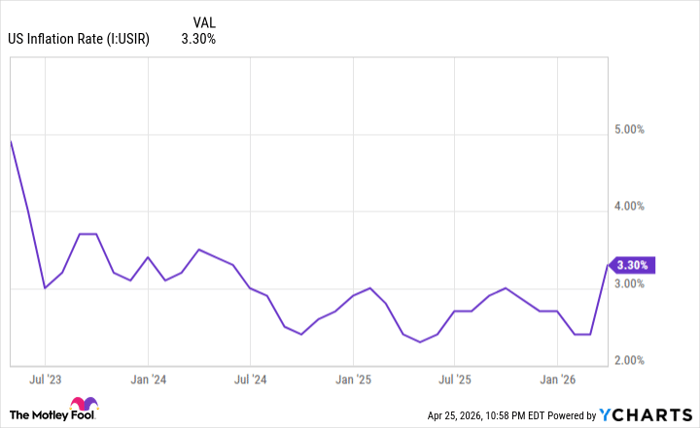
US Inflation Rate data by YCharts.
Before the Iran war began, trailing 12-month (TTM) U.S. inflation was inching ever closer to the Federal Reserve's long-term target of 2%. In February, TTM inflation clocked in at 2.4% -- a level consistent with a healthy economy.
But thanks to the largest energy supply disruption in modern history, crude oil prices and energy expenses are soaring. In March, TTM inflation jumped 90 basis points to 3.3%. According to the Federal Reserve Bank of Cleveland's Inflation Nowcasting tool, inflation is estimated to rise by another 26 basis points to 3.56% in April. Even if the Iran war ends soon, the inflationary effects of energy supply disruption should persist for several quarters.
Typically, a 116-basis-point, two-month increase in inflation wouldn't be a death knell for the stock market. But the stock market doesn't often enter a year at its second-priciest valuation over 155 years, based on the S&P 500's Shiller Price-to-Earnings Ratio.
The S&P 500's CAPE Ratio has moved up to 40, its highest level since 2000 and now above 99% of historical valuations. $SPX pic.twitter.com/uhUt33SCp5
-- Charlie Bilello (@charliebilello) April 20, 2026
Wall Street and investors have been looking for nothing short of multiple interest rate cuts in 2026. These rate cuts were expected to support an expensive stock market by fueling aggressive investments in AI data centers.
With Trump's decision leading to a meaningful increase in inflation, rate cuts are effectively off the table. According to the Federal Reserve Bank of Atlanta's Market Probability Tracker, there's a higher probability of an interest rate hike by June 17 than a rate cut, as of April 23.
President Trump's actions have put the ball firmly in the Federal Reserve's court. If America's foremost financial institution alters its language about inflation/rate hikes, or moves to raise the federal funds target rate, a stock market crash may be the logical response on Wall Street.
Should you buy stock in S&P 500 Index right now?
Before you buy stock in S&P 500 Index, consider this:
The Motley Fool Stock Advisor analyst team just identified what they believe are the 10 best stocks for investors to buy now… and S&P 500 Index wasn’t one of them. The 10 stocks that made the cut could produce monster returns in the coming years.
Consider when Netflix made this list on December 17, 2004... if you invested $1,000 at the time of our recommendation, you’d have $504,832!* Or when Nvidia made this list on April 15, 2005... if you invested $1,000 at the time of our recommendation, you’d have $1,223,471!*
Now, it’s worth noting Stock Advisor’s total average return is 971% — a market-crushing outperformance compared to 202% for the S&P 500. Don't miss the latest top 10 list, available with Stock Advisor, and join an investing community built by individual investors for individual investors.
See the 10 stocks »
*Stock Advisor returns as of May 2, 2026.
Sean Williams has no position in any of the stocks mentioned. The Motley Fool has no position in any of the stocks mentioned. The Motley Fool has a disclosure policy.
Recommended Articles


