


I Predicted the 50% Collapse in Robinhood Stock. Here's What Could Happen Next.
Key Points
Robinhood operates a popular investing platform where its clients buy and sell stocks, options, cryptocurrencies, and more.
Robinhood stock soared to a record high of $154 last year, as its clients piled into risky options contracts and cryptocurrencies.
The stock has since plummeted more than 50%, and more downside could be on the way.
- 10 stocks we like better than Robinhood Markets ›
Robinhood Markets (NASDAQ: HOOD) operates an investing platform where its clients buy and sell stocks, options, cryptocurrencies, and more. Business was booming last year as the stock market and cryptocurrency market soared in lockstep, which sent Robinhood shares barreling to a record high of about $154 in October.
I wrote a series of articles predicting Robinhood stock would crash by 50% (or more), and it's now sitting 53% below its peak. Simply put, a significant amount of the company's growth was coming from the risky options and crypto segments of its business last year, which history suggested was unsustainable.
Will AI create the world's first trillionaire? Our team just released a report on the one little-known company, called an "Indispensable Monopoly" providing the critical technology Nvidia and Intel both need. Continue »
Unfortunately, based on Robinhood's recently reported operating results for the first quarter of 2026, I don't think the decline in its stock is over. Here's what could happen next.
Image source: The Motley Fool.
Robinhood's growth drivers are losing steam
The bulk of Robinhood's revenue comes in the form of transaction fees, which it earns whenever a client buys or sells a stock, options contract, or cryptocurrency. Options contracts are financial derivatives investors use to make directional bets on stocks, exchange-traded funds (ETFs), and other assets. They are extremely risky, but Robinhood's clients trade them very actively.
Robinhood generated $623 million in total transaction-based revenue during the first quarter, which was down 20% from the fourth quarter of 2025. Options transaction revenue was the largest of four components, and it shrank by 17% to $260 million. The stock market has been particularly unpredictable during the past few months amid geopolitical tensions between the U.S. and Iran, which likely sidelined many options traders.
Robinhood's cryptocurrency transaction revenue fell at an even faster pace of 39% sequentially in the first quarter, to come in at $134 million. Even though the stock market is back at record highs, the total value of all cryptocurrencies in circulation is still down by 37% from last year's peak. The highly speculative end of the market is faring even worse, with tokens like Dogecoin and Shiba Inu trading more than 60% below their 52-week highs.
Therefore, it's no surprise Robinhood's clients are avoiding the crypto markets right now.
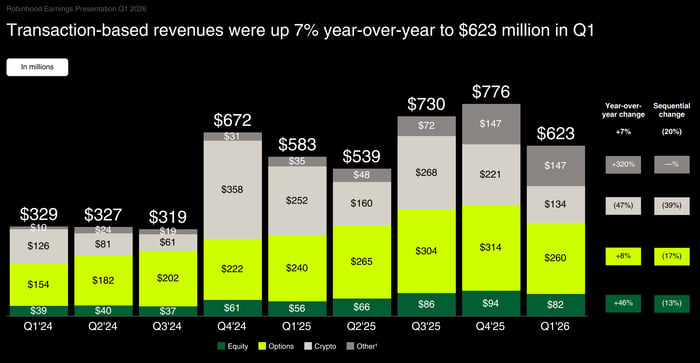
Image source: Robinhood Markets.
But this isn't the first time Robinhood's crypto business has foundered. During the second quarter of 2021 -- at the height of the last crypto market frenzy -- the company's crypto transaction revenue soared by 4,560% year over year. But it was down by a whopping 75% just one year later as the crypto market entered a so-called winter, and this marked the beginning of an 85% plunge in Robinhood stock.
More downside might be ahead for Robinhood stock
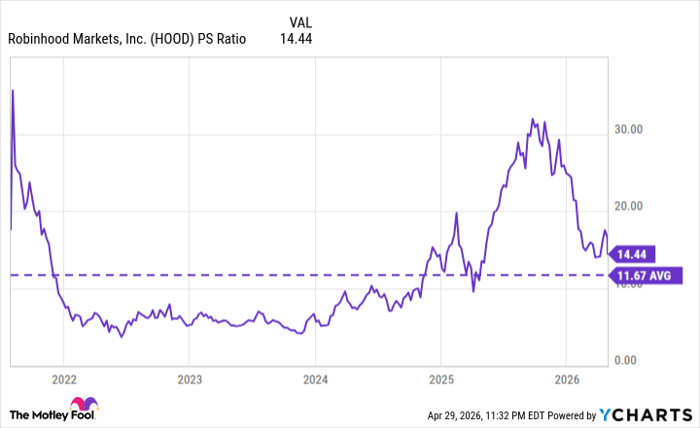
When Robinhood stock peaked last October, its price-to-sales (P/S) ratio was more than 30. That was nearly triple its average of 11.6 since going public in 2021, so its valuation was simply unsustainable.
However, even after suffering a 53% decline, Robinhood stock still trades at an above-average P/S ratio of 14.4.
HOOD PS Ratio data by YCharts
That means Robinhood stock would have to decline by 19% just to trade in line with its average P/S ratio. However, if the company's revenue continues to shrink as it did in the first quarter, then its stock would have to decline even further to maintain that average P/S ratio.
But it gets worse, because Robinhood's business faces another headwind unrelated to its shrinking transaction revenue. The company earns interest on margin loans, and it also earns interest on the cash it holds on behalf of clients, and on its own corporate cash balance. The U.S. Federal Reserve has cut interest rates six times since September 2024, which has weighed on Robinhood's ability to expand this part of its business. In fact, its net interest revenue has declined sequentially for three straight quarters.
According to the CME Group's FedWatch tool, the central bank is likely to keep rates on hold for the rest of 2026, but it could start cutting them again in 2027, which would further erode Robinhood's net interest revenue.
In summary, I think the most likely path for Robinhood stock from here is down.
Should you buy stock in Robinhood Markets right now?
Before you buy stock in Robinhood Markets, consider this:
The Motley Fool Stock Advisor analyst team just identified what they believe are the 10 best stocks for investors to buy now… and Robinhood Markets wasn’t one of them. The 10 stocks that made the cut could produce monster returns in the coming years.
Consider when Netflix made this list on December 17, 2004... if you invested $1,000 at the time of our recommendation, you’d have $496,797!* Or when Nvidia made this list on April 15, 2005... if you invested $1,000 at the time of our recommendation, you’d have $1,282,815!*
Now, it’s worth noting Stock Advisor’s total average return is 979% — a market-crushing outperformance compared to 200% for the S&P 500. Don't miss the latest top 10 list, available with Stock Advisor, and join an investing community built by individual investors for individual investors.
See the 10 stocks »
*Stock Advisor returns as of May 1, 2026.
Anthony Di Pizio has no position in any of the stocks mentioned. The Motley Fool has positions in and recommends CME Group. The Motley Fool has a disclosure policy.
Recommended Articles


