


President Donald Trump's Right-Hand Man at the Federal Reserve Is Reconsidering His Interest-Rate Outlook. Are Rate Cuts Off the Table in 2026?
Key Points
Trump appointee Stephen Miran has been quite clear that he thinks the Federal Reserve should cut its benchmark lending rate multiple times this year.
But after the Iran war started, Miran changed his outlook on interest rates.
If the most dovish member of the Fed's rate-setting committee is changing his outlook, what does that mean for how other members view interest rates?
- These 10 stocks could mint the next wave of millionaires ›
President Donald Trump has not held back punches when discussing how he wants the Federal Reserve to proceed with interest rates. For much of his second term, Trump has publicly said that he wants the Fed to lower its benchmark lending rate well below its current level.
Last year, Trump had the opportunity to appoint Stephen Miran to the Federal Reserve's Board of Governors. Miran had previously served as the chairman of the Council of Economic Advisers (CEA) under Trump. Since joining the Fed, Miran has been very clear that he wants the Fed to cut interest rates multiple times this year.
Will AI create the world's first trillionaire? Our team just released a report on the one little-known company, called an "Indispensable Monopoly" providing the critical technology Nvidia and Intel both need. Continue »
However, due to recent events, Miran is contemplating changing his interest rate outlook. Are rate cuts now off the table at the Fed?
Persistent inflation
Being a member of the Fed's Board of Governors is a powerful position because each member is automatically a member of the Federal Open Market Committee (FOMC), which votes on changes to the federal funds rate.
Given that he was on Trump's CEA, it was fairly obvious that Miran would take a very dovish stance on rate cuts. Earlier this year, Miran was calling for six rate cuts in 2026, despite inflation holding decently above the Fed's 2% target.
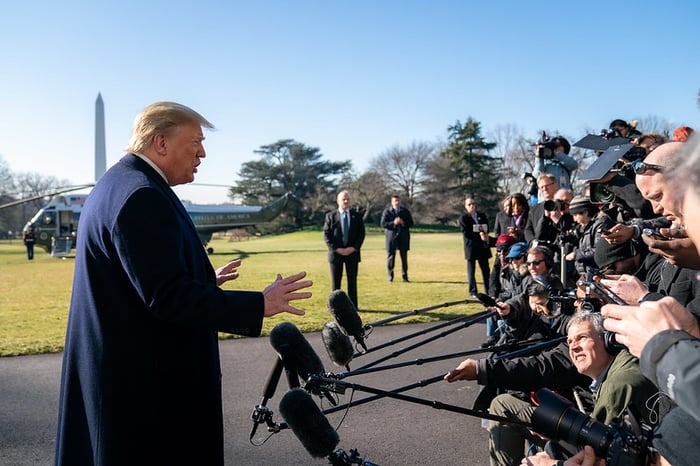
Official White House photo by Tia Dufour.
But at last month's FOMC meeting, Miran revised his outlook down from six cuts to four. Now, he's apparently considering taking it down again. "I might have three (rate cuts), I might have four, I haven't made up my mind," Miran said at a recent economic forum in Washington, according to Reuters.
Miran credited his potentially revised outlook to the Iran war. Since the conflict began at the end of February, traffic through the Strait of Hormuz, which borders Iran and Oman, has been extremely limited, due to tankers being too worried to pass through amid the recent violence. In normal times, about a fifth of the world's oil supply travels through the narrow passage.
This has led to oil prices above $100 per barrel on numerous occasions, though they are now below $100 as I write this amid recent signs of progress in negotiations between the U.S. and Iran. However, the situation remains very fluid.
While volatile energy prices are removed from core inflation, which the Fed focuses on more than the headline number, they tend to seep into most other price categories because most businesses rely on oil in one way or another. Furthermore, even if the U.S. and Iran reach a longer-term agreement in the near term, it will likely still take at least a few months for supply chains and gas prices at the pump to return to normal.
It could take much longer for oil prices to return to where prices were heading into the year, and it may never happen.
Miran is still dovish, but it's more about where the winds are heading
Make no mistake: With three or four rate cuts projected this year, Miran is still quite dovish. He said he still thinks inflation will meet the Fed's target in 2027 and that he supports a rate cut at the Fed's upcoming April meeting, given the risks he sees in the labor market.
However, if the FOMC's most dovish member is considering changing his rate trajectory outlook on concerns about persistent inflation, investors should consider how the other members of the FOMC must be feeling.
The market is certainly fairly hawkish. According to the CME FedWatch tool, which tracks bets on 30-day federal funds rate futures, the market doesn't see the Fed cutting rates again until June 2027 (as of April 20).
These probabilities change constantly, so if unemployment continues to rise, the Fed still could cut this year. Rate cuts aren't off the table in 2026, but investors shouldn't dismiss persistent inflation concerns.
Where to invest $1,000 right now
When our analyst team has a stock tip, it can pay to listen. After all, Stock Advisor’s total average return is 972%* — a market-crushing outperformance compared to 198% for the S&P 500.
They just revealed what they believe are the 10 best stocks for investors to buy right now, available when you join Stock Advisor.
See the stocks »
*Stock Advisor returns as of April 23, 2026.
The Motley Fool has a disclosure policy.
Recommended Articles


