


This Healthcare Stock Has Made Long-Term Investors Rich -- Can It Keep Doing It?
Key Points
Biogen's quarterly updates haven't been impressive of late.
It has made regulatory progress, but that won't be enough to boost top-line growth this year.
Biogen's long-term prospects look uncertain.
- 10 stocks we like better than Biogen ›
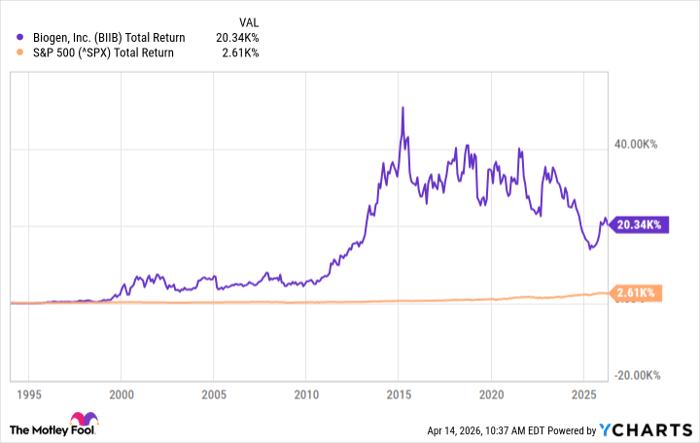
Biogen (NASDAQ: BIIB) hasn't been a great stock to own since the turn of the decade. The company faced several challenges, including biosimilar competition in its multiple sclerosis (MS) franchise and commercial setbacks in the Alzheimer's disease (AD) market. However, zooming out gives us a very different picture. Over the past three decades, Biogen's shares have outperformed broader equities.
Will AI create the world's first trillionaire? Our team just released a report on the one little-known company, called an "Indispensable Monopoly" providing the critical technology Nvidia and Intel both need. Continue »
BIIB Total Return Level data by YCharts
Could the company bounce back from recent headwinds and still deliver market-beating returns to patient investors?
What the future holds
Biogen's financial results haven't been great in recent years. In 2025, the company's revenue of $9.9 billion increased by only 2% year over year, while its adjusted earnings per share dropped by 7% to $15.28. Weakness within Biogen's MS franchise, as well as stiff competition it has encountered for Spinraza, a medicine for spinal muscular atrophy (a genetic disease that causes muscle weakness), are dragging sales growth down.
However, newer launches and label expansions could help boost revenue growth. Consider Biogen's Leqembi, a medicine for Alzheimer's disease (AD) that first earned approval in 2023. Since then, it has received additional indications, notably as a subcutaneous injection in maintenance dosing. This means patients can receive it from the comfort of their homes -- instead of having to go to healthcare facilities for intravenous infusion -- which should help boost the medicine's adoption.

Image source: Getty Images.
Further, Leqembi could soon receive the green light for subcutaneous administration for treatment initiation (right now, patients still need to see medical professionals to start treatment before opting for at-home subcutaneous injections). Leqembi's sales are growing fast. Last year, Biogen's share of revenue from it -- it co-markets Leqembi with Eisai -- was $178 million, up 197% year over year.
These label expansions could send its sales even higher. Biogen also received approval for a high-dose formulation of Spinraza that posted higher efficacy in clinical trials and requires fewer initial doses, an advantage that could help it compete with other medicines in this niche.
Then, there are other newer products like Skyclarys, approved for Friedreich's Ataxia, a rare neuromuscular disease, and Zurzuvae, a medicine for postpartum depression. These could also help the biotech company return to solid top-line growth. Beyond these products, Biogen has expanded its pipeline through acquisitions over the past few years. It still has attractive candidates in some of its core areas.
But the company's prospects are somewhat uncertain, as revenue growth won't rebound this year, despite the new approvals and label expansions. Per Biogen's own guidance, its sales will decrease on a year-over-year basis in 2026. There is still a chance it will recover in a few years, but older products are clearly still struggling enough to offset the progress of newer ones. That means Biogen has a lot riding on its pipeline candidates and on new drug launches to make significant headway, with little room for error.
In other words, this healthcare stock looks risky right now and is, at this point, unlikely to make investors rich over the long run. Biogen's shares could soar in the next five years with near-flawless execution of its strategy, but only investors comfortable with heightened risk should consider the stock.
Should you buy stock in Biogen right now?
Before you buy stock in Biogen, consider this:
The Motley Fool Stock Advisor analyst team just identified what they believe are the 10 best stocks for investors to buy now… and Biogen wasn’t one of them. The 10 stocks that made the cut could produce monster returns in the coming years.
Consider when Netflix made this list on December 17, 2004... if you invested $1,000 at the time of our recommendation, you’d have $573,160!* Or when Nvidia made this list on April 15, 2005... if you invested $1,000 at the time of our recommendation, you’d have $1,204,712!*
Now, it’s worth noting Stock Advisor’s total average return is 1,002% — a market-crushing outperformance compared to 195% for the S&P 500. Don't miss the latest top 10 list, available with Stock Advisor, and join an investing community built by individual investors for individual investors.
See the 10 stocks »
*Stock Advisor returns as of April 16, 2026.
Prosper Junior Bakiny has no position in any of the stocks mentioned. The Motley Fool recommends Biogen. The Motley Fool has a disclosure policy.
Recommended Articles


