


I've Owned Apple Stock for Years. Here's Why I'm Letting Its AI Story Play Out.
Key Points
Tech companies are spending hundreds of billions of dollars on AI capital expenditures, while Apple is mostly sticking to building devices.
Apple will implement Google Gemini into Siri to add new AI capabilities.
There's no guarantee of Apple's success, but selling the stock now is a premature move.
- 10 stocks we like better than Apple ›
I'm a long-term Apple (NASDAQ: AAPL) shareholder, and over the past couple of years, I've been seen the share prices of other tech giants blow past the company's gains. Apple hasn't competed in the artificial intelligence race in the same way that other companies have, and the result is that its shares haven't rocketed higher like some AI companies.
But I'm not quite ready to sell my Apple shares just yet. Instead of falling behind in AI, Apple may be leaning into its strengths and playing a different game than its peers. Only time will tell whether it's been the right call, but here's why I'm letting Apple's AI story play out.
Will AI create the world's first trillionaire? Our team just released a report on the one little-known company, called an "Indispensable Monopoly" providing the critical technology Nvidia and Intel both need. Continue »
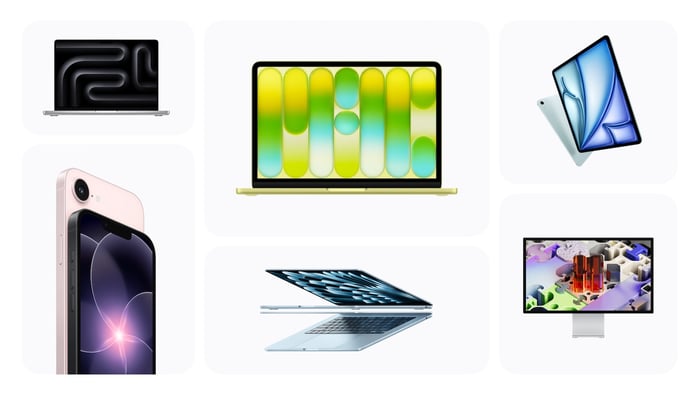
Image source: Apple.
Assessing Apple's AI strategy is tricky
A straight head-to-head AI comparison of Apple against its peers doesn't look great. Alphabet (NASDAQ: GOOGL) (NASDAQ: GOOG) has created its Gemini model, which has hundreds of millions of users, and integrated it into its Search tool and Workspace apps. It's also a core function of its Android operating system.
And, of course, OpenAI's ChatGPT and Anthropic's Claude are essentially eating everyone's lunch as the benchmark for AI capabilities. That's probably why Apple has turned to ChatGPT to help Siri offload questions it can't handle.
In comparison, Apple tried to launch its Apple Intelligence updates a couple of years ago and fumbled. Siri was supposed to have more contextual awareness, but some of the previously announced features -- like Siri working inside other apps -- didn't materialize, and other updates were modest compared to its rivals.
And then there's the AI spending spree that Apple is mostly skipping. Meta, Microsoft, Alphabet, and Amazon will collectively spend about $650 billion in capital expenditures this year, mostly for AI. Amazon CEO Andy Jassy recently said, "We're not going to be conservative in how we play this -- we're investing to be the meaningful leader ... "
In comparison, Apple spent less than $13 billion on capex in fiscal 2025.
All of the above looks like a big swing and miss for Apple, and maybe it's even getting caught watching the pitches go by. Or, Apple could be playing a different game entirely.
A different AI game
The biggest reason why I'm letting Apple's AI strategy play out is that I believe the company is playing a different game than its rivals. While most of its competitors are pouring billions of dollars into AI models to try to outdo each other, Apple appears to be focused on doing what it does best -- building and selling devices.
The company's sales rose 16% in the first quarter to nearly $144 billion, and its earnings per share rose 19% to $2.84. Much of the growth came from strong demand for its iPhone 17 as well as service revenue that jumped 14% to $30 billion.
Apple's core business is selling devices and services, not building new AI models. While everyone else spends time and money fighting to make slightly better versions of artificial intelligence, Apple can continue to sell millions of high-end devices to customers who will use those models.
What's more, Apple can still benefit from advanced AI, even if it doesn't make it itself. The next iteration of Siri will use Google Gemini as its foundational AI model, giving Siri far more capabilities. Apple is reportedly paying Alphabet an estimated $1 billion per year for several years as part of the agreement, a drop in the bucket compared to building its own advanced model.
This could allow Apple to have the best of both worlds: designing and selling high-end devices with exceptional profit margins of 37% and having advanced AI capabilities without all of the capital spend.
Time will tell
I'm not assuming Apple will succeed with this AI strategy. But I am giving it some more time to play out. I'll be watching the rollout of the new Siri closely -- which is expected to launch this year -- and whether Gemini truly makes Siri more useful.
I'm also keeping an eye on any shift in consumer demand for Apple devices, to see if other phones with their own AIs convince buyers that they don't need an iPhone to have the best software.
These are threats to be sure, but it's too early to say Apple won't benefit from its own unique AI strategy. And that's the hard part about being a long-term investor: You have to give companies time to adjust and let their strategies play out before you consider moving on.
Should you buy stock in Apple right now?
Before you buy stock in Apple, consider this:
The Motley Fool Stock Advisor analyst team just identified what they believe are the 10 best stocks for investors to buy now… and Apple wasn’t one of them. The 10 stocks that made the cut could produce monster returns in the coming years.
Consider when Netflix made this list on December 17, 2004... if you invested $1,000 at the time of our recommendation, you’d have $573,160!* Or when Nvidia made this list on April 15, 2005... if you invested $1,000 at the time of our recommendation, you’d have $1,204,712!*
Now, it’s worth noting Stock Advisor’s total average return is 1,002% — a market-crushing outperformance compared to 195% for the S&P 500. Don't miss the latest top 10 list, available with Stock Advisor, and join an investing community built by individual investors for individual investors.
See the 10 stocks »
*Stock Advisor returns as of April 15, 2026.
Chris Neiger has positions in Apple. The Motley Fool has positions in and recommends Alphabet, Amazon, Apple, Meta Platforms, and Microsoft and is short shares of Apple. The Motley Fool has a disclosure policy.
Recommended Articles


