


Should You Really Start Taking Social Security in 2026? Here's What the Data Says
Key Points
Your claiming age will affect your monthly retirement income for the rest of your life.
Research suggests there may be an ideal age for most retirees to take benefits.
Social Security's financial challenges could make it less reliable in the future.
- The $23,760 Social Security bonus most retirees completely overlook ›
Filing for Social Security benefits is a major milestone worth celebrating, and it's an exciting new chapter in your retirement journey. But this decision will also affect your monthly income for the rest of your life.
There are several factors to consider when deciding whether to take Social Security in 2026 or wait a few years. Here's everything you need to know.
Will AI create the world's first trillionaire? Our team just released a report on the one little-known company, called an "Indispensable Monopoly" providing the critical technology Nvidia and Intel both need. Continue »
The best age to take Social Security, according to research
Your claiming age is one of the biggest factors influencing your monthly benefit amount. By filing at your full retirement age, you'll receive 100% of the benefit you're entitled to based on your work history. Filing before that age will reduce your monthly payment, while delaying claiming will earn you larger checks.
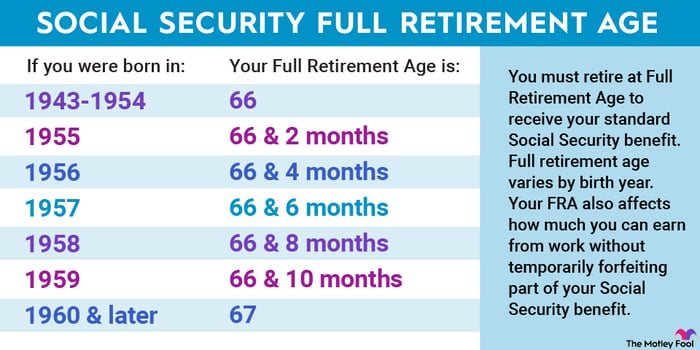
Image source: The Motley Fool.
To be clear, there's not necessarily a single best age to take Social Security, as your choice will depend on personal preferences, life expectancy, and retirement goals. But from a strictly financial standpoint, research suggests that waiting until age 70 to file could be far more lucrative than claiming early.
In a 2019 United Income study, researchers analyzed retirees' claiming decisions and their impact on lifetime income, aiming to determine the optimal age to file for benefits.
They found that 57% of retirees could accumulate more wealth over a lifetime by filing at age 70, with the average retired household foregoing around $111,000 in lifetime income by claiming at the "suboptimal" age.
How Social Security's future might affect your plans
Determining a claiming age is primarily an individual decision based on your unique situation, but Social Security's financial situation might also play a role in your choice.
While the program isn't going bankrupt, its dwindling trust funds could become a problem in the next decade. Social Security has been running at a deficit, paying out more in benefits than it's receiving in income. To bridge the gap and continue paying benefits in full, it's been pulling money from its two trust funds.
The Social Security Administration Board of Trustees estimates that both trust funds will be depleted by 2034, at which point the program's income sources will only be enough to cover around 81% of scheduled benefits. Unless Congress finds a solution before 2034, benefits could be slashed by nearly 20%.
Another challenge plaguing Social Security is its loss of buying power. Despite annual cost-of-living adjustments, benefits have lost around 20% of their buying power between 2010 and 2024, according to analysis from nonpartisan advocacy group The Senior Citizens League.
Should you take Social Security in 2026?
Benefits may not be as reliable in the future, and if you're filing before your full retirement age, you can expect smaller checks, too. In some cases, it's worth delaying benefits to offset the impact of reduced buying power and potential cuts in the next decade.
Again, there's no one-size-fits-all answer as to when you should file. But by understanding Social Security's challenges and how your age will impact your monthly payment, it will be easier to decide on the right age for your situation.
The $23,760 Social Security bonus most retirees completely overlook
If you're like most Americans, you're a few years (or more) behind on your retirement savings. But a handful of little-known "Social Security secrets" could help ensure a boost in your retirement income.
One easy trick could pay you as much as $23,760 more... each year! Once you learn how to maximize your Social Security benefits, we think you could retire confidently with the peace of mind we're all after. Join Stock Advisor to learn more about these strategies.
View the "Social Security secrets" »
The Motley Fool has a disclosure policy.
Recommended Articles


