


Where Will Viking Therapeutics Stock Be in 10 Years?
Key Points
Viking Therapeutics has a shot at becoming a leader in the weight-loss market.
However, the company's quest could run into significant obstacles.
- 10 stocks we like better than Viking Therapeutics ›
Viking Therapeutics (NASDAQ: VKTX), a clinical-stage biotech company, went public almost 11 years ago. Since then, the drugmaker's stock has performed well, while it has made significant clinical progress. Viking Therapeutics' leading candidate is now undergoing pivotal studies. The company is approaching what could be the most important period in its history as it awaits clinical trial data, which should be released within the next 18 months. For investors focused on the long game, it's important to gauge how the drugmaker's prospects might look beyond that. That said, let's discuss where Viking Therapeutics might be in 10 years.
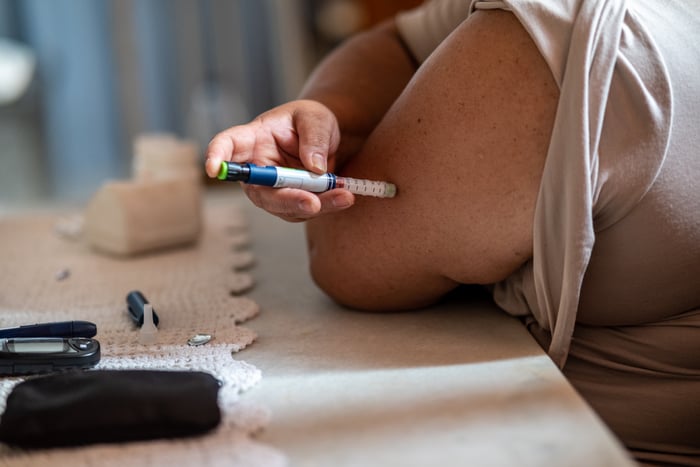
Image source: Getty Images.
Will AI create the world's first trillionaire? Our team just released a report on the one little-known company, called an "Indispensable Monopoly" providing the critical technology Nvidia and Intel both need. Continue »
The best-case scenario
Viking Therapeutics is developing medicines for weight management, with its leading candidate, VK2735, being a dual GLP-1/GIP agonist. VK2735 is undergoing a pair of 78-week phase 3 studies, the second of which recently completed enrollment. The medicine's results in mid-stage clinical trials were strong, and it will also need to demonstrate competitive efficacy to carve out a niche in the growing weight-loss market.
Here's what might happen. Viking Therapeutics could deliver efficacy on par with the current leading weight-loss medicine, Eli Lilly's Zepbound, also a dual GLP-1/GIP agonist. If Viking can pull that off, its share price will soar. Next, the company could launch VK2735 and grab a decent market share. With the anti-obesity space projected to exceed $100 billion within the next decade, there will be plenty of room for multiple winners.
An analyst once predicted that VK2735 could generate about $14.4 billion in the U.S. and $7.2 billion in Europe at its peak, for a total of about $21.6 billion. Note that Zepbound's 2025 sales of $13.5 billion suggest the medicine could approach (or even exceed) $21 billion this year, despite being launched only in late 2023. With similar efficacy, VK2735 might potentially achieve similarly outstanding sales at its very peak, especially if we include Viking Therapeutics' oral version of its crown jewel in this calculation.
The first oral weight-loss medicine that hit the shelves this year appears to be expanding the market by attracting patients who were hesitant to use drugs like Zepbound, which is administered by subcutaneous injection. Viking Therapeutics' oral VK2735 completed phase 2 studies last year, and if it also performs well in pivotal clinical trials, it will help the company establish an even stronger position over the next decade.
Lastly, Viking Therapeutics is exploring ways to help patients keep the weight off through different dosing regimens with VK2735, efforts which could further strengthen its competitive position in this market.
There is significant risk involved
While it's impossible to predict accurately how things will unfold for Viking Therapeutics through 2036, investors shouldn't bank on the best-case scenario. First, most biotechs don't have such a flawless streak of clinical and regulatory wins. Second, as the weight-loss market becomes more competitive, clinical wins that impress the market and translate into commercial success will become harder to achieve.
Zepbound might be the standard for now, but it might no longer be in five years. This has serious implications for Viking Therapeutics, which will have to do more than post robust efficacy for VK2735 in its ongoing phase 3 studies to become a strong, consistent contender in the weight-loss market over the next decade.
It's also worth noting that not that many biotechs have gone from small, clinical-stage companies to established leaders in the pharmaceutical industry over the past two decades. The best ones often get acquired. Many fail before making any significant breakthroughs. Many others see their shares rise on promising, early clinical wins, but decline significantly thereafter as they are unable to keep innovating, while their approved products (if they have any) fail to generate enough revenue to impress the market.
What does all this mean for Viking Therapeutics? Amid potential clinical and regulatory setbacks, stiff competition, and funding challenges, the drugmaker faces above-average risk. While we could see its shares soar over the next 10 years, it might also go bankrupt during that period. Interested investors should keep that in mind before initiating a position.
Should you buy stock in Viking Therapeutics right now?
Before you buy stock in Viking Therapeutics, consider this:
The Motley Fool Stock Advisor analyst team just identified what they believe are the 10 best stocks for investors to buy now… and Viking Therapeutics wasn’t one of them. The 10 stocks that made the cut could produce monster returns in the coming years.
Consider when Netflix made this list on December 17, 2004... if you invested $1,000 at the time of our recommendation, you’d have $532,066!* Or when Nvidia made this list on April 15, 2005... if you invested $1,000 at the time of our recommendation, you’d have $1,087,496!*
Now, it’s worth noting Stock Advisor’s total average return is 926% — a market-crushing outperformance compared to 185% for the S&P 500. Don't miss the latest top 10 list, available with Stock Advisor, and join an investing community built by individual investors for individual investors.
See the 10 stocks »
*Stock Advisor returns as of April 3, 2026.
Prosper Junior Bakiny has positions in Eli Lilly and Viking Therapeutics. The Motley Fool recommends Viking Therapeutics. The Motley Fool has a disclosure policy.
Recommended Articles


