


Could AI Really Kill Atlassian's Business? Here's Why Wall Street Might Be Wrong
Key Points
Wall Street is concerned AI will decimate the software industry by allowing enterprises to build their own tools.
Atlassian created software products like Jira and Confluence, and is enhancing them with new AI capabilities.
Customers are spending more money than before, yet the stock is now the cheapest it has ever been.
- 10 stocks we like better than Atlassian ›
Atlassian (NASDAQ: TEAM) created a suite of software products designed to boost productivity for enterprises by fostering collaboration between employees, and by streamlining workflows. Its stock has plummeted by 57% already this year, and it's down by a whopping 85% from its 2021 record high -- even though its business looks stronger than ever.
The stock is down because Wall Street believes artificial intelligence (AI) is about to decimate the software industry, and the concerns seem quite logical. AI could replace a large chunk of the workforce, threatening businesses like Atlassian that charge their enterprise customers on a per-user basis. Enterprises could also use AI to create their own software tools, replacing expensive third-party providers like Atlassian.
Will AI create the world's first trillionaire? Our team just released a report on the one little-known company, called an "Indispensable Monopoly" providing the critical technology Nvidia and Intel both need. Continue »
But the evidence so far suggests those worries might be overblown. Atlassian is using AI to enhance its existing software products, and this strategy has encouraged its customers to spend even more money than before. Atlassian stock has never been this cheap, so here's why the crash might actually be a buying opportunity.

Image source: Getty Images.
Atlassian is actually using AI to its advantage
Atlassian's two flagship software products are Jira and Confluence. Jira is a digital space where software development teams can collaborate, allowing them to rapidly troubleshoot bugs and launch upgrades. Confluence, on the other hand, is a digital space for the entire organization, where employees from all departments can share important documents and discuss operational progress.
The company has added two AI products to its portfolio since 2024. First is Loom, an innovative platform that allows employees to create short videos to convey messages or instructions to their colleagues, eliminating the need for formal meetings. It uses AI to autonomously create chapters and summaries, and it will even post a transcript directly to Confluence for employees to read.
The second is Rovo, a platform that specifically enhances Jira and Confluence. It includes a powerful search function that can instantly locate information from across the entire organization, whether it's stored in an Atlassian software app or a third-party app like Microsoft OneDrive. Rovo also features a chatbot which employees can collaborate with on projects, in addition to a development studio where they can create AI agents to automate specific workflows.
Rovo had over 5 million monthly active users at the conclusion of Atlassian's fiscal 2026 second quarter (ended Dec. 31), which is impressive for a product that is less than two years old.
AI products are boosting Atlassian's revenue
Atlassian had $6 billion in annual run-rate revenue at the end of its fiscal 2026 second quarter, which was a record high. Plus, the company's cloud business, which is where most customers now deploy their Atlassian software, had a net revenue retention rate of 120% during the quarter, which was up for the third consecutive period.
It meant existing customers were spending 20% more money compared to the same quarter last year, and management said the expanding use of its AI platform was the primary reason.
But that wasn't the only sign of momentum in Atlassian's business. The number of deals worth more than $1 million in annual revenue the company signed nearly doubled year over year in the second quarter, so there is clearly plenty of demand for products like Jira, Confluence, Loom, and Rovo among some of the highest-spending enterprises.
But Atlassian isn't totally out of the woods. AI is absolutely making employees more productive in many organizations, which means smaller workforces might be inevitable in the future. Therefore, Atlassian could suffer a decline in revenue if it continues charging customers on a per-user basis. Management hasn't outlined a plan to change its revenue model yet, but since the writing is basically on the wall, I would expect some news on this front in the coming quarters.
Atlassian stock has never been this cheap
When Atlassian stock peaked during the tech market frenzy in 2021, its price-to-sales (P/S) ratio surged to around 50, which was completely unsustainable. But the 85% decline in the stock since then, combined with the company's consistent revenue growth, has pushed its P/S ratio down to just 3.1. Atlassian has never been this cheap since going public in 2015.
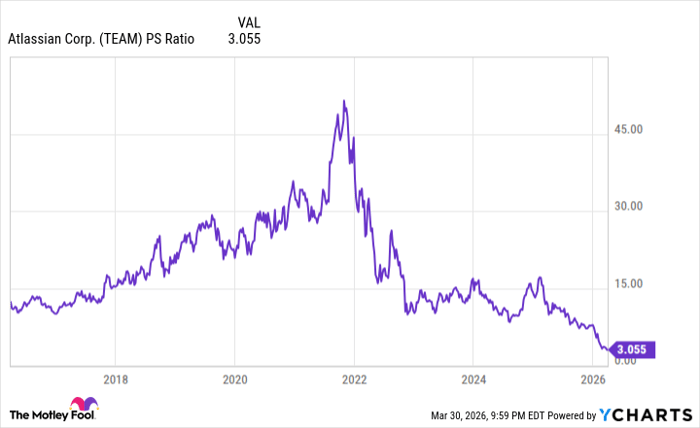
TEAM PS Ratio data by YCharts
So far, there is no sign of a software-spending slowdown among Atlassian's customers. In fact, as I highlighted earlier, it's quite the opposite. Even as AI coding assistants become more proficient at creating usable software, I don't think enterprises will be in a hurry to ditch valuable providers like Atlassian. Remember, it isn't just about the product -- Atlassian also provides technical support, data center infrastructure, and security, which cost a truckload of money.
Most businesses don't have the financial resources or the technical expertise to build what Atlassian offers, even if they do manage to create a similar piece of software to Jira or Confluence. As a result, I think Atlassian's plunging stock price presents long-term investors with a great buying opportunity.
Should you buy stock in Atlassian right now?
Before you buy stock in Atlassian, consider this:
The Motley Fool Stock Advisor analyst team just identified what they believe are the 10 best stocks for investors to buy now… and Atlassian wasn’t one of them. The 10 stocks that made the cut could produce monster returns in the coming years.
Consider when Netflix made this list on December 17, 2004... if you invested $1,000 at the time of our recommendation, you’d have $532,066!* Or when Nvidia made this list on April 15, 2005... if you invested $1,000 at the time of our recommendation, you’d have $1,087,496!*
Now, it’s worth noting Stock Advisor’s total average return is 926% — a market-crushing outperformance compared to 185% for the S&P 500. Don't miss the latest top 10 list, available with Stock Advisor, and join an investing community built by individual investors for individual investors.
See the 10 stocks »
*Stock Advisor returns as of April 3, 2026.
Anthony Di Pizio has no position in any of the stocks mentioned. The Motley Fool has positions in and recommends Atlassian and Microsoft. The Motley Fool has a disclosure policy.
Recommended Articles


