


2 No-Brainer Vanguard ETFs to Buy During the Stock Market Sell-Off
Key Points
The benchmark S&P 500 index is approaching correction territory, with a decline of 9% from its record high so far.
The stock market has always recovered to new highs over the long term, and this time probably won't be different.
Buying ETFs can give investors diversified, inexpensive exposure to the fastest-growing areas of the stock market.
- 10 stocks we like better than Vanguard Growth ETF ›
The S&P 500 is down almost 9% from its January record high. Ongoing geopolitical tensions in the Middle East have triggered a spike in oil prices, which could stoke inflation for any products requiring transportation by land, air, or sea. As a result, investors are bracing for economic uncertainty and even a potential increase in interest rates.
But throughout history, the S&P 500 has always recovered to new highs over the long term, so periods of weakness have actually been great buying opportunities. This time probably won't be different, so investors who are sitting on cash might want to put it to work.
Will AI create the world's first trillionaire? Our team just released a report on the one little-known company, called an "Indispensable Monopoly" providing the critical technology Nvidia and Intel both need. Continue »
Below, I'll share two popular Vanguard exchange-traded funds (ETFs) to consider buying during the stock market sell-off.

Image source: Getty Images.
1. The Vanguard S&P 500 ETF
The Vanguard S&P 500 ETF (NYSEMKT: VOO) directly tracks the performance of the S&P 500 by holding the same stocks and maintaining similar weightings. The S&P 500 is America's benchmark index because of its diversified composition, which features 500 companies from 11 different economic sectors.
Therefore, the index has exposure to high-flying technology stocks like Nvidia, banking giants like JPMorgan Chase, and everything in between. Below are the five largest sectors in the S&P 500 by weight, along with their three most valuable constituents:
|
Sector |
Vanguard ETF Weighting |
Top Three Stocks |
|---|---|---|
|
Information technology |
32.4% |
Nvidia, Apple, Microsoft |
|
Financials |
12.5% |
Berkshire Hathaway, JPMorgan Chase, Visa |
|
Communication services |
10.5% |
Alphabet, Meta Platforms, Netflix |
|
Consumer discretionary |
10% |
Amazon, Tesla, Home Depot |
|
Healthcare |
9.8% |
Eli Lilly, Johnson & Johnson, AbbVie |
Data source: Vanguard. Sector weightings are accurate as of Feb. 28, 2026, and are subject to change.
The other six S&P 500 sectors are industrials, consumer staples, energy, utilities, materials, and real estate.
The S&P 500 is weighted by market capitalization, meaning the largest companies in the index have a greater influence over its performance than the smallest. Nvidia, Apple, and Microsoft are three of the world's largest companies, boasting a combined market cap of $10.3 trillion, which is why the information technology sector has such a dominant representation in the index. The sector is also home to a fourth trillion-dollar giant, Broadcom.
The S&P 500 has delivered a compound annual return of 10.6% since its inception in 1957, even after accounting for every sell-off, correction, and even bear market along the way. But it has delivered an accelerated annual return of 21.7% since the artificial intelligence (AI) boom started gathering momentum at the beginning of 2023, thanks to its high degree of exposure to the information technology sector.
The Vanguard S&P 500 ETF is one of the cheapest ways to invest in the index. It has a .03% expense ratio, which is the proportion of the fund deducted each year to cover management costs. That means an investment of $10,000 would incur an annual fee of around $3, which is insignificant compared to the fund's potential returns.
2. The Vanguard Growth ETF
Investors who are comfortable enduring a little bit more volatility for an opportunity to earn even higher returns might want to consider the Vanguard Growth ETF (NYSEMKT: VUG). It tracks the performance of the CRSP U.S. Large Cap Growth index, which aims to invest in the top 85% of companies listed on American stock exchanges (by value).
To explain it another way, if we ranked all 3,498 publicly traded companies in order of their market caps, the CRSP U.S. Large Cap Growth Index would start at the top of the list and invest in every name until it captures 85% of their combined value.
Remarkably, the index holds only 150 stocks, which highlights the extreme concentration of wealth in corporate America. You read that correctly -- 150 companies account for 85% of the entire value of the U.S. stock market, while the other 3,348 companies represent the remaining 15%.
Over 64% of the Vanguard Growth ETF's portfolio is parked in the technology sector, so it has a much higher exposure to stocks like Nvidia than does the S&P 500. In fact, here is a list of its top five holdings and their weightings relative to the benchmark index:
|
Stock |
Vanguard Growth ETF Weighting |
S&P 500 Weighting |
|---|---|---|
|
1. Nvidia |
12.82% |
7.32% |
|
2. Apple |
12.23% |
6.64% |
|
3. Alphabet |
10.18% |
5.54% |
|
4. Microsoft |
9.15% |
4.96% |
|
5. Meta Platforms |
4.44% |
2.40% |
Data source: Vanguard. Portfolio weightings are accurate as of Feb. 28, 2026, and are subject to change.
Having more exposure to the fastest-growing areas of the stock market will inevitably lead to higher returns over the long run, which is why the Vanguard Growth ETF has soared by 297% over the last decade, trouncing the 209% return in the S&P 500 over the same period.
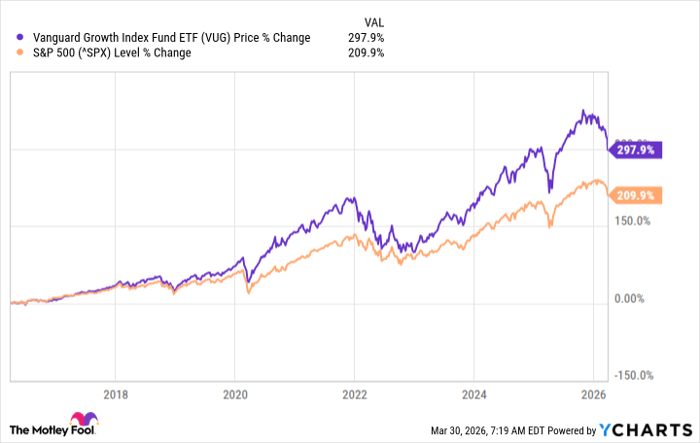
VUG data by YCharts.
But as I mentioned earlier, higher returns often come with more volatility. While the S&P 500 is down around 9% from its recent all-time high, the Vanguard Growth ETF is down by 16%. Therefore, investors who buy this ETF should aim to hold it for a long-term period of five years or more to smooth out the noise and maximize their potential returns.
Should you buy stock in Vanguard Growth ETF right now?
Before you buy stock in Vanguard Growth ETF, consider this:
The Motley Fool Stock Advisor analyst team just identified what they believe are the 10 best stocks for investors to buy now… and Vanguard Growth ETF wasn’t one of them. The 10 stocks that made the cut could produce monster returns in the coming years.
Consider when Netflix made this list on December 17, 2004... if you invested $1,000 at the time of our recommendation, you’d have $515,294!* Or when Nvidia made this list on April 15, 2005... if you invested $1,000 at the time of our recommendation, you’d have $1,077,442!*
Now, it’s worth noting Stock Advisor’s total average return is 914% — a market-crushing outperformance compared to 184% for the S&P 500. Don't miss the latest top 10 list, available with Stock Advisor, and join an investing community built by individual investors for individual investors.
See the 10 stocks »
*Stock Advisor returns as of April 3, 2026.
JPMorgan Chase is an advertising partner of Motley Fool Money. Anthony Di Pizio has no position in any of the stocks mentioned. The Motley Fool has positions in and recommends AbbVie, Alphabet, Amazon, Apple, Berkshire Hathaway, Home Depot, JPMorgan Chase, Meta Platforms, Microsoft, Netflix, Nvidia, Tesla, Vanguard Growth ETF, Vanguard S&P 500 ETF, and Visa and is short shares of Apple. The Motley Fool recommends Broadcom and Johnson & Johnson. The Motley Fool has a disclosure policy.
Recommended Articles


