


One-Third of the World's Fertilizer Passes Through the Strait of Hormuz. That Could Have Serious Repercussions for This Consumer Staples Company.
Key Points
In theory, consumer staples stocks should be ideal avenues for waiting out geopolitical turmoil.
Unfortunately, the reality is proving much different for General Mills and others.
Some of the stock’s recent weakness may be attributable to the closing of the Strait of Hormuz.
- 10 stocks we like better than General Mills ›
During periods of geopolitical strife, it's common for investors to turn to defensive sectors, such as consumer staples and utilities. That's conventional wisdom, and it often works -- until it doesn't. The conflict in Iran is an example of that wisdom being rejected.
These days, it's almost impossible to watch the news or scour the internet without seeing updates on the currently shuttered Strait of Hormuz. Many of those headlines pertain to the strait's status as the shipping lane for 20% of the world's oil, but a third of the world's fertilizer transported by ship also moves through that waterway.
Will AI create the world's first trillionaire? Our team just released a report on the one little-known company, called an "Indispensable Monopoly" providing the critical technology Nvidia and Intel both need. Continue »

With fertilizer supplies constricted, it's time to pass on food stocks. Image source: Getty Images.
This fact goes a long way toward explaining why consumer staples stocks, including General Mills (NYSE: GIS), aren't just betraying their defensive ways. They're being savagely punished, as highlighted by General Mills' share price decline of 17% over the past month.
Now isn't the time to snack on food stocks
Many of the big-name publicly traded food companies, such as General Mills, don't own or operate farms. Rather, they contract out to networks of independent farms and growers. So while General Mills isn't a direct user of fertilizer, its suppliers are. And they're being hamstrung by the situation in the Middle East, wreaking havoc on food stocks.
General Mills has other challenges, too, right now (more on that later). So its recent performance is even worse than that of a major consumer staples exchange-traded fund (ETF), indicating that while investors have some affinity for this defensive sector, that sentiment isn't extending to the Rice Chex maker.
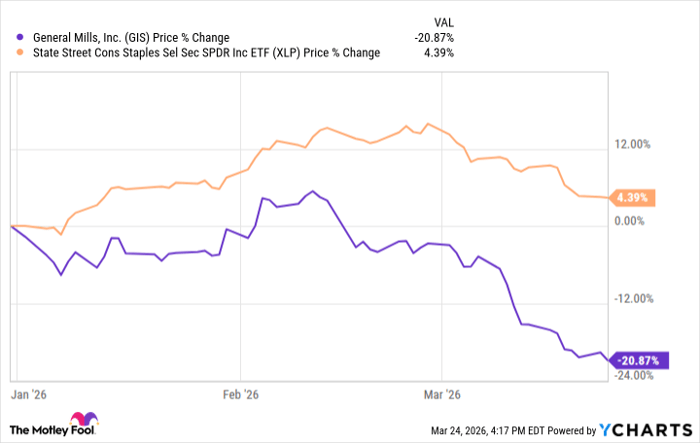
GIS data by YCharts
In terms of the Middle East, what's happening right now is a chokehold on the global fertilizer supply chain. Understanding why General Mills and some of its rivals are on the bad end of this trade isn't difficult. History shows that many wars have been fought over the world's various commodities. Petroleum is particularly valuable to global decision-makers, who want to ensure it continues to flow and reach end markets.
Fertilizer? Well, that's further down their respective lists. Even if there were shipping personnel out there brave enough to take an assignment today involving the Strait of Hormuz, chances are they'd prefer to be moving oil, not phosphate fertilizers. Shipping oil is pricier -- and therefore more profitable -- because because it's a hazardous material, more security is needed, and the shippers themselves are affected by fuel prices.
It's not a stretch to say that the companies providing insurance to the shippers and any prospective escorts share the same sentiment. Insurance fees run higher on oil shipments due to environmental concerns, fire hazards, and in some regions, the possibility of war.
The result is a strain on farming. Northern Hemisphere farmers, likely including those that supply General Mills, usually order fertilizer in March for use in the second quarter. Constricted fertilizer supplies make it harder for these farmers to obtain financing, and some experts fret that this will result in higher food prices. That could send already inflation-weary consumers to off-label brands rather than "premium" offerings from the likes of General Mills.
More reasons to steer away from General Mills
The Strait of Hormuz is a trying situation for General Mills, but there other reasons for investors to go shopping elsewhere in the realm of food stocks.
The Pillsbury maker's earnings for its fiscal third quarter (which ended in February) missed estimates as sales slipped 8%, and its outlook for the entirety of fiscal 2026 calls for a 16% to 20% drop in adjusted earnings. Demand is slack in part because consumers want to avoid sticker shock. Constrained fertilizer can easily contribute to higher food prices, but even if the Strait of Hormuz soon reopens, that doesn't mean shoppers will realize immediate savings.
Bottom line: Shares of General Mills are down 54% over the past three years. Investors kicking the tires on this stock should wait for confirmation that things are turning for the better. And those signs may not emerge anytime soon.
Should you buy stock in General Mills right now?
Before you buy stock in General Mills, consider this:
The Motley Fool Stock Advisor analyst team just identified what they believe are the 10 best stocks for investors to buy now… and General Mills wasn’t one of them. The 10 stocks that made the cut could produce monster returns in the coming years.
Consider when Netflix made this list on December 17, 2004... if you invested $1,000 at the time of our recommendation, you’d have $503,268!* Or when Nvidia made this list on April 15, 2005... if you invested $1,000 at the time of our recommendation, you’d have $1,049,793!*
Now, it’s worth noting Stock Advisor’s total average return is 898% — a market-crushing outperformance compared to 182% for the S&P 500. Don't miss the latest top 10 list, available with Stock Advisor, and join an investing community built by individual investors for individual investors.
See the 10 stocks »
*Stock Advisor returns as of March 27, 2026.
Todd Shriber has no position in any of the stocks mentioned. The Motley Fool has no position in any of the stocks mentioned. The Motley Fool has a disclosure policy.
Recommended Articles


