


AUD/USD Price Forecast: Momentum weakens, downside risks build below 0.6900
- AUD/USD extends losses for a fourth straight day, slipping to fresh two-month lows.
- US Dollar remains supported by safe-haven demand and rising Oil prices amid Middle East tensions.
- Technical outlook turns bearish below 0.7000, with momentum indicators pointing to further downside risk.
The Australian Dollar (AUD) edges lower against the US Dollar (USD) on Friday, with AUD/USD extending losses for a fourth straight day as the Greenback remains broadly supported amid ongoing geopolitical tensions in the Middle East. At the time of writing, the pair is trading around 0.6866, slipping to fresh two-month lows.
The US Dollar continues to draw support from its status as the world’s primary reserve currency, with investors turning to the Greenback to meet funding needs and seek safety during periods of heightened market stress.
At the same time, rising Oil prices are indirectly boosting demand for the USD, as global crude transactions are largely priced in Dollars, leaving risk-sensitive currencies such as the Australian Dollar under sustained pressure.
The US Dollar Index (DXY), which tracks the Greenback’s value against a basket of six major currencies, is trading around 100.19 and is poised to finish the week higher by over 0.50%. In contrast, AUD/USD is heading for a weekly decline of over 2%, marking its steepest drop since October 2025.
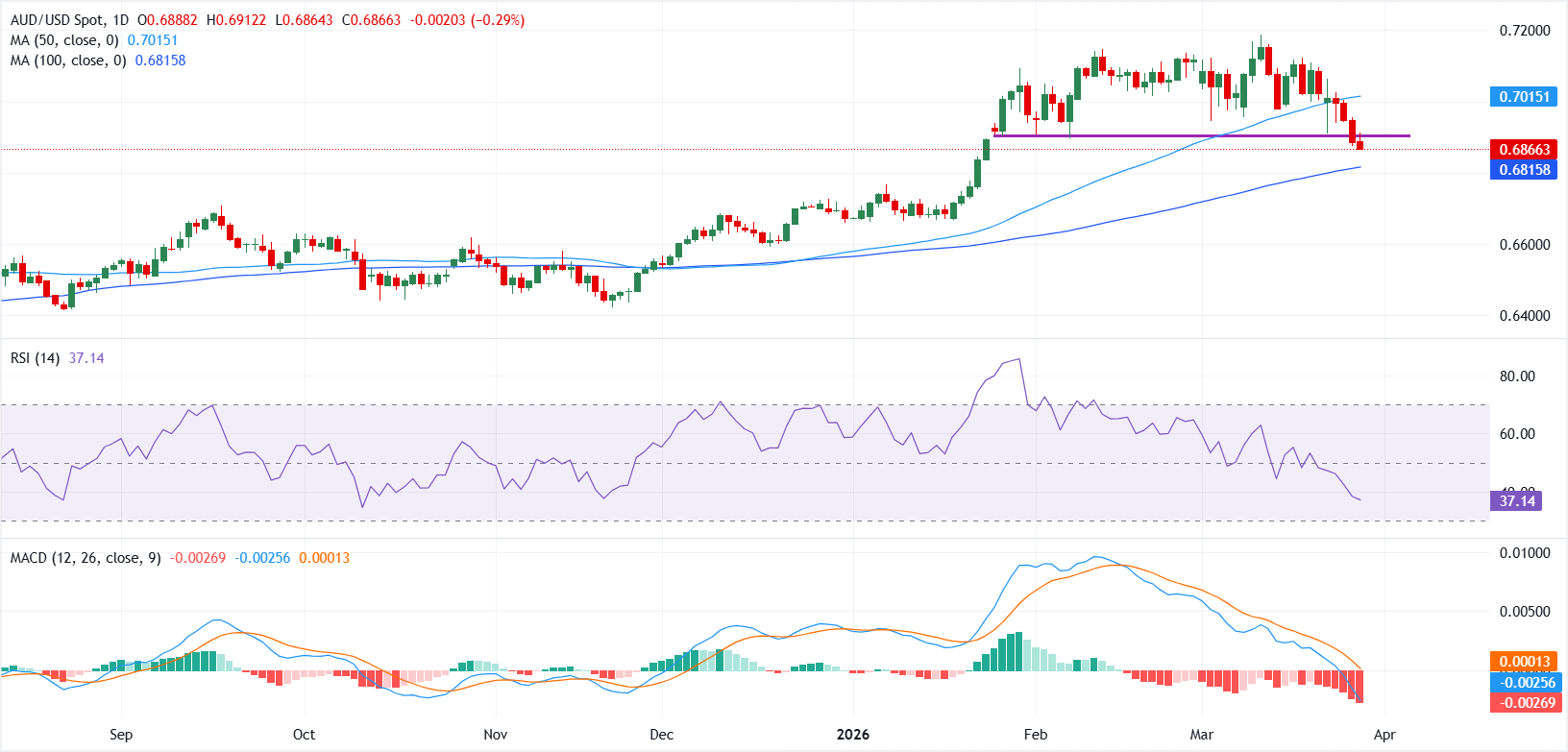
From a technical perspective, the AUD/USD outlook has turned bearish after breaking below the 0.7000 psychological level, which closely aligns with the 50-day Simple Moving Average (SMA) at 0.7015.
The latest leg lower has also driven the pair under the multi-month support zone around 0.6900, reinforcing downside pressure and signaling a shift in near-term market structure.
The Relative Strength Index (RSI) retreats toward 37, showing weakening momentum without reaching oversold territory, which suggests room for further downside pressure. The Moving Average Convergence Divergence (MACD) line remains below its signal and drifts deeper into negative territory, with a slightly expanding negative histogram, reinforcing the downside tone in the short term.
On the downside, immediate support is seen at the 100-day Simple Moving Average (SMA) around 0.6815. A daily close below this level could expose the next bearish target near the 0.6700 psychological mark, a previous breakout zone that could cap further downside.
On the upside, the 0.6900 zone now acts as immediate resistance, having previously served as a key support level. A sustained move above the 100-day SMA, around the 0.7000 handle, would be needed to ease bearish pressure and signal a continuation of the uptrend.
Australian Dollar FAQs
One of the most significant factors for the Australian Dollar (AUD) is the level of interest rates set by the Reserve Bank of Australia (RBA). Because Australia is a resource-rich country another key driver is the price of its biggest export, Iron Ore. The health of the Chinese economy, its largest trading partner, is a factor, as well as inflation in Australia, its growth rate and Trade Balance. Market sentiment – whether investors are taking on more risky assets (risk-on) or seeking safe-havens (risk-off) – is also a factor, with risk-on positive for AUD.
The Reserve Bank of Australia (RBA) influences the Australian Dollar (AUD) by setting the level of interest rates that Australian banks can lend to each other. This influences the level of interest rates in the economy as a whole. The main goal of the RBA is to maintain a stable inflation rate of 2-3% by adjusting interest rates up or down. Relatively high interest rates compared to other major central banks support the AUD, and the opposite for relatively low. The RBA can also use quantitative easing and tightening to influence credit conditions, with the former AUD-negative and the latter AUD-positive.
China is Australia’s largest trading partner so the health of the Chinese economy is a major influence on the value of the Australian Dollar (AUD). When the Chinese economy is doing well it purchases more raw materials, goods and services from Australia, lifting demand for the AUD, and pushing up its value. The opposite is the case when the Chinese economy is not growing as fast as expected. Positive or negative surprises in Chinese growth data, therefore, often have a direct impact on the Australian Dollar and its pairs.
Iron Ore is Australia’s largest export, accounting for $118 billion a year according to data from 2021, with China as its primary destination. The price of Iron Ore, therefore, can be a driver of the Australian Dollar. Generally, if the price of Iron Ore rises, AUD also goes up, as aggregate demand for the currency increases. The opposite is the case if the price of Iron Ore falls. Higher Iron Ore prices also tend to result in a greater likelihood of a positive Trade Balance for Australia, which is also positive of the AUD.
The Trade Balance, which is the difference between what a country earns from its exports versus what it pays for its imports, is another factor that can influence the value of the Australian Dollar. If Australia produces highly sought after exports, then its currency will gain in value purely from the surplus demand created from foreign buyers seeking to purchase its exports versus what it spends to purchase imports. Therefore, a positive net Trade Balance strengthens the AUD, with the opposite effect if the Trade Balance is negative.
Recommended Articles


