


Gold Prices Fall for Ten Consecutive Days, Why Does Gold Still Have a Bullish Logic?
TradingKey - Recently, gold has inevitably faced periodic pressure amid fluctuating expectations for Federal Reserve rate cuts and the sustained strength of the U.S. dollar and Treasury yields. However, geopolitical risks, inflation concerns, and long-term allocation demand continue to provide support, leading the market into a re-pricing phase following a high-level retracement. From a broader structural perspective, while the short-term correction is significant, the overall upward trend for gold has not been fundamentally compromised.
As of press time on March 24, spot gold remains under pressure, dipping to $4,305.94 during the session—marking its tenth consecutive day of decline with a cumulative drop exceeding $900. Viewed over a longer timeframe, gold has retreated more than 20% since the escalation of the Middle East conflict on February 28. The safe-haven logic that previously bolstered gold is being gradually offset by a stronger dollar and expectations of higher interest rates. The market is no longer merely trading on whether geopolitical risks will drive gold higher, but rather whether these risks will simultaneously push up inflation and interest rates.
Fundamentals
From a fundamental perspective, the primary theme suppressing gold remains the re-pricing of the Fed's policy path. The Federal Reserve maintained interest rates at 3.50%—3.75% on March 18, but its latest stance emphasized that inflation "remains elevated," and officials' projected rate cuts for 2026 have significantly narrowed. The "faster and earlier cuts" the market once anticipated have been delayed. As the likelihood of rates remaining higher for longer increases, the appeal of gold as a non-yielding asset diminishes, serving as a core driver of this correction.
Meanwhile, the dollar's strength continues to amplify this pressure. Oil prices rebounded today, with Brent and WTI both gaining nearly 3% in a single day, reigniting inflation expectations. Consequently, Treasury yields have climbed, and the dollar has strengthened in tandem.
For gold, this is a double blow: a stronger dollar makes the asset more expensive for international buyers, while rising yields increase the opportunity cost of holding the metal. Even with persistent risks in the Middle East, short-term capital prefers to move to the sidelines rather than maintain long positions.
Capital flow data has already provided a signal. Gold ETFs recently saw outflows of approximately $7.9 billion, equivalent to about 54.8 tons. This volume suggests proactive position reduction by medium-term funds rather than simple short-term profit-taking. Despite the significant drop from recent highs, the underlying long-term bullish thesis—driven by global fiscal pressures, central bank buying, and geopolitical shifts—remains intact. However, in the short term, these factors are being overshadowed by the direct impact of interest rates and the dollar.
Technicals
From a technical standpoint, gold has entered a clear downward corrective phase. Notably, gold closed at $4,406.64 yesterday, holding above the $4,380 level and remaining higher than the low formed on February 2. This indicates robust support in the $4,380-$4,400 range, suggesting the overall uptrend for gold is not yet broken.
The daily gold chart shows that despite yesterday's negative close, the price formed a long lower shadow. Furthermore, the 144-day moving average has not been effectively broken, implying the broad trend is still bullish. Although gold dipped toward $4,300 today, it quickly rebounded above $4,400, indicating that bearish momentum is waning and bargain hunters are actively entering the market.
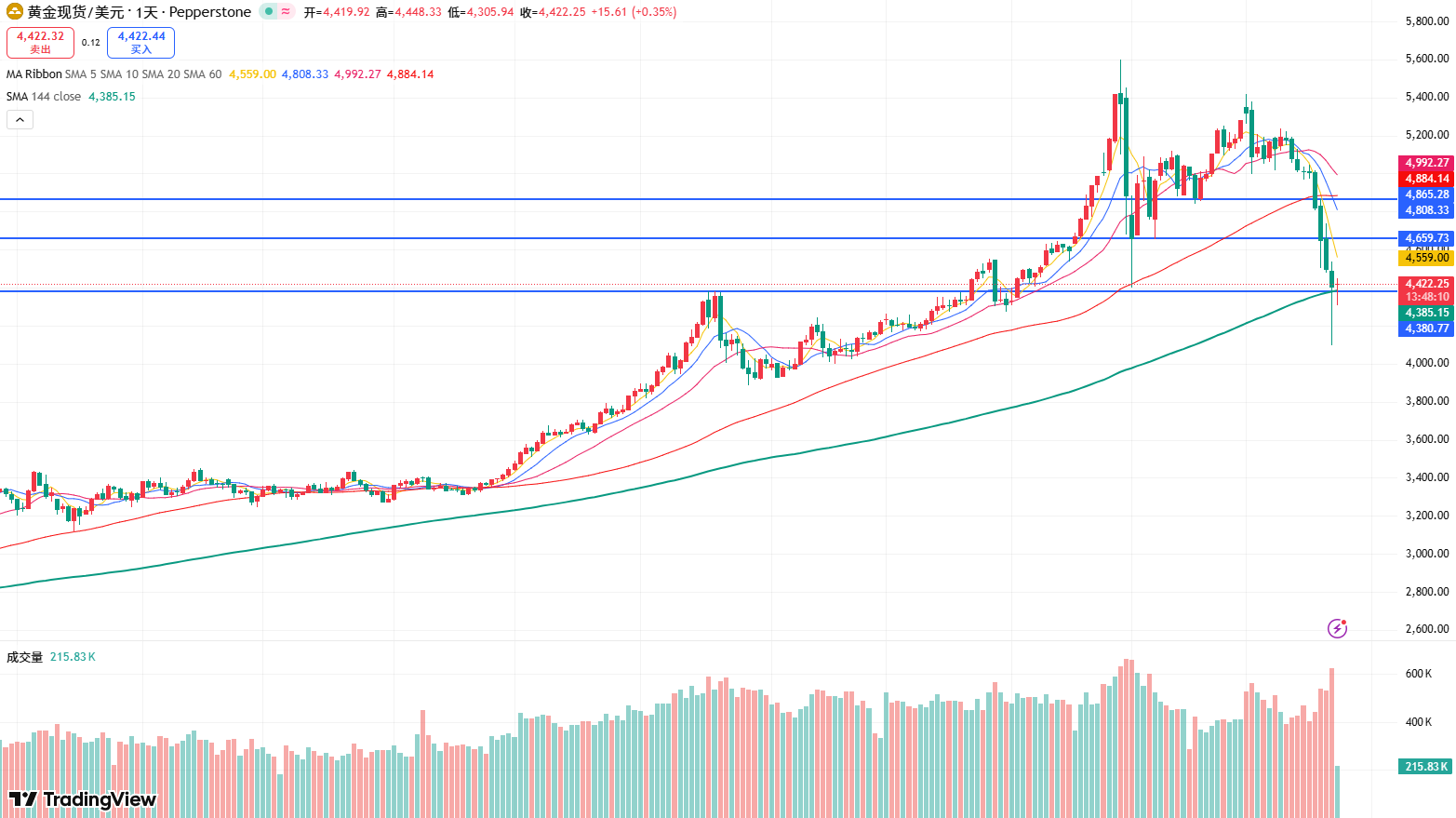
Investors should continue to watch the $4,380 level. A daily close below this mark could signal a breakdown of the upward trend, potentially leading to a deeper corrective consolidation. Conversely, if prices hold above this level, gold could resume its climb to test the $4,660 resistance. A break above $4,660 would open the door for a move toward $4,860 or higher.
Regarding today's market momentum, gold is not simply seeing its decline stall, but is in a typical consolidation phase after a high-level retracement. Bearish pressure is coming from interest rates, the dollar, and yields, while support is anchored by geopolitical risks and medium-to-long-term allocation demand.
For short-term strategy, the market may continue to test the $4,380 level. If this level fails to hold, sentiment may shift further toward a more defensive posture. Buying on dips remains the recommended approach.
Support Levels: 4,380, 4,306
Resistance Levels: 4,660, 4,860
Recommended Articles


