


4 Best Auto Stocks to Buy Under $50
Most people think they have auto stocks figured out in 2026. EVs are the future. Legacy makers are dying. Everyone’s still waiting for the next Tesla (TSLA).
That’s been the dominant narrative for a while now, although recent performance hasn’t really backed it up consistently for the last two years, you probably haven’t made much money on it.
If you look a bit deeper at the current data, the picture is a lot more nuanced. The auto sector is starting to split in different directions across business models and regions - into some companies are quietly pulling ahead while others lag, and this shift isn’t fully reflected in retail positioning yet. Hybrids are quietly eating into pure EV market share.
Trade wars are redrawing supply chains overnight. And a handful of companies, the ones not getting the loudest headlines, are sitting on catalysts that institutional money is already positioning around.
We found four of them. All under $50…!!
One company has guided toward a potential first profitable quarter, although execution remains key.
Another just launched the most important vehicle in its history.
A third earns revenue from one of the world’s biggest automakers - without needing to sell a single car under its own badge.
And the fourth? An engine company most investors have never heard of, whose sales just jumped nearly 60% in six months.
Here’s what each of them looks like right now.
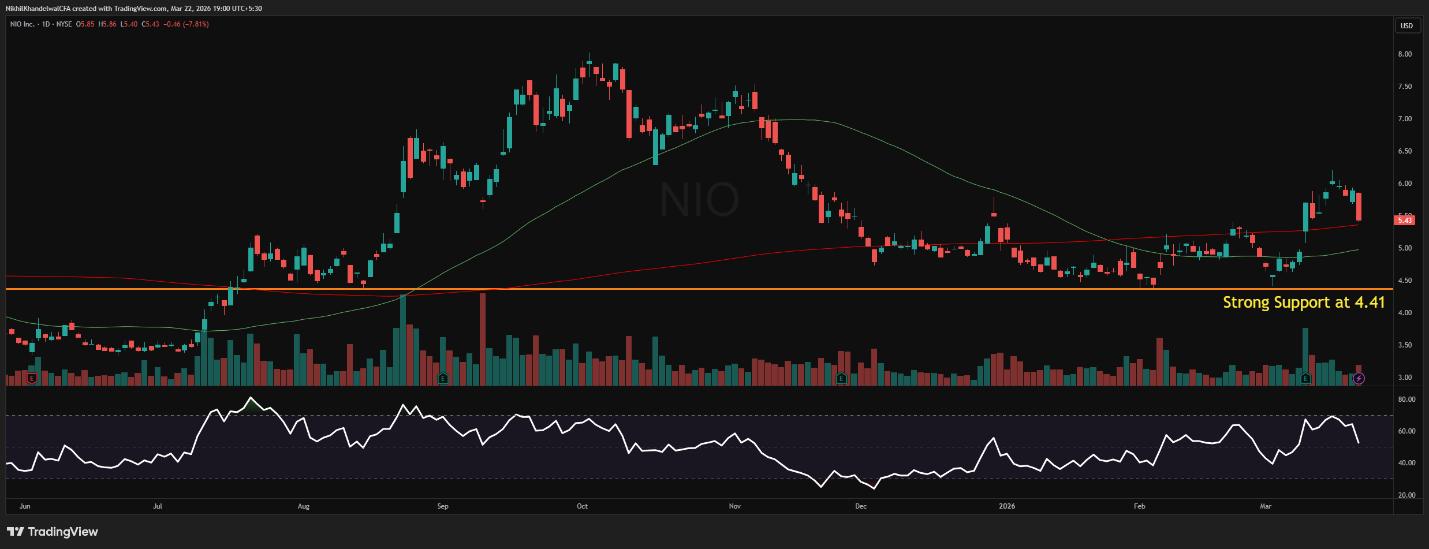
#1. NIO Inc. (NYSE: NIO)
Why NIO in 2026?
• Multi-year lows, major inflection point: NIO is trading near $5.89, which is trading significantly below its historical peak levels above $60. That's not necessarily a buying signal on its own - but combine it with the company's stated goal of posting its first quarterly net profit in 2026, and you've got a setup that short-sellers are increasingly nervous about.
• Breakeven on the horizon: Management has publicly guided for full-year breakeven in 2026. If they hit that target, investor perception around NIO could shift from "perpetual cash-burner" to "path to profitability" - and markets tend to re-price quickly when that happens.
• Global expansion underway: NIO is targeting thousands of vehicle deliveries outside China this year, with the ET5 Touring and ET7 spearheading its international push across 18 countries. Less dependence on China’s highly competitive home market is which is really the key strategic objective here.
• Battery swapping is the differentiator: While Tesla and BYD compete on charging speed, NIO’s Battery-as-a-Service (BaaS) model lets drivers swap a depleted battery for a fully charged one in minutes. Over 2,500 swap stations globally as of Q1 2026. No other manufacturer offers this at scale.
Catalysts for Growth
• First quarterly net profit target (2026) could materially change the investment thesis - from “perpetual cash-burner” to “path to profitability.” analyst sentiment often adjusts following such developments when that shift happens.
• Global expansion into 18+ countries using NIO’s own lineup - including the ET5 Touring and ET7 - positioning international markets as an incremental growth driver, not an afterthought.
• Battery-as-a-Service subscriber growth - effectively creating a subscription-like revenue model for battery usage - creates recurring revenue that traditional automakers simply don’t have, and it significantly improves customer retention.
• NIO’s mass-market sub-brand Onvo - which already launched its L60 model in China - targets a lower price point to compete directly with BYD and Tesla’s Model 3, potentially expanding its total addressable market.
• European tariff waiver negotiations with the European Commission under the minimum price and sales quota framework could crack open a major blocked market.
Business Segments
NIO operates across four primary business lines. Vehicle sales remain the dominant revenue source, while the BaaS model and power services create a recurring subscription layer that distinguishes NIO from traditional OEMs.
Business Segment | Key Details |
Vehicle Sales | EP9, ES8, ET7, ET5, EC6 - core revenue driver |
Battery-as-a-Service (BaaS) | Monthly subscription model; 2,500+ swap stations globally |
Power Solutions | Home charging, Power Express valet, mobile charging trucks |
Software & Services | NIO OS in-car software, OTA updates, digital content subscriptions |
Potential Risks
• HBM chip supply pressure: NIO’s CEO William Li flagged potential cost increases of up to 10,000 yuan (~$1,456) per vehicle tied to HBM (high-bandwidth memory) chip constraints for AI-enabled vehicles. The company has explicitly stated it won’t raise prices until these pressures ease - which means near-term margin compression is likely.
• European headwinds: Falling EV incentives and rising electricity prices across Europe are dampening consumer demand. NIO acknowledged these challenges directly in recent communications.
• Intense China competition: BYD, Li Auto, AITO, and dozens of smaller players are fighting aggressively for Chinese EV market share. Price wars continue to squeeze margins across the board.
• Cash burn: Despite the breakeven guidance, NIO continues to consume significant cash. Any slip in the profitability timeline could pressure the stock sharply lower.
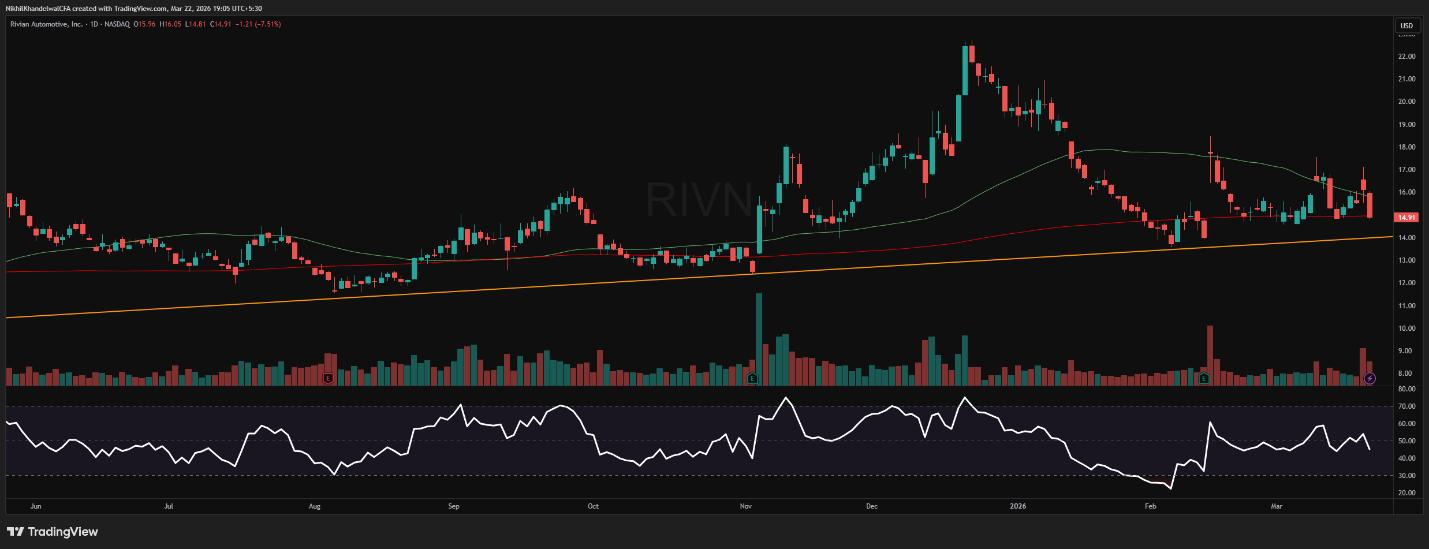
#2. Rivian Automotive, Inc. (NASDAQ: RIVN)
Why Rivian in 2026?
• The R2 launch represents a key milestone for Rivian’s next growth phase: The company is planning to begin R2 production around 2026, with deliveries likely ramping thereafter - priced from $45,000 to $57,990. This is Rivian's first genuinely mass-market vehicle, competing head-on with Tesla's Model Y. earlier models primarily established the brand and initial production capability.
• 53% delivery growth guided: Management is forecasting 62,000-67,000 deliveries in 2026, up from ~40,000 in 2025. This represents a meaningful increase. This indicates a notable scaling phase that which could positively impact unit economics if executed efficiently.
• The tiered pricing structure allows coverage across multiple customer segments: The R2 lineup goes from a $45,000 base to a $57,990 Performance trim with 656 horsepower and 330 miles of range. That's a wide price ladder that captures multiple customer segments without cannibalizing itself.
• Illinois now, Georgia by 2028: Manufacturing in Normal, Illinois with a planned expansion to Georgia gives Rivian redundancy in production and access to favorable southeastern manufacturing costs.
Catalysts for Growth
• R2 SUV deliveries commencing spring 2026 - the single biggest near-term catalyst for the stock, as actual deliveries convert reservation holders to paying customers and validate production capability.
• R2 positioned as volume driver through 2027, with an estimated initial R2 volumes are expected to scale gradually post-launch, with no confirmed official unit guidance alone, scaling sharply from there.
• Amazon commercial van deliveries continue to provide baseline revenue and a real-world proving ground for Rivian's commercial EV capability.
• Cost structure is the other side of the story. As volume scales, per-unit costs should come down - which addresses the one thing that’s dogged Rivian investors since day one: gross margin.
• Software and services revenue from Rivian Fleet OS creates a recurring income stream beyond vehicle sales - still small, but worth watching as it scales.
Business Segments
Business Segment | Key Details |
Automotive (Consumer) | R1T pickup, R1S SUV, R2 SUV (new 2026) - primary revenue driver |
Commercial Vehicles | EDV delivery vans for Amazon; fleet and logistics customers |
Software & Services | Rivian Fleet OS, over-the-air updates, connected services subscriptions |
Potential Risks
• Policy-related developments remain an important risk factor: Barclays analysts explicitly flagged tariff exposure, potential EV tax credit withdrawal, and pricing pressure as real headwinds. If federal EV incentives are reduced or eliminated, the R2’s price competitiveness versus Toyota and Ford hybrids diminishes quickly.
• Production ramp execution: Rivian has a history of missing delivery targets. Scaling from ~40,000 to 62,000+ vehicles in 12 months is operationally demanding and any supply chain disruption could cause a potential downside deviation from guidance.
• Cash burn remains substantial: Rivian continues to operate at a loss while investing heavily in new models and manufacturing expansion. Capital markets access is crucial - and dilutive if conditions deteriorate.
• Tesla Model Y dominance: The R2 is directly competing with the world’s best-selling EV in a segment Tesla owns. Convincing buyers to try an unproven model in that segment is a genuine sales challenge.
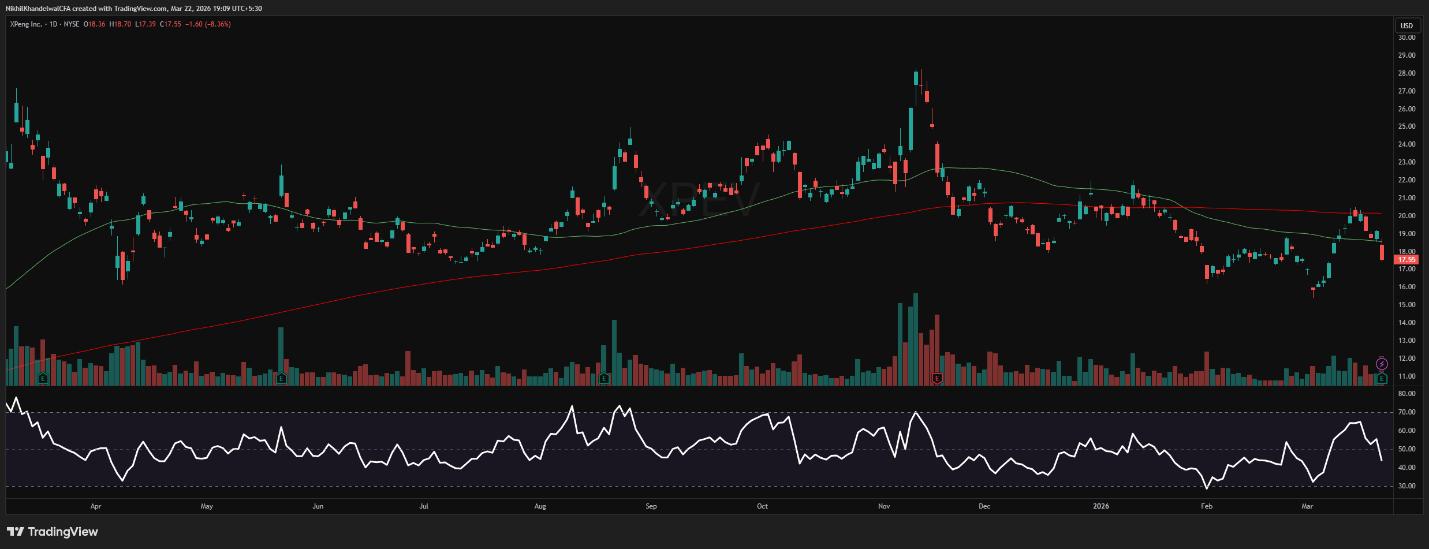
#3. XPeng Inc. (NYSE: XPEV)
Why XPeng in 2026?
• The Volkswagen deal materially alters the investment perspective on XPeng: XPeng is supplying its Turing AI chips and autonomous driving technology for the Volkswagen ID.UNYX 08 - a full-size EV that goes on sale in H1 2026. This represents a deeper technology collaboration rather than a marketing initiative. It's a technology supply agreement with the world's second-largest automaker.
• multiple new model launches planned, although exact numbers remain subject to execution: That's an extraordinary pace of product cadence. XPeng is betting that volume and diversity of models will establish market share across multiple EV segments before competitors can react.
• Global delivery starting: The P7+ global shipment to 18 countries is proof XPeng is serious about building a real brand outside China - indicating a more structured international expansion approach to impress investors. Less China concentration risk is the bonus.
• Tech licensing - an alternative revenue stream: Most Chinese EV makers compete on price and that’s basically it. XPeng has opened a second lane: technology licensing. The VW deal produces revenue that doesn’t depend on selling a single car with XPeng’s logo on it - and that’s a potentially higher-margin revenue stream with better margins.
Catalysts for Growth
• ID.UNYX 08 mass production commencing H1 2026 - the first real revenue test of XPeng’s technology licensing business. When the cars roll off the line, execution can then be evaluated against actual outcomes.
• Second co-developed EV with Volkswagen expected - and this partnership may extend beyond a single project. VW has committed to 50 new energy vehicles in China by 2030. XPeng is positioned to be the technology backbone behind a big chunk of that.
• Volkswagen Hefei facility production capacity of 350,000 vehicles annually - once that ramp is complete, XPeng’s technology reaches a far bigger pool of buyers than its own production lines could ever serve.
• Strong February delivery momentum (15,256 vehicles) sustaining sequential growth in a seasonally weak month may be viewed as a positive indicator for the full-year delivery trajectory.
Business Segments
Business Segment | Key Details |
Smart EVs (Consumer) | G3 SUV, P7 sedan, G6, G9 - core vehicle business in China |
ADAS Technology Licensing | Turing AI chip + autonomous driving tech supplied to Volkswagen |
International Sales | P7+ global delivery launched; 18 countries in first shipment |
Potential Risks
• China price war intensity: The domestic Chinese EV market is among the most highly competitive in the world, with BYD, NIO, Li Auto, and Huawei-backed AITO all competing aggressively. Margin sustainability is a constant challenge.
• US-China tensions limit Western markets: Despite the P7+ global launch, US market access remains blocked due to trade restrictions. XPeng cannot access the world's second-largest auto market without a fundamental change in trade policy.
• Execution risk on 20+ models: Launching more than 20 new models in a single calendar year is extremely capital-intensive and operationally demanding. Overpromising and underdelivering on this target would be could negatively impact management credibility.
• VW partnership execution: Technology partnerships of this complexity are often involve execution challenges. Any technical delays, quality issues, or commercial disagreements between XPeng and Volkswagen could disrupt the timeline and the revenue opportunity.
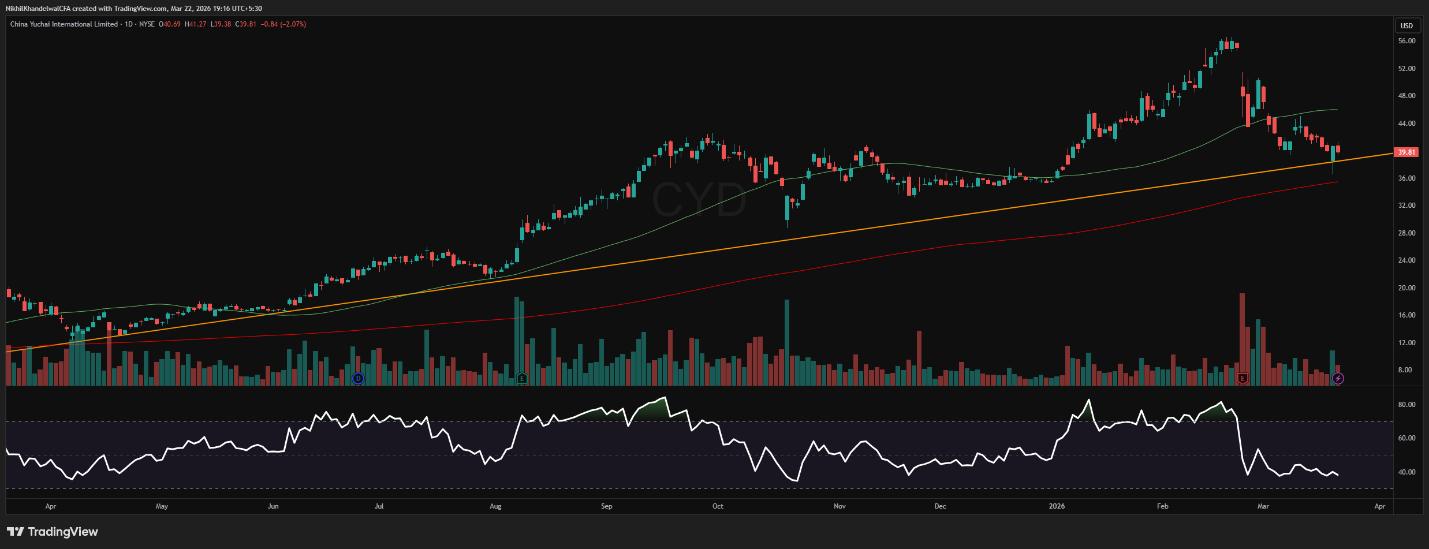
#4. China Yuchai International Limited (NYSE: CYD)
Why China Yuchai in 2026?
• Analyst just raised target 60%+ to $45: an analyst upgrade (source not widely verified) suggested a higher valuation from $28 to $45 in March 2026 - a 60%+ jump in target price. This represents a significant revision; indicating a reassessment of valuation expectations.
• Truck engine demand has shown strong growth: H2 2025 truck engine unit sales jumped 59.4%. That's not a rounding error. China's infrastructure spending and commercial vehicle cycle contributing to demand growth that CYD is participating in.
• Better product mix is lifting margins: CYD sold more heavy-duty, high-horsepower engines in the second half of 2025 - and that mix shift pushed gross margins to 18.9%. This reflects both volume growth and improved revenue mix.
• EPS has shown measurable growth: Earnings per share climbed to RMB 4.57 - a providing a clearer basis for valuation assessment in small-cap value names can actually use to calculate a reasonable valuation anchor.
Catalysts for Growth
• Ongoing truck engine demand surge driven by China's commercial vehicle replacement cycle and infrastructure investment - total engine sales reached 210,913 units in H2 2025 alone.
• Industrial, marine, and genset divisions growing at 7.5% - these off-road engine segments provide revenue diversification beyond trucking and are tied to construction and industrial activity cycles.
• Continuous cost-cutting program improving operating leverage - even modest cost reductions at this revenue scale translate into concrete EBIT gains.
• Bus engine market serving China's expanding public transit systems - as Chinese cities upgrade fleets to cleaner engines, CYD is a natural beneficiary with established supply relationships.
Business Segments
Segment | H2 2025 Volume | Growth Rate |
Truck & Bus Engines | Dominant portion of 210,913 total | +49.2% demand growth |
Off-Road Engines | Industrial, marine, genset applications | +7.5% growth |
Passenger Vehicle Engines | Smaller share of revenue mix | Flat to modest growth |
Potential Risks
• China economic sensitivity: CYD's revenue is almost entirely tied to China's commercial vehicle and industrial market. Any slowdown in Chinese economic growth, construction activity, or freight demand directly impacts engine volumes.
• Long-term electrification risk: China is pushing commercial electric vehicles - particularly electric trucks and buses. Over a 5-10 year horizon, this transition poses an existential risk to internal combustion engine makers that don't adapt.
• Geopolitical risk for US investors: CYD is a US-listed Chinese company. Any escalation in US-China tensions, delisting threats, or accounting scrutiny (a recurring theme for Chinese ADRs) could create sharp price dislocations unrelated to business fundamentals.
• Dividend sustainability: CYD's dividend is part of the investment case for some holders. If earnings growth slows or capital needs increase, dividend sustainability becomes a question mark.
Final Thoughts
The auto sector in 2026 remains complex and evolving - and that's exactly why the opportunity exists. Trade wars, shifting demand, technology bets that may or may not pay off. It's a lot to track. But these four companies each have something concrete happening right now: a product launch, a profitability milestone, a technology deal, a demand surge. Not promises. Events. Pull up the charts, read the latest earnings calls, and decide for yourself whether the entry point makes sense for your portfolio. Investors should evaluate these factors carefully before making decisions.
Recommended Articles


