




Fed Chair Jerome Powell Just Gave Good News About the Economy -- and Bad News to President Donald Trump
Key Points
Federal Reserve Chair Jerome Powell recently said there are signs of stabilization in the labor market and some signs of disinflation in certain areas of consumer prices.
The Fed has lowered rates in recent months due to concerns about the labor market.
This may indicate the Fed no longer sees a pressing need to keep lowering interest rates based on current data.
- These 10 stocks could mint the next wave of millionaires ›
Federal Reserve Chair Jerome Powell concluded the Fed's January meeting, as he always does, with a press conference to go over the Fed's recent actions and answer reporters' questions about the economy. The market keeps a close eye on these press conferences, looking for clues about future interest rate and balance-sheet moves by the Fed.
At the Fed's recent meeting and during the press conference, Powell provided a positive update about the economy, but that was likely bad news for President Donald Trump, who has been at odds with the Fed since the beginning of his second term.
Where to invest $1,000 right now? Our analyst team just revealed what they believe are the 10 best stocks to buy right now, when you join Stock Advisor. See the stocks »
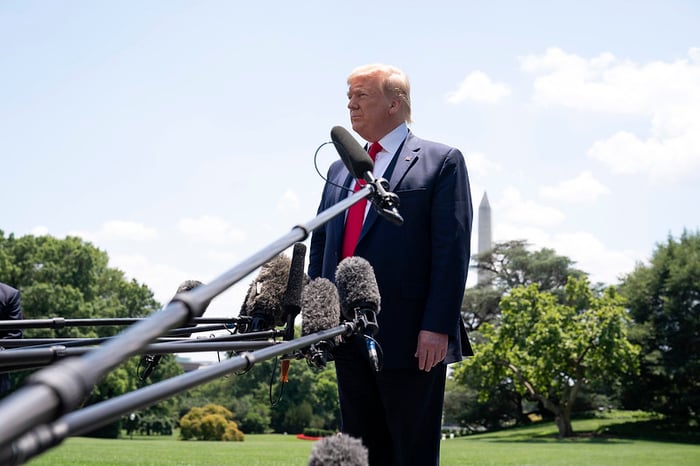
Official White House photo by Joyce N. Boghosian.
A positive update on the economy and the labor market
During the post-meeting press conference, Powell essentially issued positive updates on the strength of the economy, inflation, and the labor market. On inflation, Powell said the Federal Reserve's Board of Governors has observed disinflation in the services sector. However, inflation in the goods sector is still elevated due to tariffs. Long-term inflation expectations are still within the Fed's preferred 2% target.
Powell also said that data show solid economic activity continuing to surprise positively. Consumers remain resilient, and businesses are also continuing to boost investments, although Powell noted that housing remains a weak spot. Powell also believes the government shutdown likely weighed on economic activity, but he expects a reversal this quarter.
Finally, Powell noted that labor market data suggest that things may be stabilizing after experiencing some softening in the months prior. While job growth is slowing, much of this can be attributed to slower growth in the number of available workers, driven by lower immigration and lower labor force participation, although labor demand is still weak. Job openings, layoffs, hiring, and nominal wage growth have not changed much in recent months.
Bad news for Trump
So why is a positive update on the economy and labor market bad news for Trump? The 47th president has been quite vocal in his desire for the Fed to lower interest rates. This data is not supportive of further rate cuts, especially on the labor side.
The Fed's dual mandate calls for stable prices and maximum employment. But prices are still high, and inflation, at 3% in January, is still high. If the Fed continues to lower rates, it will continue to stimulate the economy and risk increasing inflation more. However, the Fed has also been watching the labor market, as unemployment has risen.
If the labor market is not an issue, the Fed really has no reason to lower rates and stimulate the economy if consumers remain resilient and inflation remains elevated. While Trump may be the loudest presidential critic of the Fed, he is certainly not the only president to have wanted the Fed to change interest rates on his terms.
Many people in the U.S. have been hit by an affordability crisis. Inflation has surged since the pandemic, along with the cost of living. Housing costs consume a much higher proportion of salaries, and many salaries, despite being higher, have not been enough for people to afford the cost of living while saving enough to buy a home and also stash away enough savings for retirement.
The economy is the top issue for many voters, and midterm elections are scheduled for later this year. Trump and the Republicans will want to maintain their majority in Congress to carry out Trump's agenda for the rest of his term, which is why interest rates and affordability are top of mind right now.
The market is still penciling in two Fed interest rate cuts this year. However, if data continues to support stabilization in the labor market and disinflation, there will be no need for the Fed to cut further right now, potentially hurting the stock market, which would be more bad news for Trump.
Now, that doesn't mean things can't change quickly, as inflation and labor market data come out monthly and have been hard for investors to predict. There could still be more interest rate cuts than the market expects right now, but the other side of this equation is also possible, which is something for investors to keep in mind.
Where to invest $1,000 right now
When our analyst team has a stock tip, it can pay to listen. After all, Stock Advisor’s total average return is 894%* — a market-crushing outperformance compared to 194% for the S&P 500.
They just revealed what they believe are the 10 best stocks for investors to buy right now, available when you join Stock Advisor.
See the stocks »
*Stock Advisor returns as of February 5, 2026.
The Motley Fool has a disclosure policy.
Recommended Articles


