

Better AI Stock: Taiwan Semiconductor Manufacturing or AMD

Source The Motley Fool

Key Points

  • TSMC is seeing great success right now.

  • AMD is looking to turn its business around over the next five years.

  • 10 stocks we like better than Taiwan Semiconductor Manufacturing ›

Two of the biggest names in the AI investing world are Taiwan Semiconductor Manufacturing (NYSE: TSM) and AMD (NASDAQ: AMD). Each of these stocks had a strong 2025, with AMD rising 77% and TSMC increasing by 54%.

However, 2025 is in the past. What matters now is how these stocks will grow over the next five years, as AI spending is expected to grow throughout at least 2030.

Where to invest $1,000 right now? Our analyst team just revealed what they believe are the 10 best stocks to buy right now. Continue »

Does either stock have an advantage over the other? Let's take a look.

AI engineer looking at lines of code.

Image source: Getty Images.

AMD uses TSMC chips

While each of these stocks may be labeled as a "chip" company, that definition needs further refinement. AMD designs chips that are used in PCs, gaming devices, and AI graphics processing units (GPUs). However, it outsources the manufacturing work to varying suppliers. TSMC is one of those suppliers, and it is utilized by many of the leading computing companies. So, a better way to label these companies is to call AMD a chip designer and TSMC a chip fabricator.

This also leads to each company marketing to a different client base. TSMC only has to inform a handful of companies of its capabilities. Because it's so well-known and widely utilized, it really doesn't have to convince any client of its capabilities; it's already the industry standard.

AMD is different. It's going up against some major competition. Nvidia is currently the king of AI computing hardware, as it has developed the best technology stack to run AI workloads. Additionally, there is rising competition from Broadcom and its custom-designed AI chips specifically tailored for each AI hyperscaler's workload. AMD is often seen as a third option, as it hasn't been a popular pick for nearly any AI competitor. AMD has a lot of work to do to catch up to the competition, but management believes that it has made the proper improvements to make that happen.

AMD's management noted that downloads for its GPU controlling software, ROCm, increased 10 times year over year in November 2025. That's significant because it shows more developers are investigating cheaper AMD hardware versus Nvidia's. Furthermore, AMD's management believes that its data center division can generate a 60% compound annual growth rate (CAGR) over the next five years, with a companywide growth rate of 35%. That's a lofty projection, and if it pans out, AMD could be a great stock to own.

TSMC's management team offers similar guidance. For the five years starting in 2024 and ending in 2029, it expects AI chips to deliver nearly a 60% CAGR, although the companywide growth rate will be around 25%.

This brings up an interesting comparison point: Would you rather own a stock that isn't executing as well right now, but has greater future potential, or a stock that's delivering excellent results now and is expected to do so in the future, but doesn't have as high a ceiling? That's the AMD versus TSMC argument in a nutshell. So, which is the better buy?

TSMC is the clear-cut winner

To me, TSMC takes the cake. As long as there is AI spending, odds are TSMC will continue to be an excellent stock investment. Its chips go into Nvidia, Broadcom, and AMD-designed chips, and would likely go into another competitor's product should one arise. TSMC is about as surefire a bet as you're going to get in the AI realm, making it a great buy.

AMD is much higher risk with greater uncertainty, but until it starts showing that it can actually deliver the growth levels it gave in its projections, I'm an AMD skeptic.

As a final nail in the coffin, TSMC's stock is far cheaper than AMD's.
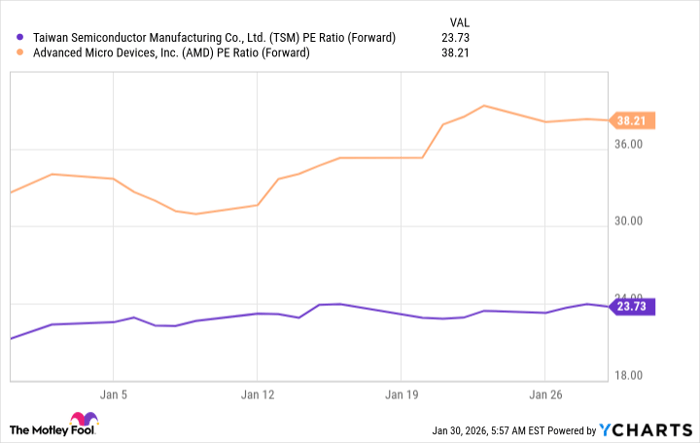
TSM PE Ratio (Forward) Chart

TSM PE Ratio (Forward) data by YCharts

At 24 times forward earnings versus 38, TSMC's stock is just too cheap to pass up for its ongoing success.

I think TSMC is a surefire bet, although AMD may produce superior returns if everything pans out the way management believes. However, I'm not going to pass up 20% or greater annual returns for something slightly better, making TSMC the top stock pick.

Should you buy stock in Taiwan Semiconductor Manufacturing right now?

Before you buy stock in Taiwan Semiconductor Manufacturing, consider this:

The Motley Fool Stock Advisor analyst team just identified what they believe are the 10 best stocks for investors to buy now… and Taiwan Semiconductor Manufacturing wasn’t one of them. The 10 stocks that made the cut could produce monster returns in the coming years.

Consider when Netflix made this list on December 17, 2004... if you invested $1,000 at the time of our recommendation, you’d have $450,256!* Or when Nvidia made this list on April 15, 2005... if you invested $1,000 at the time of our recommendation, you’d have $1,171,666!*

Now, it’s worth noting Stock Advisor’s total average return is 942% — a market-crushing outperformance compared to 196% for the S&P 500. Don't miss the latest top 10 list, available with Stock Advisor, and join an investing community built by individual investors for individual investors.

See the 10 stocks »

*Stock Advisor returns as of February 2, 2026.

Keithen Drury has positions in Broadcom, Nvidia, and Taiwan Semiconductor Manufacturing. The Motley Fool has positions in and recommends Advanced Micro Devices, Nvidia, and Taiwan Semiconductor Manufacturing. The Motley Fool recommends Broadcom. The Motley Fool has a disclosure policy.

Disclaimer: For information purposes only. Past performance is not indicative of future results.
placeholder
Bitcoin briefly loses 2025 gains as crypto plunges over the weekend.Bitcoin experienced a sharp decline this weekend, briefly erasing its 2025 gains and dipping below its year-opening value of $93,507. The cryptocurrency fell to a low of $93,029 on Sunday, representing a 25% drop from its all-time high in October. Although it has rebounded slightly to around $94,209, the pressures on the market remain significant. The downturn occurred despite the reopening of the U.S. government on Thursday, which many had hoped would provide essential support for crypto markets. This year initially appeared promising for cryptocurrencies, particularly after the inauguration of President Donald Trump, who has established the most pro-crypto administration thus far. However, ongoing political tensions—including Trump's tariff strategies and the recent government shutdown, lasting a historic 43 days—have contributed to several rapid price pullbacks for Bitcoin throughout the year. Market dynamics are also being influenced by Bitcoin whales—investors holding large amounts of Bitcoin—who have been offloading portions of their assets, consequently stalling price rallies even as positive regulatory developments emerge. Despite these sell-offs, analysts from Glassnode argue that this behavior aligns with typical patterns seen among long-term investors during the concluding stages of bull markets, suggesting it is not indicative of a mass exodus. Notably, Bitcoin is not alone in its struggles, as Ethereum and Solana have also recorded declines of 7.95% and 28.3%, respectively, since the start of the year, while numerous altcoins have faced even steeper losses. Looking ahead, questions linger regarding the viability of the four-year cycle thesis, particularly given the increasing institutional support and regulatory frameworks now in place in the crypto landscape. Matt Hougan, chief investment officer at Bitwise, remains optimistic, suggesting a potential Bitcoin resurgence in 2026 driven by the “debasement trade” thesis and a broader trend toward increased adoption of stablecoins, tokenization, and decentralized finance. Hougan emphasized the soundness of the underlying fundamentals, pointing to a positive outlook for the sector in the longer term.
Author  Mitrade
Nov 17, 2025
Bitcoin experienced a sharp decline this weekend, briefly erasing its 2025 gains and dipping below its year-opening value of $93,507. The cryptocurrency fell to a low of $93,029 on Sunday, representing a 25% drop from its all-time high in October. Although it has rebounded slightly to around $94,209, the pressures on the market remain significant. The downturn occurred despite the reopening of the U.S. government on Thursday, which many had hoped would provide essential support for crypto markets. This year initially appeared promising for cryptocurrencies, particularly after the inauguration of President Donald Trump, who has established the most pro-crypto administration thus far. However, ongoing political tensions—including Trump's tariff strategies and the recent government shutdown, lasting a historic 43 days—have contributed to several rapid price pullbacks for Bitcoin throughout the year. Market dynamics are also being influenced by Bitcoin whales—investors holding large amounts of Bitcoin—who have been offloading portions of their assets, consequently stalling price rallies even as positive regulatory developments emerge. Despite these sell-offs, analysts from Glassnode argue that this behavior aligns with typical patterns seen among long-term investors during the concluding stages of bull markets, suggesting it is not indicative of a mass exodus. Notably, Bitcoin is not alone in its struggles, as Ethereum and Solana have also recorded declines of 7.95% and 28.3%, respectively, since the start of the year, while numerous altcoins have faced even steeper losses. Looking ahead, questions linger regarding the viability of the four-year cycle thesis, particularly given the increasing institutional support and regulatory frameworks now in place in the crypto landscape. Matt Hougan, chief investment officer at Bitwise, remains optimistic, suggesting a potential Bitcoin resurgence in 2026 driven by the “debasement trade” thesis and a broader trend toward increased adoption of stablecoins, tokenization, and decentralized finance. Hougan emphasized the soundness of the underlying fundamentals, pointing to a positive outlook for the sector in the longer term.
placeholder
Gold Price Forecast: XAU/USD opens lower around $4,450 on fears of widening Iran conflictsGold price (XAU/USD) opens over 1% lower to near $4,445.00 on Monday, as oil prices have rallied further on fears of further widening of conflicts in the Middle East. WTI Oil price is up almost 3% above $102.50 in the opening trade, increasing fears of higher inflation expectations globally.
Author  FXStreet
Mar 30, Mon
Gold price (XAU/USD) opens over 1% lower to near $4,445.00 on Monday, as oil prices have rallied further on fears of further widening of conflicts in the Middle East. WTI Oil price is up almost 3% above $102.50 in the opening trade, increasing fears of higher inflation expectations globally.
placeholder
Gold rises on softer US Dollar, traders await Trump's address on Iran warGold price (XAU/USD) extends the rally to near $4,775 during the early Asian session on Thursday. The precious metal surges amid a weakening US Dollar (USD) and cooling geopolitical tensions in the Middle East.
Author  FXStreet
Yesterday 01: 20
Gold price (XAU/USD) extends the rally to near $4,775 during the early Asian session on Thursday. The precious metal surges amid a weakening US Dollar (USD) and cooling geopolitical tensions in the Middle East.
placeholder
Silver Price Forecast: XAG/USD falls to near $72.00 amid fading safe-haven demandSilver price (XAG/USD) continues to lose ground after registering tiny losses in the previous day, trading around $72.90 during the Asian hours on Thursday. The safe-haven demand for the precious metal fades amid rising optimism over Middle East peace.
Author  FXStreet
Yesterday 08: 19
Silver price (XAG/USD) continues to lose ground after registering tiny losses in the previous day, trading around $72.90 during the Asian hours on Thursday. The safe-haven demand for the precious metal fades amid rising optimism over Middle East peace.
placeholder
Gold retreats sharply from two-week top/$4,800 as Trump’s Iran comments boost USDGold (XAU/USD) witnessed an intraday turnaround from the $4,800 mark, or a fresh two-week high set earlier this Thursday, and for now, seems to have snapped a four-day winning streak amid resurgent US Dollar (USD) demand.
Author  FXStreet
Yesterday 07: 03
Gold (XAU/USD) witnessed an intraday turnaround from the $4,800 mark, or a fresh two-week high set earlier this Thursday, and for now, seems to have snapped a four-day winning streak amid resurgent US Dollar (USD) demand.
goTop
quote